RimWorld Infestation Spawn Rules and How to Keep Bugs Out of Your Base
RimWorld 1.6.4871 · Infestation · Mountain bases
RimWorld Infestation Spawn Rules and How to Keep Bugs Out of Your Base
 Instant answer: natural infestations only break into thick-roof cells that sit near your buildings, stay warmer than −17 °C, and have a real walkable pocket.
Deny those cells, freeze a bait cave, or wipe every hive the second the letter drops. Deep-drill Too Deep, Biotech wastepack cocoons, and Odyssey insect rooms are different systems.
Instant answer: natural infestations only break into thick-roof cells that sit near your buildings, stay warmer than −17 °C, and have a real walkable pocket.
Deny those cells, freeze a bait cave, or wipe every hive the second the letter drops. Deep-drill Too Deep, Biotech wastepack cocoons, and Odyssey insect rooms are different systems.
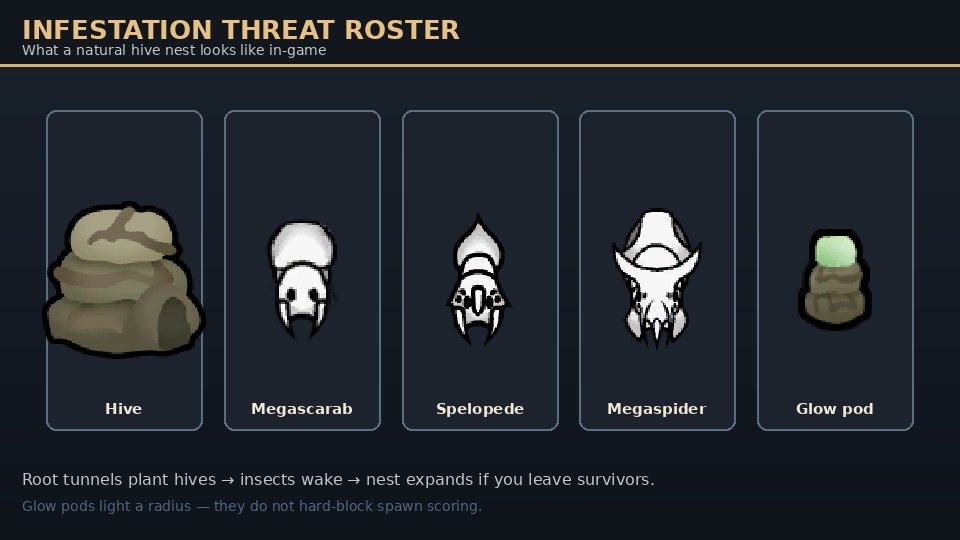
Players mash four different bug stories into one word. Sorting them early saves a rebuild.
Natural Infestation (storyteller Threat Big) is the classic letter: insects tunnel in, plant hives, then the nest expands if you dawdle. It only fires when the map still has eligible thick-roof cells near colony buildings, the insect faction exists, and hive count is under the map cap of 30. Incident tuning on this build: base chance 2.7, minimum 20 days between fires, minimum threat points 400.
Too Deep (deep drill) is a separate letter. Vibrations from usable deep drills pull insects up next to a machine. Base mean time is about 20 days per active drill before difficulty scaling. The tunnel does not plant a reproducing hive the same way the natural event does — you are fighting a point-budget insect wave near the drill. Full placement and slider math lives on how to use deep drill.
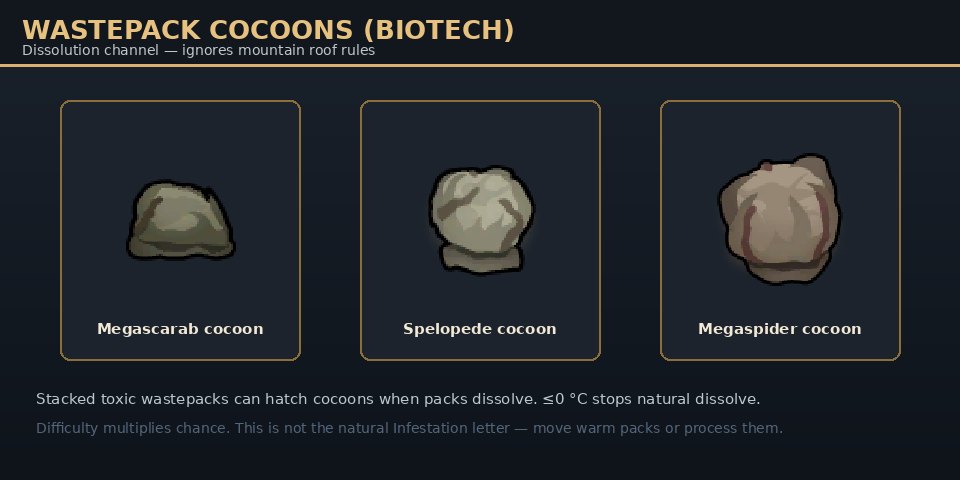
With Biotech active, stacked toxic wastepacks can trigger a cocoon infestation when packs dissolve. Difficulty multiplies the chance (Peaceful 0, Builder 0.25, Adventure 0.5, Rough 1, Blood And Dust 1.5, Losing Is Fun 2). This ignores mountain roof rules. Packs held at ≤0 °C stop natural dissolve (and that trigger); destroying packs can still force a dissolve event. Move warm or outdoor packs into a disposable shed, or process them — pollution cleanup covers the wider toxic loop.
Odyssey map pieces can already contain insect hive rooms when you arrive. Those are layout features (often dormant hives waiting for you), not the natural Infestation incident. Treat them like a known cave fight on a quest map, not as proof your home mountain is “cursed.”
Natural Infestation pauses the colony: tunnels, then hives, then a defense job that snowballs if you tab away. Too Deep is a raid stuck to a drill. Wastepack cocoons look like your toxic dump grew eggs overnight. Odyssey insect rooms are nests you walked into on a map you chose.
Prep follows the type. Mountain bases need denial and bait. Drill miners need shed placement and the deep-drilling slider. Biotech factories need wastepack logistics. Odyssey runs need breach kits and the sense to leave a ruin alone.
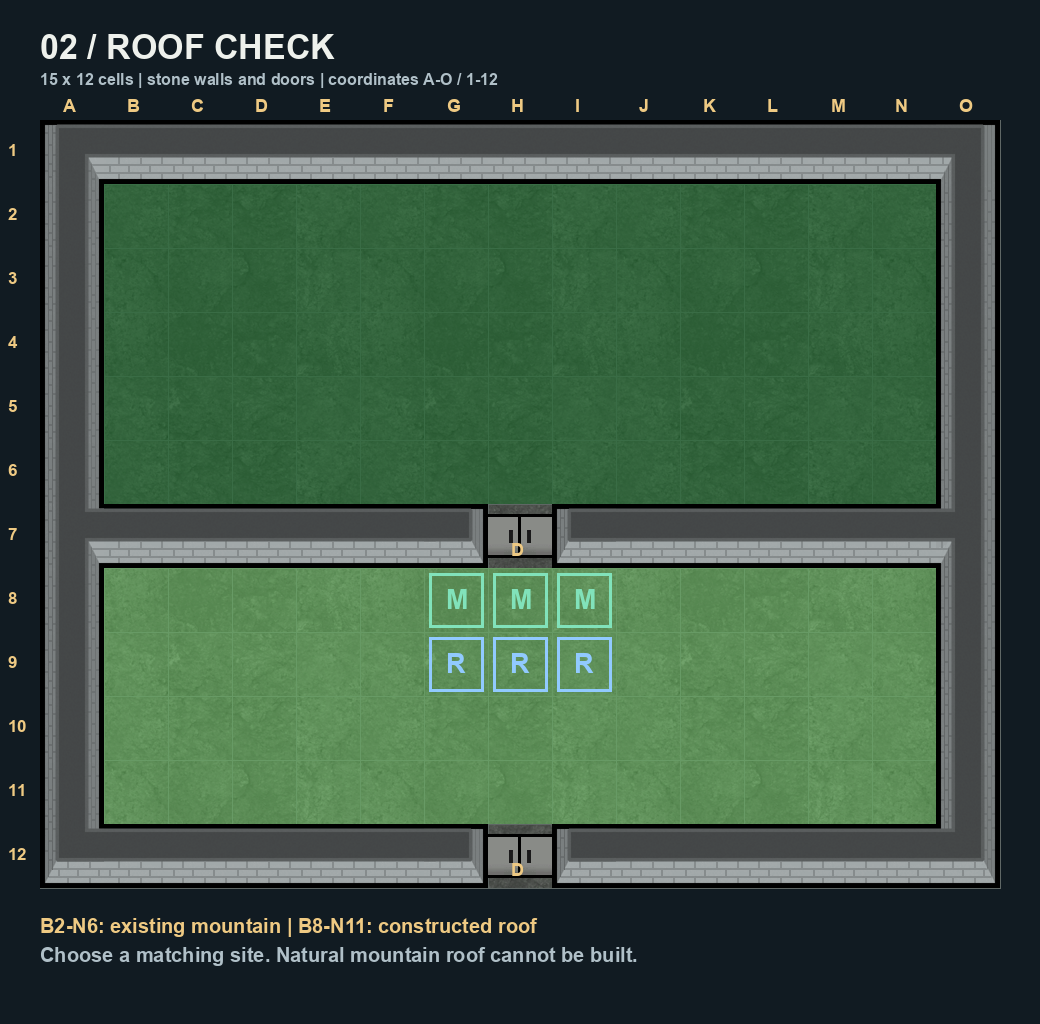
Root-tunnel scoring hard-zeros a cell when any of these fail. Soft weights then prefer dark, warm-enough, deep pockets near walls. Those hard and soft filters pick the first tunnel of a natural Infestation letter. Extra tunnels in the same strike, and later child hives from reproduction, use local placement (roofed, walkable, spacing) — freezing one bait room does not apply the same −17 / thick-roof / 30-tile gates to every later hive tile.
 Thick roof check
 Hive plant target
 Light = soft weight
 Open sky loses
Hard gates zero a cell; soft weights then steer toward dark, warm-enough pockets near walls. Composite under 7.5 still fails.
What the storyteller still requires:
- Infestation incident min threat points: 400.
- Min refire: 20 days after the last Infestation.
- Fewer than 30 hives already on the map.
- Hive count for a strike: threat points are first scaled by a points factor (~0.7 at low points → ~0.45 around 5000), then divided by 220 (minimum one tunnel). Example: ~5000 threat points → about 10 tunnels, not ~23.
Once a cell clears the hard gates, the game prefers deep insect country: farther from open sky, tucked near walls, darker on the glow grid, and warm enough up to the −7 °C soft cap. A lit shallow mountain garage by the outside often loses to a dim central stockpile even when both sit under mountain.
Steer the weights on purpose. Make the bait deeper, darker, and warm enough (around or above −7 °C for the temp term) compared with every other thick-roof room. Keep hospitals bright, shallow, and cold so the scorer prefers the junk cave over your valuables.
Tip: enable Development mode and turn on the infestation chance overlay while you redesign. High-score mountain cells light up so you can see which rooms still invite bugs.
Infestation does not “remember” your freezer. It re-rolls weighted cells that still pass the hard filters for the root tunnel. Your favorite storage cave usually wins because it is:
- Under unbroken overhead mountain.
- Warm from coolers exhausting heat next door, hiders, or hive leftovers.
- Dark between colonist pathing.
- Deep, with long roof runs to the outdoors.
- Inside the 30-tile bubble of workshops and bedrooms.
Clearing insects without changing the room leaves the high-score pocket intact. Twenty days later the storyteller can roll the same magnet again. If you rebuild the exact same dark warm cave, expect a rematch.
Mountain bases amplify this. Every excavated wing adds thick-roof walkable area next to colony buildings. Surface killboxes and open yards almost never compete with that score.
Common “I fixed it” mistakes
- Killing bugs but leaving the dark warehouse at 5 °C under mountain.
- Dropping one cooler in a huge cave and reading the thermostat on the cold tile only.
- Lighting the hallway while the back storage alcove stays pitch black.
- Moving beds to the surface but leaving workshops, batteries, and hoppers underground as magnets inside the 30-tile bubble.
- Sealing a breach with a wooden barricade and calling the room “gone” while the thick roof and walkable footprint remain.
The scorer wants a walkable thick-roof pocket that feels mountainous, sits near your stuff, and is not arctic. Change at least two of those if you want rematches to stop. And remember: once the first tunnel lands, extra hives from the same letter or later reproduction can plant nearby under looser local rules — a frozen bait room does not auto-freeze every child tile.
Wall-fill unused mountain
Cheapest long-term fix: do not leave random excavated pockets. Backfill with stone chunk walls, or never mine rooms you will not claim. Two-tile maintenance gutters behind batteries are classic infestation alleys.
Freeze thick-roof space under −17 °C
A dedicated deep-freeze under mountain can hard-block root-tunnel cells if the whole candidate volume stays below −17 °C. One warm corner still scores. Pair coolers with airlocks so doors do not leak summer heat — see freezer setup and airlock freezer fixes.
Bait room (steer, do not “delete” risk)
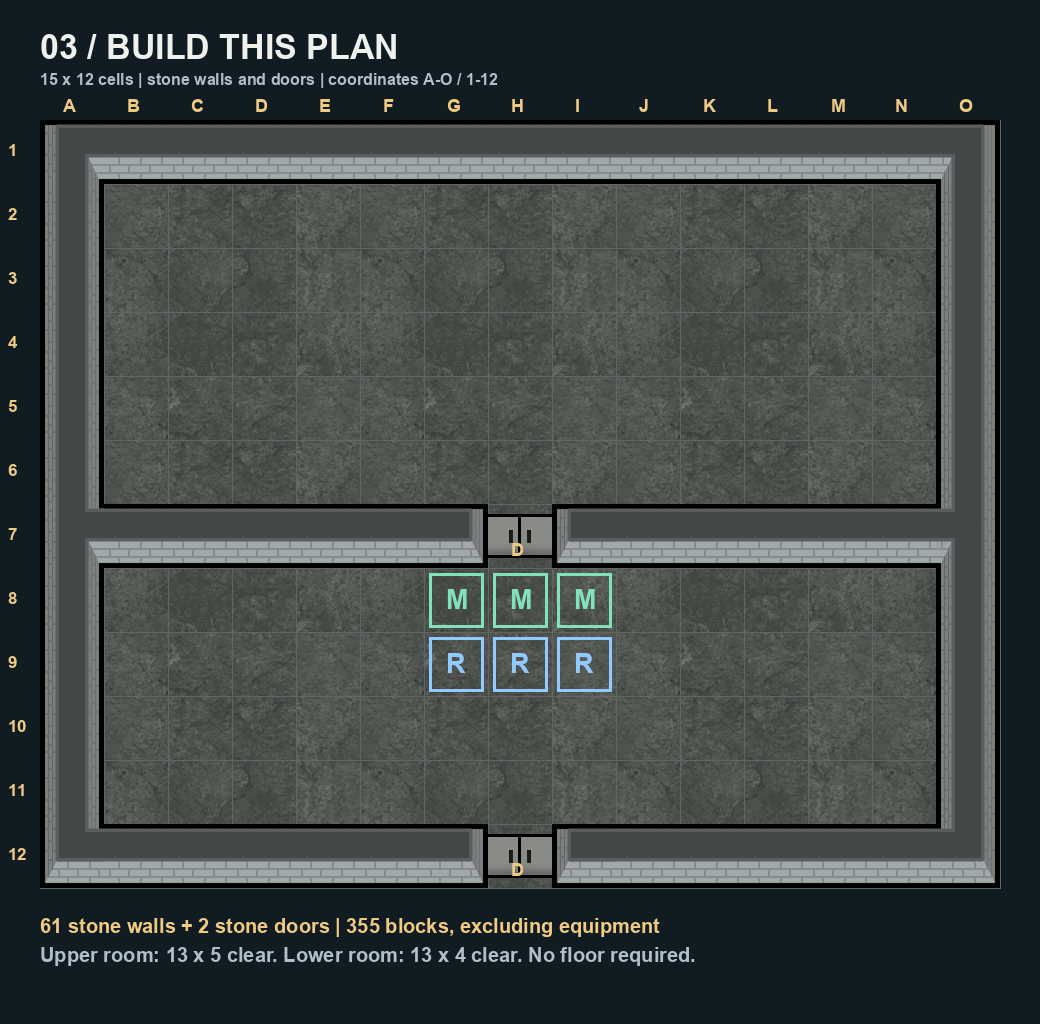
Build one disposable thick-roof chamber inside the 30-tile bubble. Keep it dark, slightly warm (warmth above −7 °C does not further boost the temp term), empty of valuables, and give it a kill corridor you designed on purpose. Light and live in every other mountain room so the bait wins the soft weights. Stock wood or chemfuel for a sealed burn, use a stone doorway for melee, and keep a roof you can collapse if needed. Chemfuel logistics: chemfuel guide.
Power-loss failure mode
Solar flares disable electricity — generators and coolers both go dark for the flare — so freezer denial dies and “safe” mountain hospitals warm again. Wood or chemfuel generators do not bypass that. Use non-power denial (wall-fill / abandon thick-roof footprint) or accept temporary spawn reopen during the flare. Battery death without a flare is a separate case: keep critical freezer batteries topped, or accept the same warm reopen until power returns. Solar flare survival pairs with this.
Surface living as prevention
If you hate bug letters more than raids, shrink mountain footprint. Sleep, cook, and recreate under constructed roofs; use mountain only for freezers you keep arctic-cold. Layout habits: optimal colony layout and best base layout tool.
Hybrid mountain: claim only what you police
Plenty of colonies keep a mountain freezer and a mountain workshop, then sprawl “temporary” mining halls with no doors, lights, or temperature control. Temporary becomes permanent. Finish every dig with a plan for roof type, temp, and access. If a shaft is only for steel, wall it closed when the vein dies — normal Remove Roof cannot strip thick overhead mountain. Thin rock roof or constructed roofs can be removed; thick cannot.
Colonist pathing also matters. If haulers constantly open the bait room door, you warm it, light it, and teach insects that the “safe” cave is busy. Forbid the bait door until the letter drops, or use a held-open stone door chain you only unlock for burns.
When prevention is “good enough”
You do not need zero risk on Losing Is Fun. You need no surprise hives in the hospital. A bait wing with firefoam and a drafted melee trio is enough for most colonies. Save total denial for builders who refuse insect events on principle.
Hives arrive via short tunnel spawners. They start dormant-capable but wake under pressure. Each hive pushes heat (6 per second, soft cap 38 °C), drops slime, spawns jelly, and can reproduce on a roughly 2–3 day cadence if awake and the map is under 30 hives. Child hives use local roofed/walkable/spacing placement — not a fresh root-tunnel score pass.
Destroy every hive
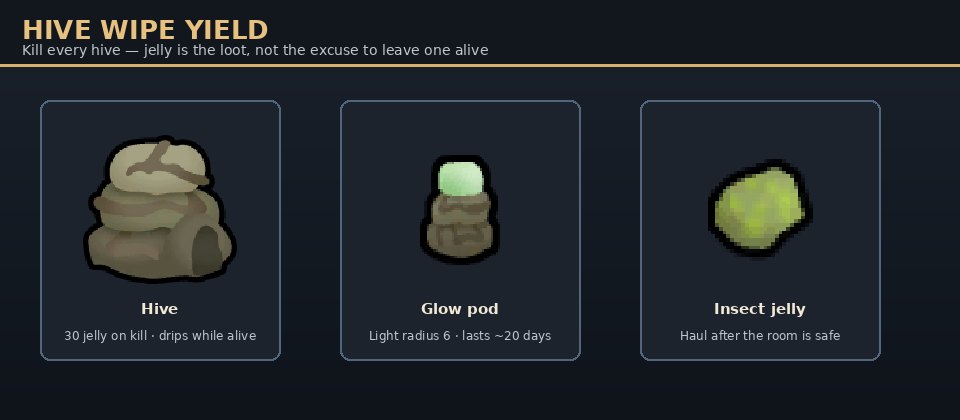
Win condition is zero hives. Leaving one “for jelly” mid-raid is how megaspiders inherit your hospital. Killed hives leave 30 insect jelly; living hives also drip stacks over time.
Melee doorway block
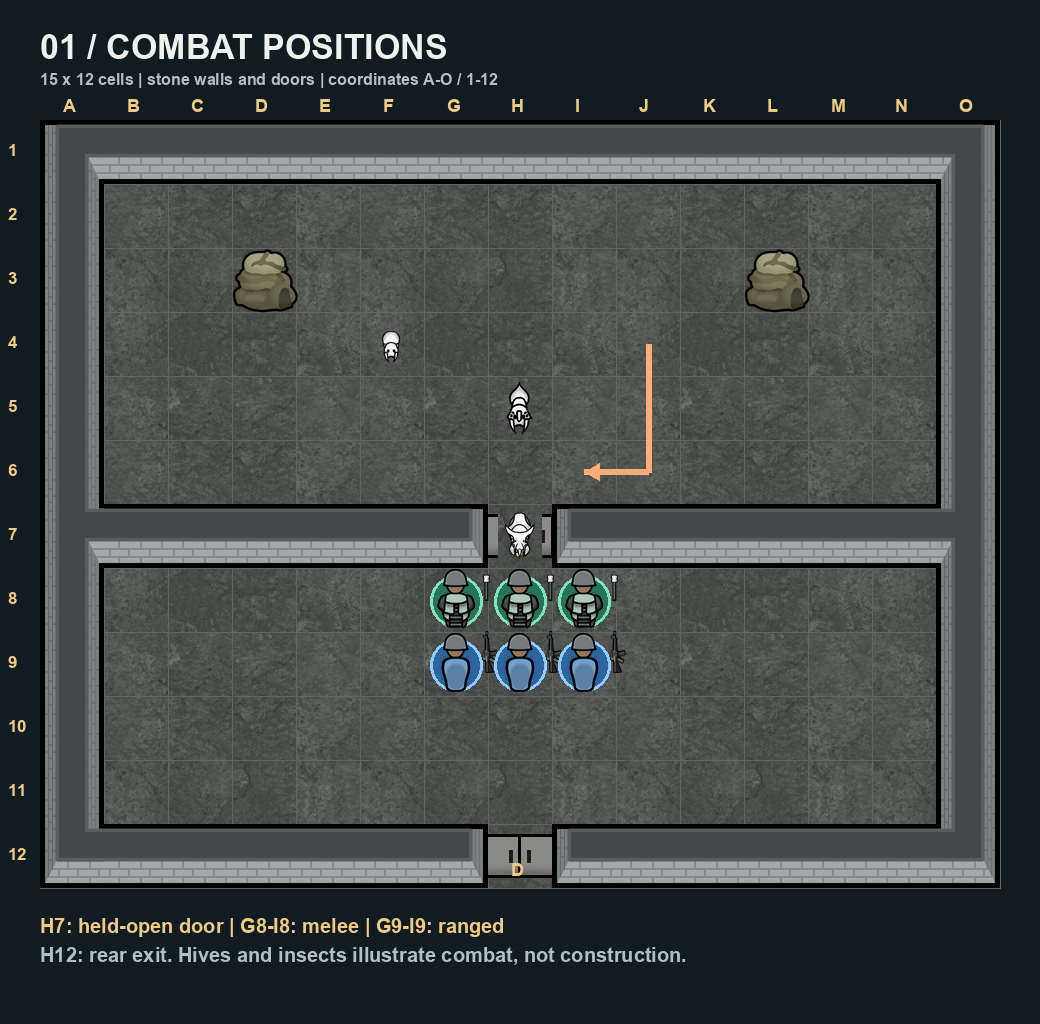
Insects are brutal in open rooms and weaker in a one- or two-tile choke. Three shielded melee pawns in a stone doorway, shooters behind. Assign a master, train Release (attack), and use follow-drafted / release-to-attack. Normal animals are not draftable like colonists. Do not kite megaspiders across your sterile tiles unless you like infection cascades. General defense patterns: combat defense guide and killbox guide.
Sealed fire / heatstroke
Wooden bait rooms, chemfuel puddles, or molotovs in a sealed stone shell can cook insects and burn hives (flammability 1.0, 130 HP). Keep colonists on the safe side of the door and watch smoke. Insects hate extreme cold more than fire; a sealed inferno still deletes any furniture you forgot inside.
Kiting and skipping the nest
If the breach is in a dead-end wing, draft everyone out, wall the corridor, and reclaim later with better gear. Do not funnel the entire colony through the hive room “to save the rice.” Rice is cheaper than a colonist.
Loadout notes
- Plasteel or stone doors at the choke — wood doors become the fire plan by accident.
- Blunt melee helps on high-sharp-armor insects; keep a mace or club option next to the monosword cosplay.
- Firefoam packs are the real burn insurance. Smokeleaf high cuts Consciousness and Moving — bad for a melee firefight, not free insurance.
- Animals with hard armor (rhinos, thrumbos, even boomrat chaos) change the math; release carefully so they do not path through your shooters.
- If psychic drones or other mood hits land mid-fight, pause and rearrange before a colonist has a mental break inside the hive room.
After-action checklist
Too Deep
Park drills in disposable stone sheds, not under the barracks. Lower the deep drilling infestations difficulty factor if you want ore without bug tax. Insect points for a drill event clamp between 200 and 1000 after a 0.3–0.6 threat factor. Details and planner: deep drill tool.
Wastepack cocoons (Biotech)
Cocoons fire from wastepack dissolution events. They want walkable space near the packs and avoid overlapping other cocoons. They do not need thick roof. Packs at ≤0 °C stop natural dissolve, so a properly cold freezer is not an automatic cocoon magnet. Warm rooms, outdoor-temp storage, or destroying packs (which can still dissolve) are the usual triggers. Push risky packs to a poisoned outdoor yard or a one-way dump shed.
Odyssey insect rooms
Expect pre-placed hives in some generated interiors. Clear them like a ruin clear: breach, melee choke, burn if the room is expendable. Locusts can appear in hive spawn lists when Odyssey is active — same wipe rules, slightly different pawn mix.
Insect jelly never rots, counts as fine food, gives a small joy bump, and sells decently (market value 8). A living hive spawns 20 jelly about every 10.4–12 hours if adjacent space allows, and killing a hive drops 30. Farming means keeping hives contained, not “afk forever.”
- Use a bait cave with overlapping killbox line of sight.
- Cull insects on a schedule; do not wait for reproduction spikes (hive child spawns prefer a few tiles of spacing inside a ~10 radius).
- Expect heat and slime tax — cool the farm or accept tropical cave temperatures near 38 °C.
- Glow pods from hives last 20 days with radius 6 light; handy lamps, not infestation hard counters.
- Ideology / precepts around insect meat are separate from jelly — check your memes before butchering.
If your colony is still fighting starvation raids, skip farming. Denial and bait-burn are safer until you have spare firefoam and plate armor.
Practical farm loop
- Bait letter into the farm cave on purpose.
- Cull insects at the doorway until only the hives you want remain — usually one or two, never a sprawl toward the 30 hive map cap.
- Hauling zone for jelly only; forbid slime if cleaners are drowning.
- Schedule a wipe day before reproduction timers stack. Hives try to child-spawn on a multi-day rhythm when awake.
- If a heat wave or flare ruins containment, abort the farm and burn. Greed is how farms become graves.
Late farms often feel worse than early megascarab farms because later letters bring megaspiders and nastier mixes. Treat midgame jelly as a bonus. Do not build your food pyramid on it.
Infestation chance overlay
In Development mode, turn on the infestation chance overlay. High-score tiles under mountain show where bugs prefer to land. Use it while you redesign a base, then turn it off for normal play.
Mods
QoL packs may add infestation warnings, roof graphics, or temperature overlays. Those help you read the base. They do not change the −17 °C hard block unless a mod says it does. After a combat AI mod, check your doorway blocks again; insect pathing fights change with AI packs.
Stale advice traps on 1.6
- “16 tiles” rule: outdated. Use thick roof + ~30-tile building proximity + temperature.
- “Lights stop infestations”: lights only soft-weight scores. Freezing and roof denial hard-stop.
- “Glow pods patch made rooms safe”: pods are loot lamps (20-day lifespan, radius 6). They do not replace coolers.
- “Insects always docile until attacked”: hive defense jobs escalate; treat awake hives as hostile infrastructure.
- “One molotov always clears”: open mountain rooms vent heat; sealed burn rooms work, drafty caverns often do not.
- “Just strip the rock roof”: thick overhead mountain cannot be removed with normal Remove Roof — wall-fill or never excavate.