RimWorld Shelving Efficiency: 3 Stacks per Tile and the Aisles That Keep It Fast
A RimWorld shelf holds 3 stacks per tile, so the 2×1 shelf takes 6 and the 1×1 small shelf takes 3. A floor stockpile holds 1. Shelves also stop weather damage and hide how ugly their contents are. They don't stop rot. They refuse chunks, wastepacks and any corpse of body size 0.75 or more, and stepping onto one costs a pawn extra time. Build two-deep rows with one-tile aisles and the whole storeroom averages about 2 stacks per tile, twice what a floor zone holds.
PC 1.6.4871 · Base game, Complex Furniture research · Unmodded · Updated October 6, 2026
Watch on Open.Video · English audio
How many stacks does a RimWorld shelf hold?
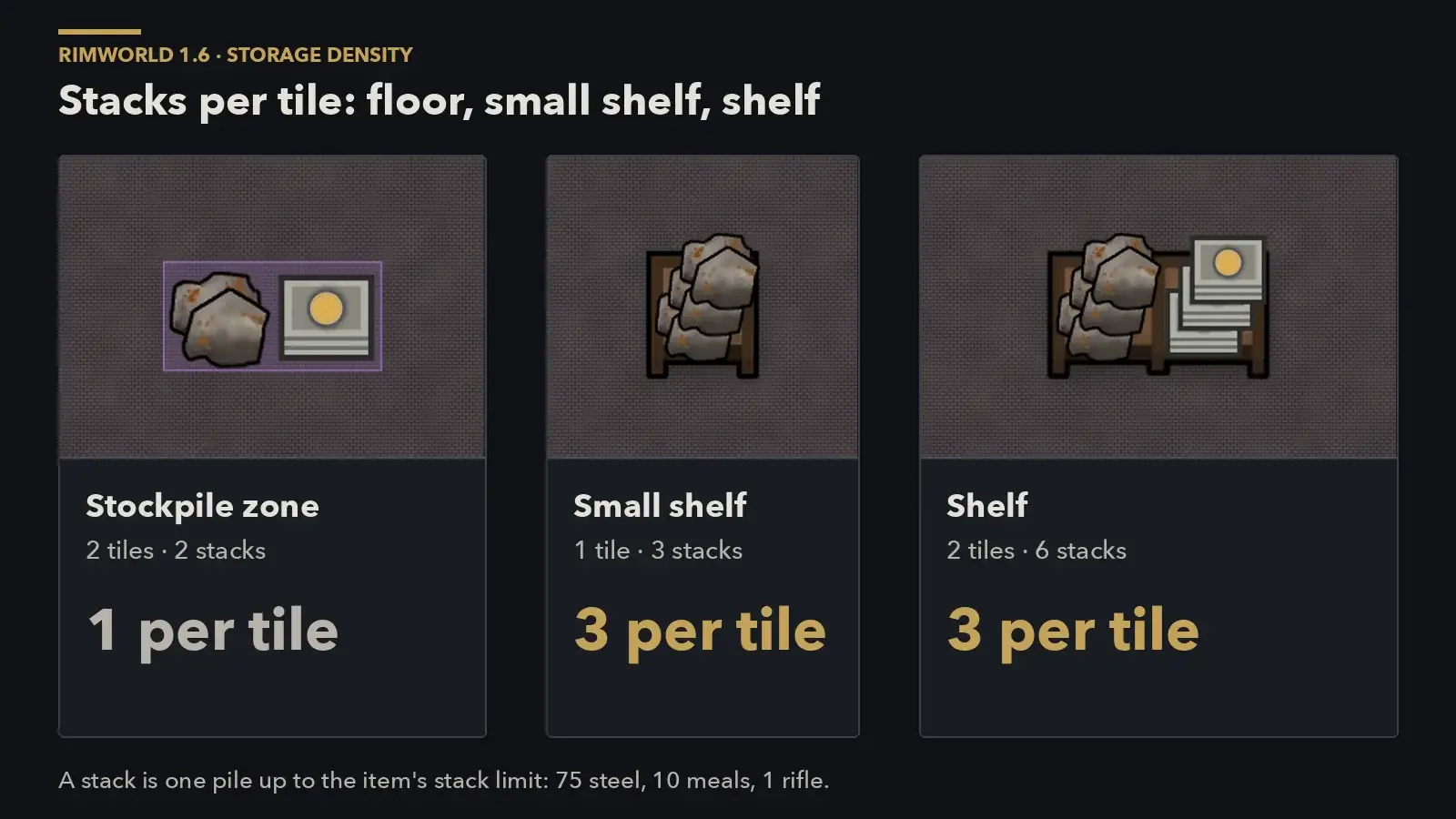
Every shelf tile holds three stacks, so the 2×1 shelf holds six and the small shelf holds three. Each stack can be a different item. A floor stockpile tile holds one.
| Storage | Tiles | Stacks | Per tile | Contents' beauty | Weather damage |
|---|---|---|---|---|---|
 Stockpile zone Stockpile zone | Any | 1 per tile | 1 | Counts | Outdoors, yes |
 Small shelf Small shelf | 1×1 | 3 | 3 | Hidden | Never |
 Shelf Shelf | 2×1 | 6 | 3 | Hidden | Never |
Both shelves need the Complex Furniture research. Placing one on top of an existing stockpile zone cuts those tiles out of the zone, and the shelf's own storage settings take over.
Stacks are not item counts
The triple capacity is in stacks, so what a shelf actually holds depends on the item's stack limit:
| Item | Stack limit | One 2×1 shelf holds |
|---|---|---|
| Weapons, apparel | 1 | 6 pieces |
| Simple, fine, lavish and survival meals | 10 | 60 meals |
| Medicine, beer, mortar shells | 25 | 150 |
| Components | 50 | 300 |
| Steel, wood, cloth, rice, raw meat, pemmican, stone blocks | 75 | 450 |
| Chemfuel, neutroamine, most drugs | 150 | 900 |
| Hay | 200 | 1,200 |
| Silver, gold | 500 | 3,000 |
That's why a meal shelf fills up long before a silver shelf. Partial stacks still take a whole slot. A tile holding 5 components, 3 medicine and a rifle is full for anything else, though haulers can still top up the components and medicine.
Shelves vs. a stockpile zone
Shelves win wherever floor space costs you something: inside walls, under a roof, in a freezer you have to cool, or inside a fire-suppression radius. Every tile you don't need is wall, roof and cooling you don't build.
On the tiles they cover, shelves fit three times the stacks. Count the aisles and it's still about twice per tile.
Items on a shelf also drop out of the room's beauty, good or bad. The tile counts only the shelf and the floor under it, which is how a workshop full of ugly leather stays pleasant. It works both ways, so anything pretty on a shelf adds nothing either.
And items on a shelf never lose hit points to weather, even unroofed in the rain.
Floor zones still have jobs:
- Anything a shelf refuses: chunks, toxic wastepacks, minified furniture and large corpses. See what never fits.
- The early game before Complex Furniture. Tribal starts live on floor zones for a while.
- Things that never deteriorate. Steel, silver, gold, plasteel, uranium, jade and stone blocks lose nothing outdoors, so if outdoor floor space is free, a plain zone works.
- A roofed storeroom with walls. Nothing deteriorates on that floor either, so indoors the only thing a shelf buys you is space.
Aisles and the real path cost
Shelves have a path cost of 50. Pawns can walk over them, but entering a shelf tile from open floor adds 50 ticks. A colonist moving at 4.6 tiles per second normally needs 13 ticks per tile, so that one step takes 63 ticks, about 21% speed.
You only pay that 50 once. Moving from one shelf tile straight onto another skips it. What's left is the items' own cost: a tile with items on it costs 14, on a shelf or on the floor. The two don't stack. A tile charges whichever is higher, so the first stocked shelf tile costs 50, not 64.
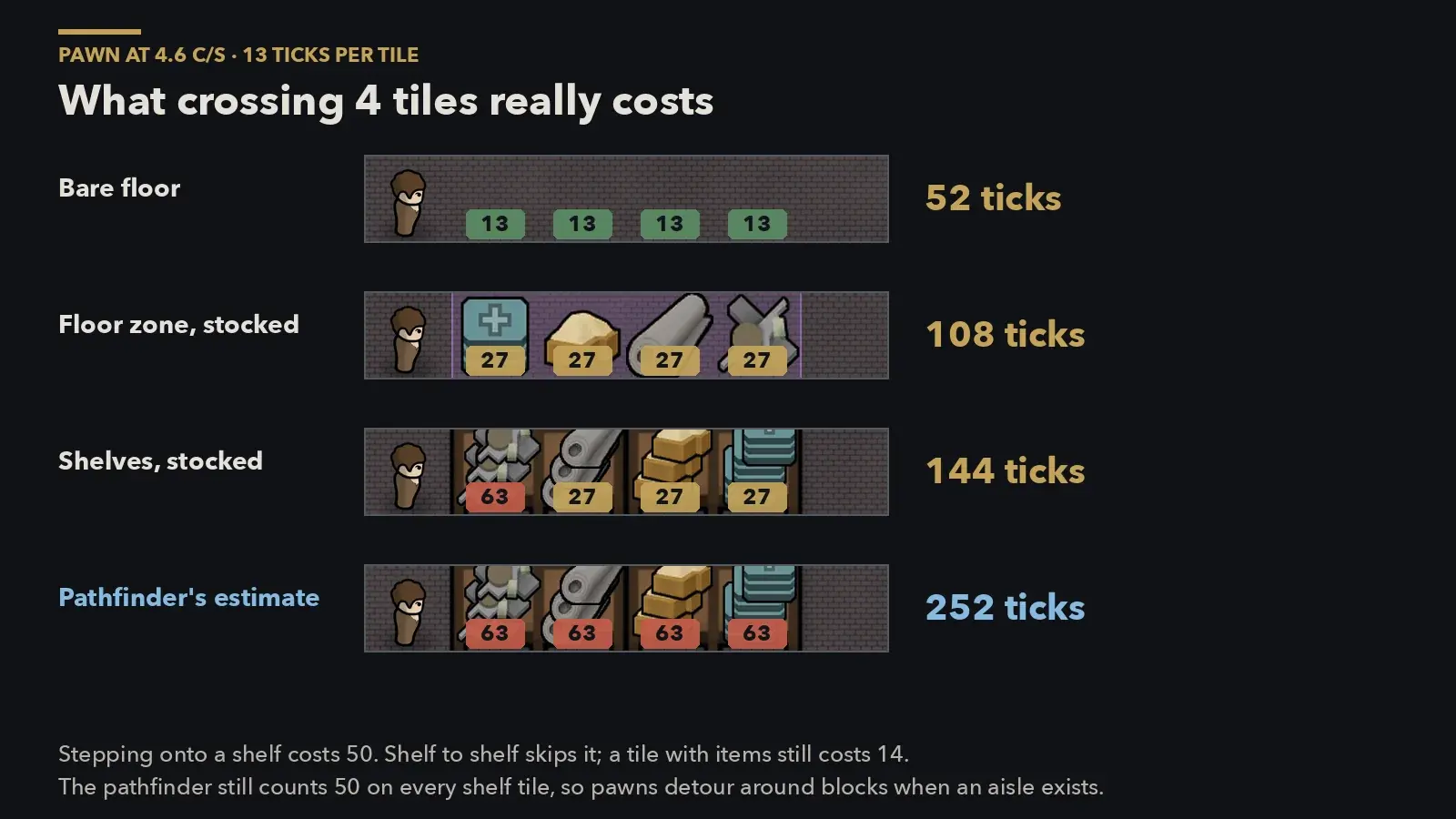
When pawns plan a route, they still price every shelf tile at 50. They detour around a shelf block whenever there's a reasonable way around, and only cut across when there isn't. Either way, a stocked shelf block costs 36 ticks more to cross than the same stocked floor zone, however deep it is. It's one bad step rather than a slow crawl, but haulers cross storerooms all day. Keep through-routes on bare floor and put storage alongside them.
Every shelf tile should touch an aisle
Haulers don't need to stand on a shelf to use it. They stop on any of the 8 tiles around it, diagonals included, and drop or pick up from there. As long as every shelf tile touches a walkable tile, nobody has to climb onto the block.
- Two-deep rows with a one-tile aisle: every shelf tile touches the aisle. Shelves cover 2 of every 3 tiles, so the room averages 2 stacks per tile.
- Single rows with aisles give 1.5 stacks per tile. Only worth it in narrow rooms.
- A solid block gives 3 stacks per tile, but haulers have to step onto it to reach the middle rows. Save it for bulk you rarely touch, like the silver vault or spare steel.
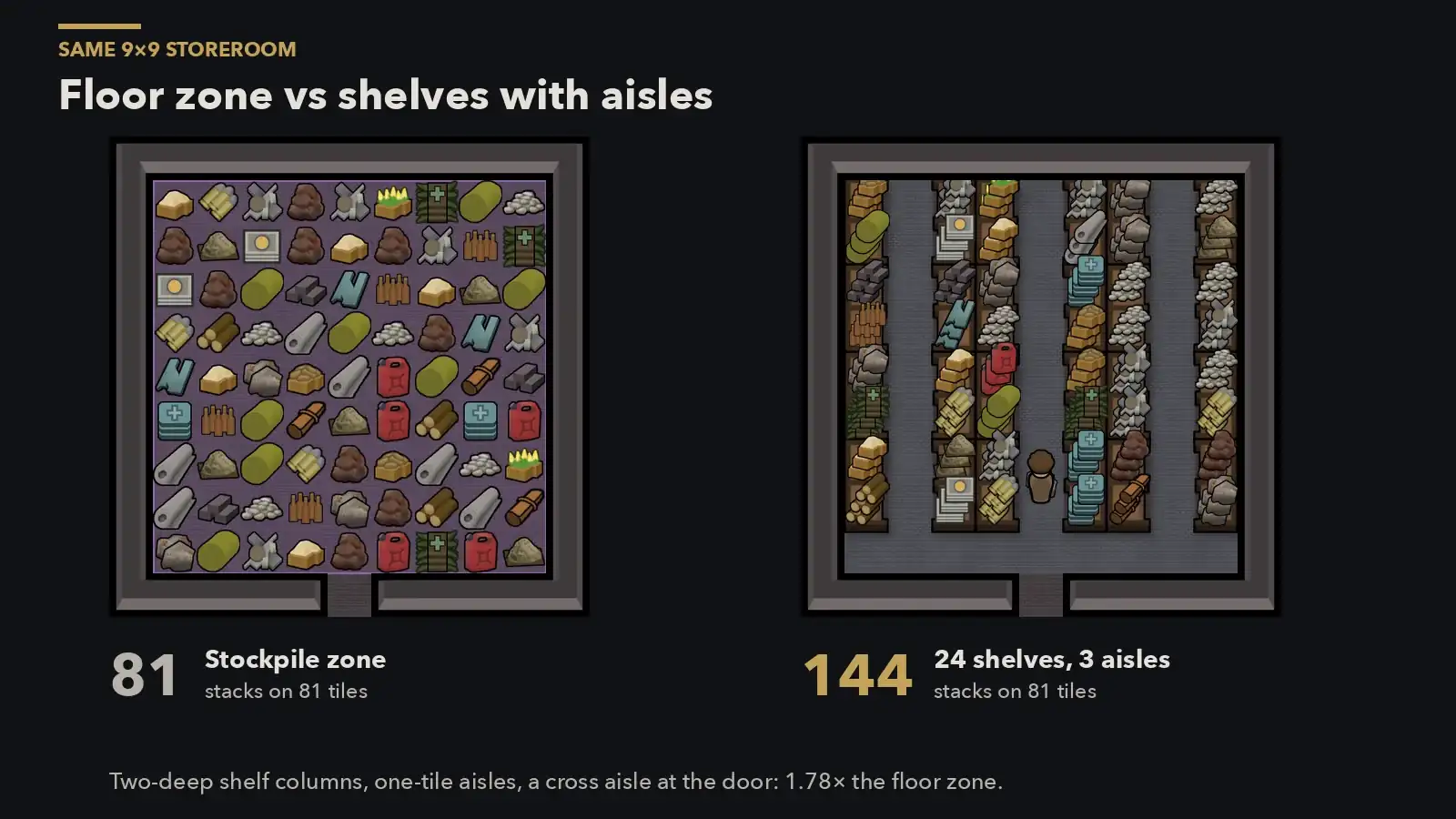
Worked example: a 9×9 storeroom
- Run the door into a cross aisle along one wall.
- From the wall: shelf column, aisle, two shelf columns, aisle, two shelf columns, aisle, shelf column. That's columns S A S S A S S A S, with the aisles every third tile.
- Stand 2×1 shelves upright, four per column, filling the 8 rows above the cross aisle. That's 24 shelves on 48 tiles.
The room holds 144 stacks instead of 81 as a floor zone, for 480 wood or steel. Every shelf tile touches an aisle, so nobody ever steps onto a shelf.
Ingredient shelves beside a bench
The same reach rule is behind the "shelf trick". Put a shelf next to a workbench's work spot and the crafter grabs ingredients without walking. Set the bench's bills to drop products on the floor and let haulers restock the shelf. For a full kitchen layout, see how to build a kitchen. Workbench speed buffs like the tool cabinet are a separate system. Where the storeroom sits matters more than any aisle: put it on a route people already walk. Colony layout goes into that.
Why the shelf stays empty
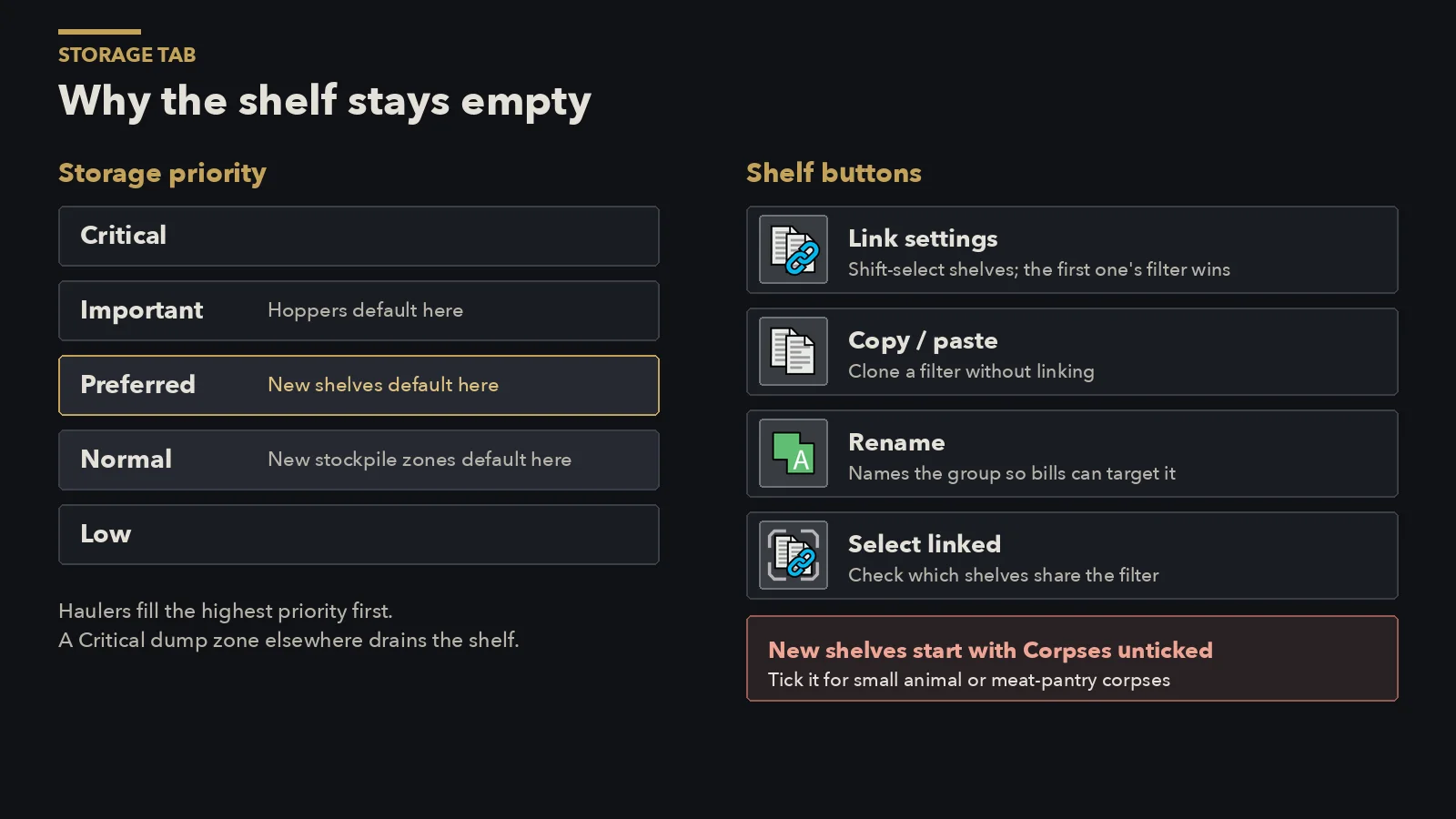
Haulers fill the highest-priority storage first, and only move things when a better spot exists. Work down this list:
- Another spot ranks higher. New shelves start at Preferred and new stockpile zones at Normal, so a fresh shelf normally pulls from zones. But an Important or Critical zone that accepts the same item keeps it there.
- The filter excludes it. Open the shelf's Storage tab and check the item and its category. Shelves start with food, manufactured goods, raw resources, items, weapons, apparel and body parts allowed. Corpses are off.
- The shelf copied another filter. Link settings keeps the filter of the first shelf you selected. Linking a fresh shelf to your weapon rack turns it into a weapon rack.
- The item is forbidden, or sits in an area your haulers can't reach or aren't allowed into.
- The item can't go on shelves at all. See the next section.
- Every slot is full. Three part-stacks of different items fill a tile, and it won't take a fourth kind.
- Nobody is hauling. Check that someone has Hauling enabled and isn't buried in other work.
Link, copy, rename
Shift-select shelves (blueprints work too) and use Link settings so they share one filter and priority. Copy and paste clones a filter onto other shelves without linking them. Rename gives the shelf or its group a name, and a bill's "take to" option can then target it like a named stockpile.
What never fits on a shelf
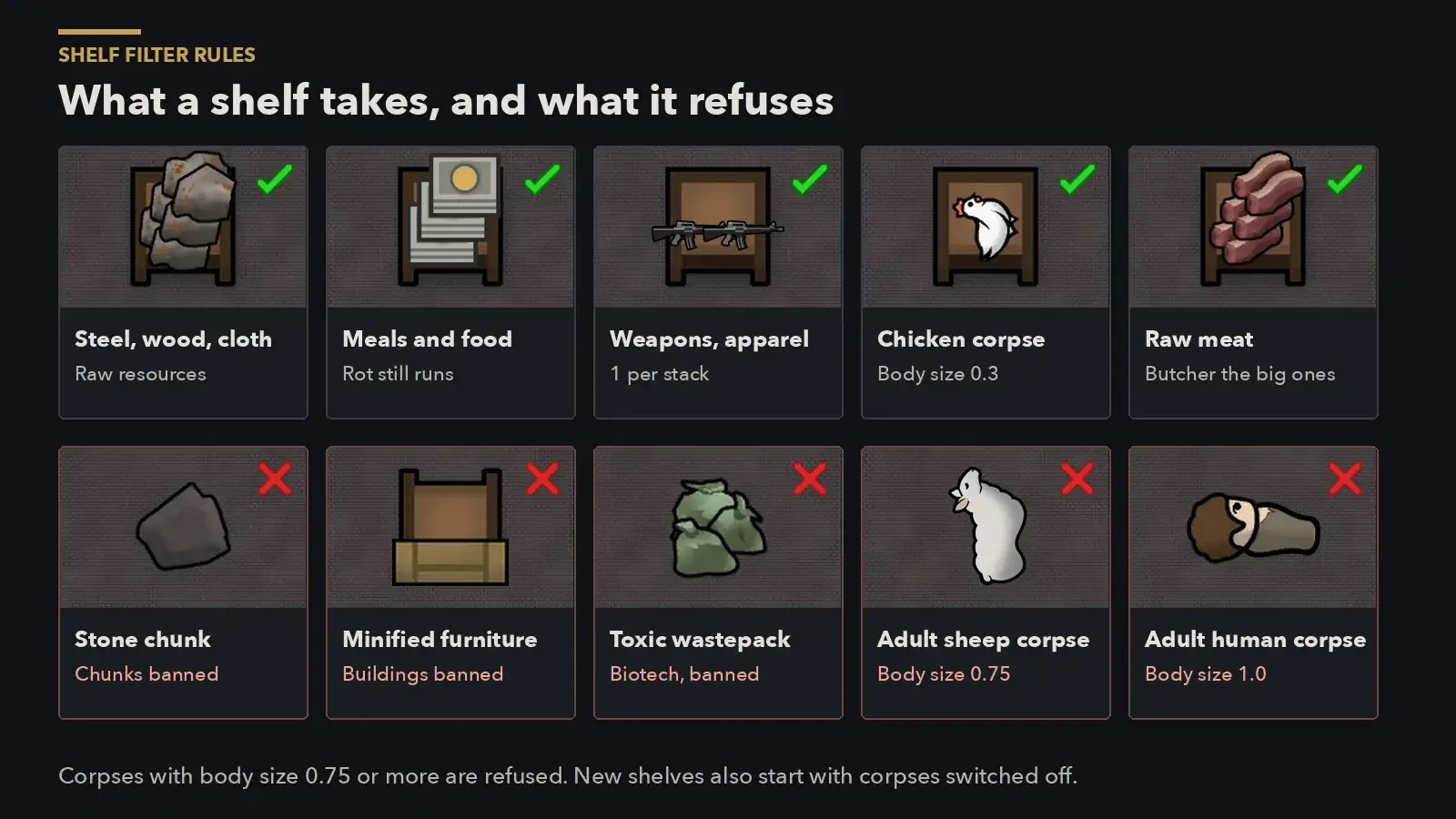
 Chunks, stone and slag. Keep a floor zone beside the stonecutter or smelter; stone blocks do fit.
 Minified buildings, including uninstalled furniture and minified trees.
 Toxic wastepacks (Biotech). A floor stockpile holds up to 5 per tile. For getting rid of them, see pollution cleanup.
- Corpses with body size 0.75 or more. The cutoff includes 0.75 itself, so adult sheep, goats, capybaras and Labrador retrievers are refused along with adult humans (1.0) and teenagers (0.8). The check uses the body's current size, so young animals of those species can fit. Chickens, cats, Yorkshire terriers, rats and other small animals fit, and so do human children under 13.
Small corpses still need Corpses ticked in the shelf's filter, because new shelves start with it off. For a cannibal or ghoul pantry, butchering gives you meat that fits anyway. Butchering by rot stage covers which bodies are worth cutting up.
Deterioration is not rot
These are two separate systems, and shelves only touch one of them.
- Deterioration is hit-point loss from weather. It applies outdoors or without a roof, gets worse in rain and shallow water, and does nothing to items on a shelf.
- Rot is a food timer that only temperature controls. A shelf doesn't change it.
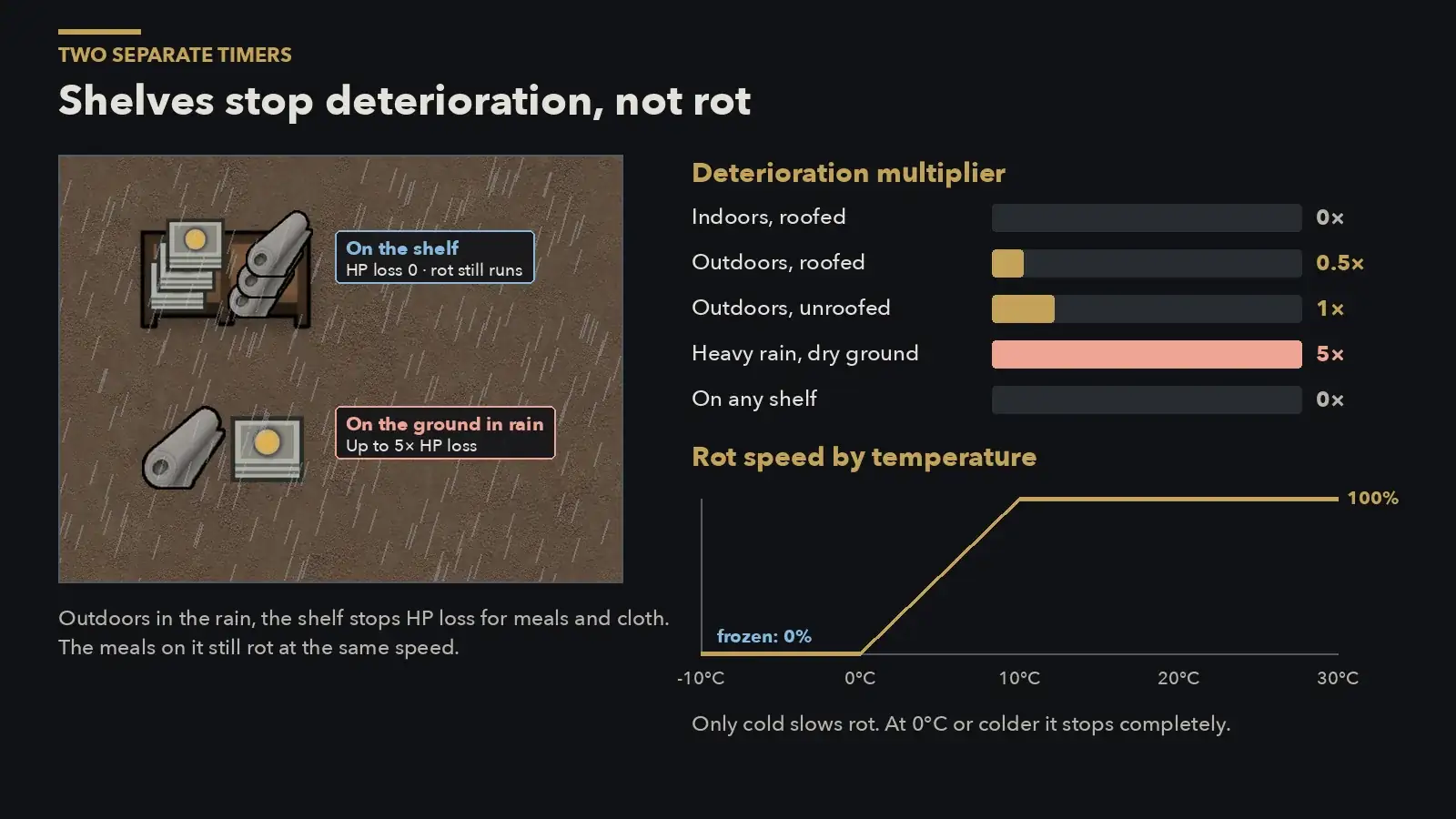
| Where the item sits | Deterioration |
|---|---|
| Indoors, under a roof, dry floor | None |
| Under a roof but outdoors (no walls, or 25%+ of the room's roof open) | Half the item's rate |
| Outdoors, unroofed | The item's full rate |
| Same, in heavy rain | Up to 5× on dry ground |
| Lying in water | Adds 3× the rate before rain applies: 3× even indoors, up to 20× unroofed in heavy rain |
| On any shelf, anywhere | None |
Base rates per day, from the item's info card: simple meals 10 HP, rice, raw meat and herbal medicine 6, cloth 4, components and industrial or glitterworld medicine 2, wood 0.5, survival meals 0.25. Weapons and apparel start at 2 for normal quality; better quality lowers it, down to 0.2 for legendary. Metals and stone blocks never deteriorate. With Biotech, polluted ground, toxic fallout and noxious haze multiply the rate further, but a shelf still zeroes it.
Rot runs at full speed at 10°C or warmer, slows between 0 and 10°C, and stops at 0°C or colder. Simple meals start to rot after 4 days, raw meat after 2, rice after 40. Shelves make a freezer smaller and cheaper to cool, but they never replace one.
"My cloth is damaged and it's on a shelf"
Check the item's hit points against its deterioration line in the info card. Damage usually happened before the haul, while the cloth sat in the field or in a caravan drop. If the shelf item shows a live deterioration rate in vanilla, look for a mod that changes shelves.
Wood, steel, or stone shelves
The material sets build time, hit points and how well the shelf burns. Capacity stays the same, and a fireproof shelf won't save what's sitting on it.
| Shelf material | Cost (2×1 / small) | Work (2×1 / small) | Hit points | Flammability | Beauty |
|---|---|---|---|---|---|
| Wood | 20 / 10 | 350 / 175 | 65 / 32 | 100% | 0 |
| Steel | 20 / 10 | 500 / 250 | 100 / 50 | 40% | 0 |
| Granite blocks | 20 / 10 | 3,140 / 1,640 | 170 / 85 | 0% | 0 |
| Marble blocks | 20 / 10 | 2,890 / 1,515 | 120 / 60 | 0% | 2 |
| Silver | 200 / 100 | 500 / 250 | 70 / 35 | 40% | 7 |
| Gold | 200 / 100 | 450 / 225 | 60 / 30 | 40% | 22 |
Wood is the usual pick. It's the fastest to build and cheap to replace. Steel is fine once you have plenty. Stone takes about six times longer to build and only makes sense near fire risks, like a chemfuel and mortar shell store. Silver and gold are small-volume materials, so a shelf costs 200 of them; a gold shelf's beauty is real, but it adds about 2,000 wealth per shelf. Shelves have no quality since 1.5, so there's no masterwork shelf to chase.
Small shelf, bookcase, and hopper
| Building | Holds | Default priority | Use it for |
|---|---|---|---|
| Small shelf | 3 stacks on 1×1 | Preferred | Odd gaps, a single medicine slot by hospital beds, bench-side ingredients |
 Bookcase / small bookcase Bookcase / small bookcase | Books only: 10 / 5 | Important | Books. Their beauty still counts, unlike items on a shelf |
 Hopper Hopper | 1 stack of raw food | Important | Feeding a nutrient paste dispenser, nothing else |
A 2×1 shelf and two small shelves store the same and cost the same in wood or steel. In stone the 2×1 saves 140 work, and it's one less building to link. Small shelves fill corners that a 2×1 can't.
Shelves and room role
A room becomes a Storeroom when shelves outscore its other uses. Each shelf, small shelf or hopper adds 1 point. Each workbench adds 27 to Workshop, and each cooking station adds 28 to Kitchen. A few ingredient shelves never flip a kitchen, but 28 shelves in a one-bench workshop do.
That matters in 1.6, because most production benches work at 80% speed outside their room role. The Storeroom role itself gives no mood effect, so there's no reason to dress up a warehouse. Bookcases don't count toward it. If the storeroom's walls are ugly, fixing an ugly environment covers what helps.
Shelf and aisle calculator
Pick an item and how many you need to store. The calculator shows stacks, how many shelves to build, the material and work, and floor space with aisles included, next to what a floor zone would need.
Floor space counts shelf tiles plus their share of aisle. Add your cross aisle and door. Marble and sandstone build a little faster than granite.
Old patches, console, and mods
- 1.4.3523 brought the current system: 3 stacks per tile, the small shelf, linking and the Storeroom role, plus the ban on chunks, minified things and large corpses. Small corpses stayed allowed. Guides written before then that say "a shelf holds one stack" are describing the old shelf.
- 1.5.4062 removed shelf quality and let a single shelf become a named storage group.
- 1.6 left shelf capacity alone. Its room-role work penalty is the main new reason to keep storage out of workshops.
- On console, treat these numbers with care. They're for PC 1.6. The console patch notes don't mention the 1.4 shelf rework, so check a shelf's description in your own game before planning around 3 per tile.
- Deep-storage mods such as LWM's Adaptive Deep Storage add buildings that hold more per tile, and stack-size mods change every number on this page. The 3-per-tile rule is vanilla only.
If another guide gives the corpse cutoff as "greater than 0.75", or says a 2×1 shelf takes 83% of the work of two small shelves, it's out of date for 1.6.4871. A body of exactly 0.75 is already refused, and the work is identical for wood and steel.
Quick answers
How many stacks fit on a RimWorld shelf?
Three per tile: 6 on the 2×1 shelf, 3 on the small shelf. A floor stockpile tile holds 1.
Do shelves hold more than a stockpile zone?
Three times as much on the tiles they cover. Counting aisles, a two-deep layout averages about 2 stacks per tile. The 9×9 example, with its extra door aisle, comes out at 1.78×.
Do shelves stop deterioration outdoors?
Yes, completely, even unroofed in rain. Indoors under a roof nothing deteriorates anyway.
Do shelves keep meals from rotting?
No. Only temperature matters. Keep food at 0°C or colder to stop rot.
Why won't pawns stock the shelf?
A higher-priority spot takes the item, the filter excludes it, it's forbidden or unreachable, or it can't go on shelves. Corpses start switched off.
Can shelves hold corpses?
Only with body size under 0.75, and only after you enable corpses in the filter. Adult humans, adult sheep and adult goats never fit.
Should there be a gap between shelves?
Keep every shelf tile touching a walkable tile. Two shelf rows, then a one-tile aisle, repeated.
Is a small shelf better than a 2×1 shelf?
Same capacity and cost per tile. Use small shelves for gaps and the 2×1 elsewhere.