Stop Losing Colonists to Bad Base Design: Fix Your RimWorld Colony Layout
Colonists die in badly laid out bases for dull reasons: a hospital across the map, a dirty kitchen, a freezer that thaws, an infestation that lands beside the bedrooms. Most of it comes down to numbers the game checks every day. Food stops rotting at 0 °C and below. A kitchen only poisons meals below −2 cleanliness. Each tool cabinet adds 6% work speed, two per bench at most. A 5×5 bedroom reads as average-sized. This guide builds your colony layout around those rules, starting with an 11x11 starter base you can lay down on day one.
PC 1.6.4871 · Base game, Royalty, Ideology and Biotech rooms · Updated October 27, 2026
Watch on YouTube · English audio
11x11 Starter Base Layout for the First Few Days
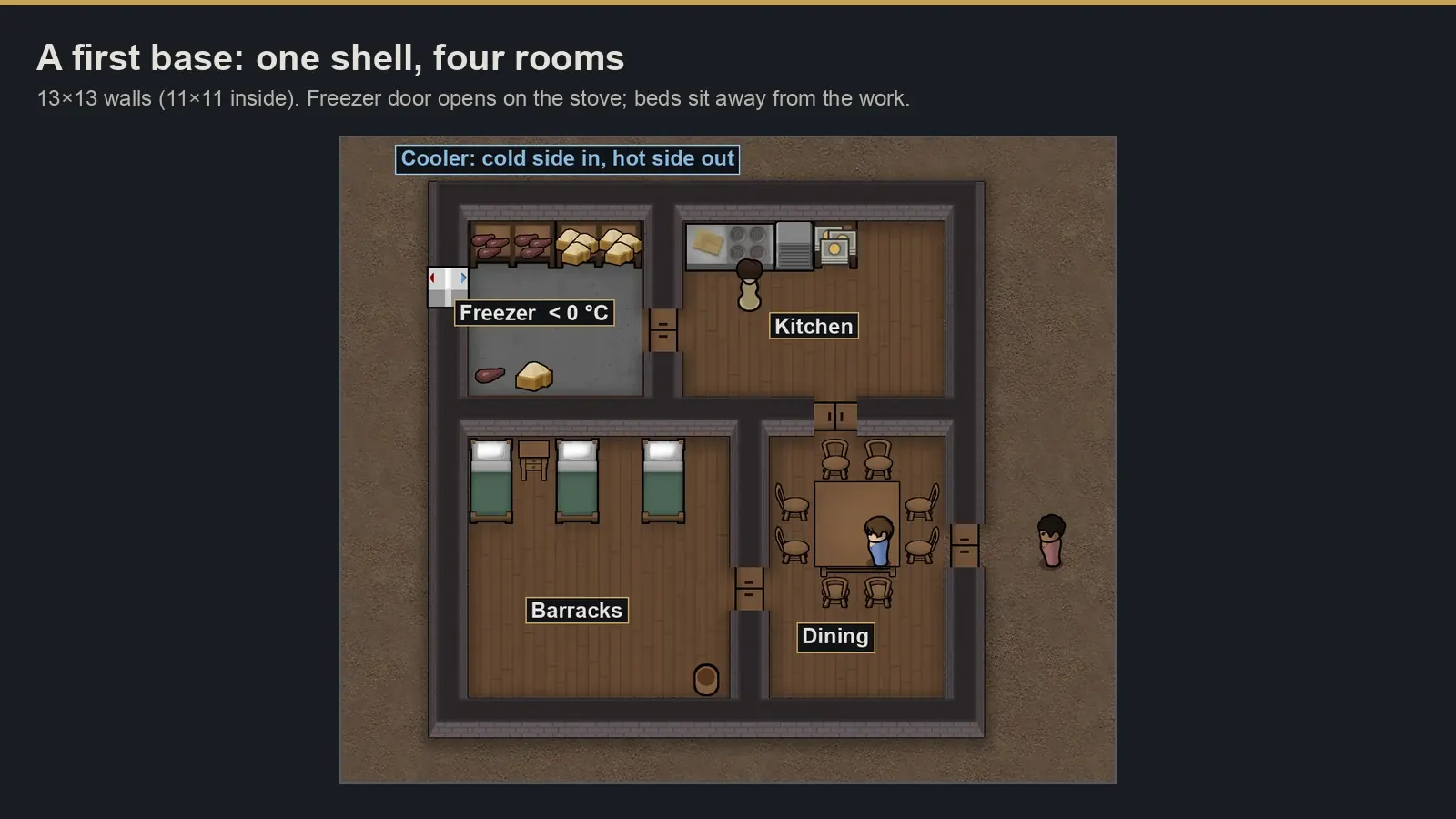
The 11x11 base is a 13×13 outer shell with an 11×11 interior, split by interior walls into a freezer, a kitchen, a barracks and a small dining room. That fits the three colonists of a Crashlanded start. Shared walls cost less, hold heat in, and keep every room a few steps from the others.
A single cross wall through an 11×11 interior leaves four 5×5 rooms and 100 floor tiles. Left as one open room, an empty 11×11 scores 169.4 space (121 tiles at 1.4 each), well into "very spacious". Splitting it gives up that score for rooms that each do one job. The diagram above moves the walls to give the kitchen and barracks the wider sides.
- Pick flat, buildable ground close to wood and stone, with room to grow on at least two sides. A cliff or mountain edge covers one flank for free.
- Roof and wall the shell first, then split it. Mark the interior walls with the plan tool before you build them.
- Put the freezer next to the kitchen with one door between them and the stove right beside it. Set the cooler in an outside wall so the hot side vents outdoors.
- Build a table and chairs. Eating without a table gives a −3 mood thought that lasts a day.
- Put the beds in a barracks, away from the stove and the workbenches.
- Expand outward: a workshop next to storage, a hospital near the main door, and private bedrooms on the far side.
Want to sketch your own version? The base layout planner works on a grid, and the optimal colony layout guide compares mountain, open-ground and gravship bases.
Base Layout Flow: Where Each Room Goes
Walking time is the hidden cost of a bad base design. Put the rooms colonists visit many times a day in the middle and the rooms they visit once a day on the edges.
| Ring | Rooms | Why |
|---|---|---|
| Core | Kitchen, freezer, dining and rec, main storage | Cooks, haulers and hungry colonists cross these all day. |
| Middle | Workshop, research, hospital | The workshop sits on storage. The hospital sits near the main door so rescues are short. |
| Edge | Bedrooms, prison, power | Visited once or twice a day. Edge bedrooms also put a room between raiders and the core. |
| Outside | Dumping zone, butchery for big hunts, crematorium | Ugly, dirty or hot. Keep them out of the rooms people eat and sleep in. |
Corridors don't need fixed widths. One tile is enough for a side corridor. Use two or three where traffic jams form. Don't line a main corridor with shelves: walking over a shelf adds 50 path cost, so colonists route around it or slow down.
Bedroom Size, Furniture and Barracks
The game scores Space by counting tiles: 1.4 for each open tile and 0.5 for each tile under furniture you can't stand on (beds, dressers, end tables, shelves). Chairs and stools count as open. Doors aren't part of the room. For a full planner with mood and rest, see the bedroom tool.
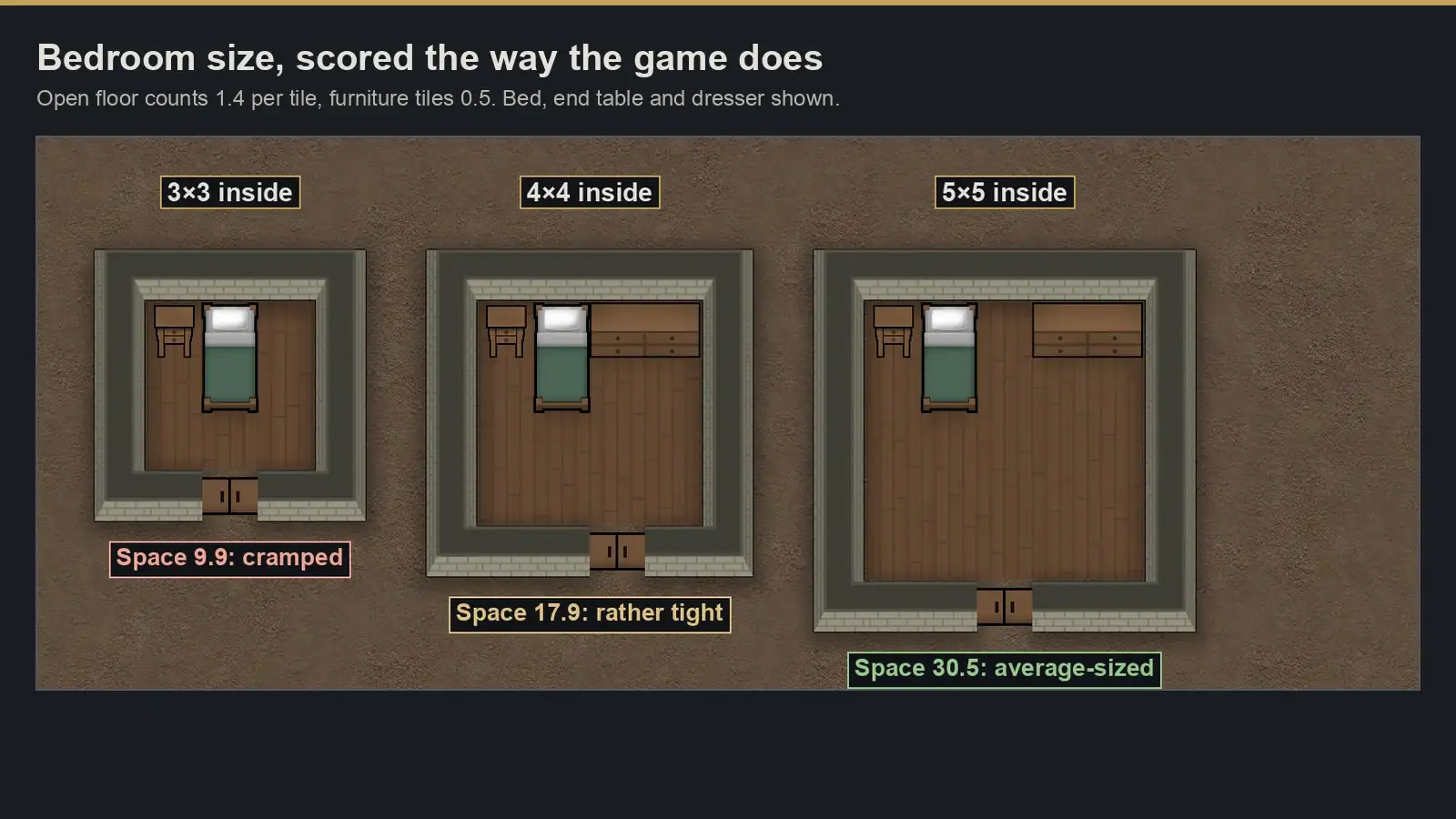
| Space score | Label | Bedroom with bed, end table and dresser |
|---|---|---|
| Under 12.5 | Cramped | 3×3 (8.1, or 9.9 without the dresser) |
| 12.5 to 29 | Rather tight | 4×4 (17.9) |
| 29 to 55 | Average-sized | 5×5 (30.5), 6×6 (45.9) |
| 55 to 70 | Somewhat spacious | 7×7 (64.1) |
| 70 to 130 | Quite spacious | 8×8 (85.1), 9×9 (108.9) |
| 130 to 349.5 | Very spacious | 10×10 (135.5) to 15×15 (310.5) |
| 349.5 and up | Extremely spacious | 16×16 (353.9) and up |
Size matters less than it looks. The bedroom mood thought comes from impressiveness, which mixes wealth, beauty, space and cleanliness, and space only bites when it is the weakest part. Below 125 space, any impressiveness above four times the space score is cut: the room keeps a quarter of the excess. A 5×5 bedroom (space 30.5) starts losing points above about 122, and a 3×3 with a bed and end table above about 40. It is a soft cap, but extra decoration in a tiny room pays off poorly.
Furniture placement
- The end table must touch the head of the bed on a side, not diagonally. It adds 0.05 comfort.
- The dresser can sit anywhere within 6 tiles of the bed. It also adds 0.05 comfort.
- Each bed links to one of each. Add a sculpture, a plant pot or a better floor for beauty, and keep the room clean.
Barracks or private rooms
| Impressiveness | Slept in bedroom | Slept in barracks |
|---|---|---|
| Awful (under 20) | −2 | −7 |
| Dull (20) | 0 | −5 |
| Mediocre (30) | +1 | −4 |
| Decent (40) | +2 | −3 |
| Slightly impressive (50) | +3 | −2 |
| Somewhat impressive (65) | +4 | −1 |
| Very impressive (85) | +5 | +1 |
| Extremely impressive (120) | +6 | +2 |
A barracks stays negative until it is very impressive, so private rooms pay off as soon as you can spare the walls. Even an awful bedroom (−2) beats a decent barracks (−3). Couples share a double bed in one bedroom.
Room Size Checker
Enter the room's inside size and how many tiles your non-standable furniture covers (bed 2, double bed 4, dresser 2, end table 1, shelf 2). Chairs don't count.
The result is for a plain rectangular room. Noble bedrooms need every tile floored and no production buildings from Acolyte up, plus an end table and dresser from Knight up. See Royalty.
Freezer and Kitchen: Temperature and Cleanliness
How cold the freezer needs to be
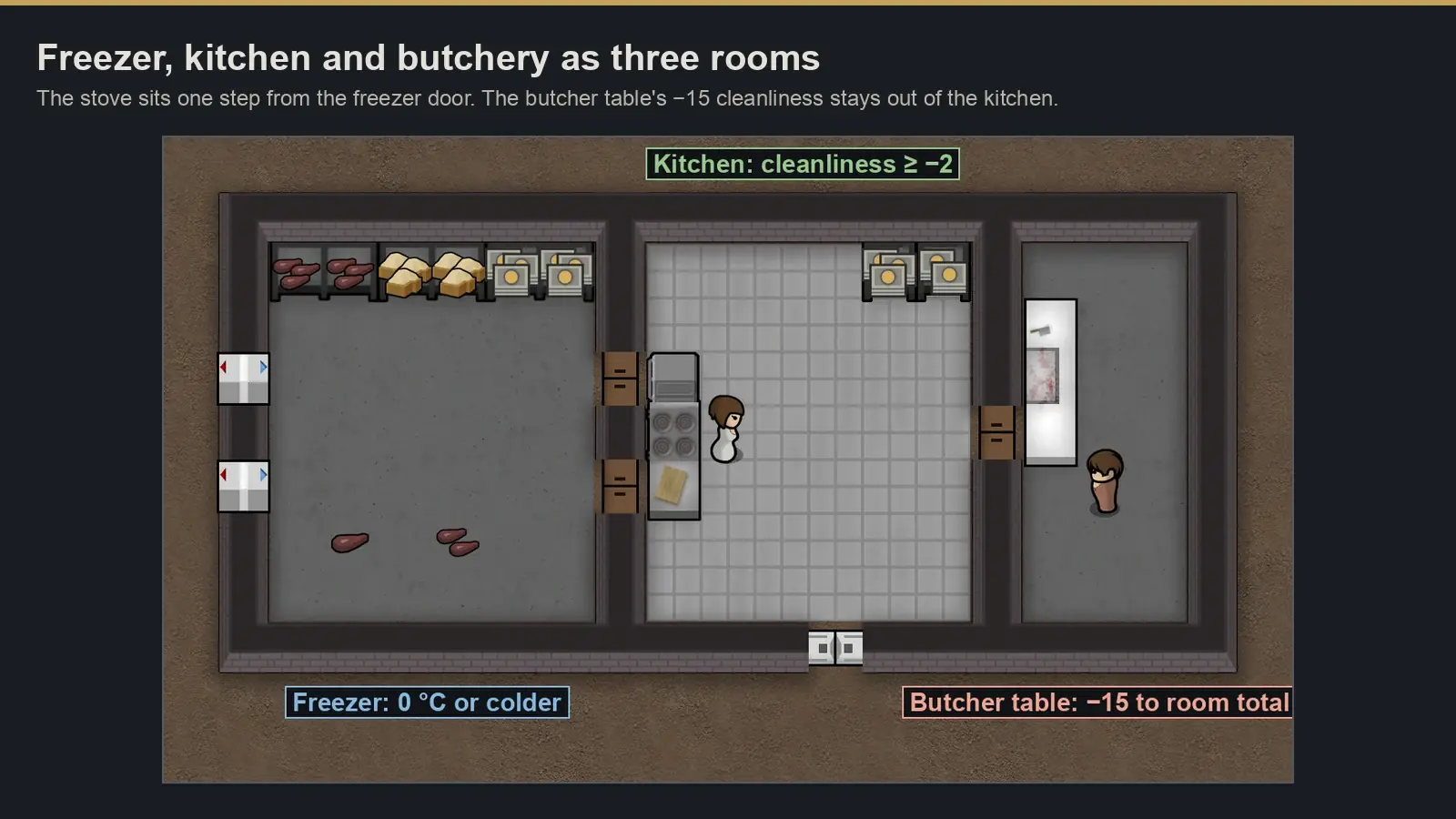
Rot stops completely at 0 °C and below. Between 0 and 10 °C food rots at a fraction of full speed (5 °C is half speed), and from 10 °C up it rots at full speed. Set the coolers for about −5 to −10 °C. That margin covers a door held open during hauling or a heat wave, and anything colder only costs power. Step-by-step builds are in the freezer guide and the kitchen guide.
- Coolers go in a wall, with the blue side into the freezer and the red side outdoors or into a large room that can absorb the heat.
- Use one door between the freezer and the kitchen. A second door in a short airlock helps in hot biomes.
- Shelves in the freezer triple what each tile holds and keep things tidy.
- Biotech wastepacks can't go on shelves. Freezing them (0 °C or below) pauses their dissolving, but damage can still break them open.
Kitchen cleanliness and food poisoning
Each cooking job rolls up to twice. The kitchen rolls first: if the room's cleanliness is −2 or better, that roll is zero. Below −2 it climbs to 2.5% at −3.5 and 5% at −5. If that roll passes, the cook rolls: 5% at Cooking 0, 1% at 5, 0.1% from 9 up. A 5% room and a 5% cook together poison 9.75% of jobs, not 10%.
| Where the meal is cooked | Room poison chance |
|---|---|
| Kitchen at −2 cleanliness or cleaner | 0% |
| Kitchen at −3.5 | 2.5% |
| Kitchen at −5 or dirtier | 5% |
| Outdoors, or a space that isn't a proper room | 2% flat |
You don't need sterile tile to stop room-caused poisoning. You need a clean room and someone assigned to clean it. The big dirt source is the butcher table, which adds −15 to the room's cleanliness total. That total is averaged over the room's tiles, so in a small kitchen the table can pull the average below −2 almost by itself. Give it its own room or put it in the freezer, and keep it out of the kitchen. A campfire tribe start cooks outdoors and lives with the flat 2% until it has a roofed kitchen.
Dining Room and Rec Room Layout
Combining the two works. In 1.6 the "ate in impressive dining room" and "impressive rec room" thoughts read only the room's impressiveness. They don't check whether the game labels it a dining room or a rec room, so one big, beautiful hall gives both thoughts, from +2 at decent (40) to +8 at wondrous (240).
- Every eating colonist needs a free table spot. A missing one gives "ate without table" (−3 for a day, and it doesn't stack).
- Mix recreation types so nobody gets bored of one activity.
- Bigger rooms hold more art and score more space, but a hall spread too wide gets expensive to floor and keep clean.
| Recreation type | Buildings |
|---|---|
| Dexterity | Horseshoes pin, hoopstone ring, billiards table |
| Cerebral | Chess table, poker table, game of ur |
| Television | Tube, flatscreen or megascreen television |
| High culture | Harp, harpsichord, piano, drum |
| Telescope | Telescope |
| Meditative | Viewing art, skygazing, walks |
| Social | Chatting at tables and gather spots |
Workshop Layout: Storage on One Side, Benches on the Other
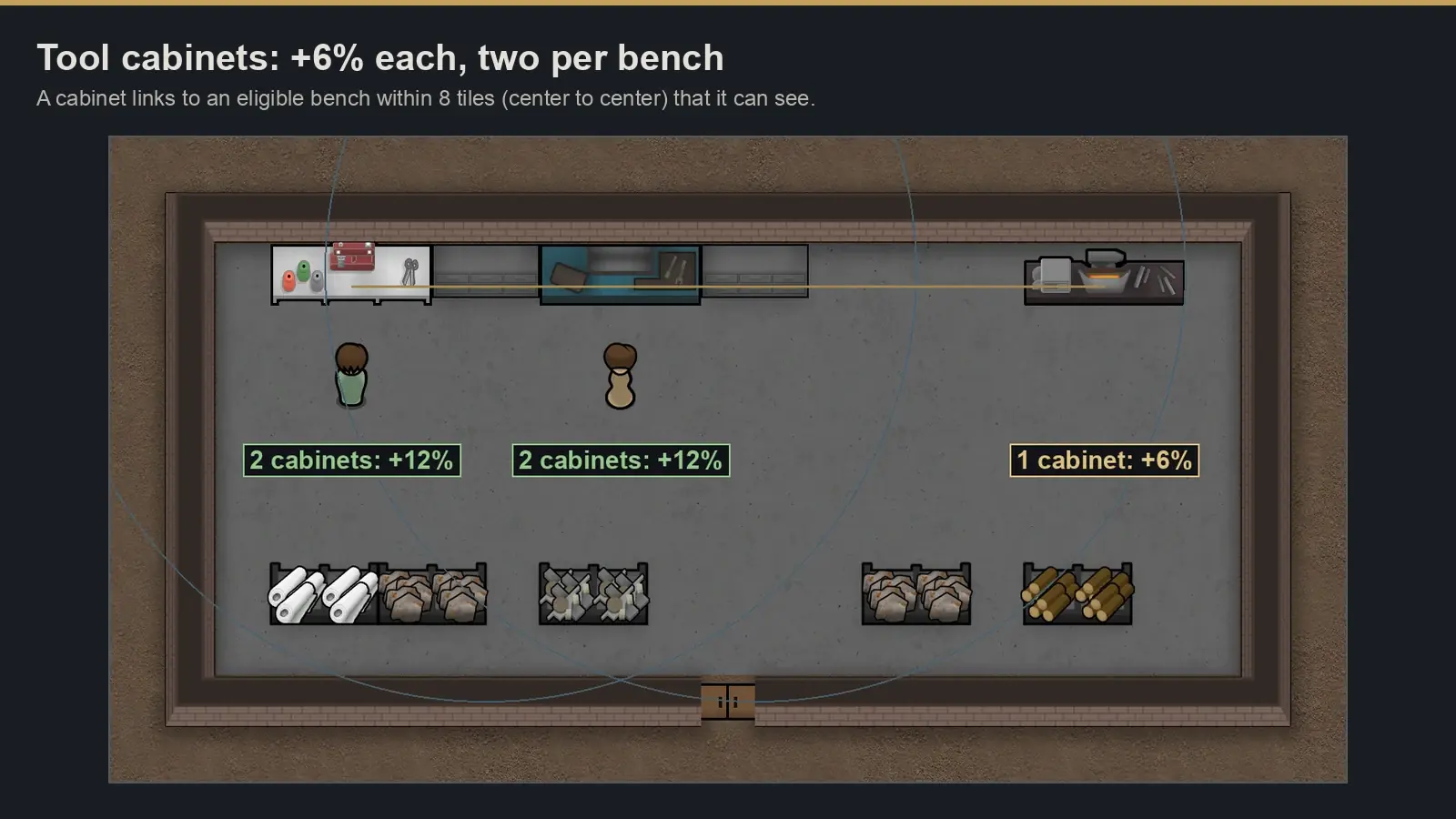
Put the materials a bench uses on shelves a few tiles away, facing the bench. A tailor who grabs cloth from two tiles away spends the bill working instead of walking across the base.
- A tool cabinet gives +6% work table speed. A bench uses at most two, so +12% is the cap.
- Only some benches take cabinets: crafting spot, sculptor's table, butcher table, tailoring benches, smithies, machining table, stonecutter's table, drug lab and fabrication bench. Stoves, breweries, smelters and research benches don't.
- A cabinet links to an eligible bench within 8 tiles, center to center, as long as it can see it. One cabinet between two benches serves both. The tool cabinet guide lists the exact benches and what to do when a link fails.
- Most benches are 3×1. The fabrication bench is 5×2. Leave the interaction spot in front of each bench free.
- Electric smelters and crematoriums push heat. Give them a vent or a cooler, or their own room.
Workshops have no mood thought, so floors and art matter less here. Light still matters, because work in the dark is slower.
Hospital Layout: Clean, Near the Door, Monitors Between Beds
| Item | Effect | Placement rule |
|---|---|---|
| Hospital bed | Base stats: +10% tend quality, 1.11 immunity gain, 1.1 surgery success factor (bed quality, light and the room also apply) | Needs the Hospital bed research |
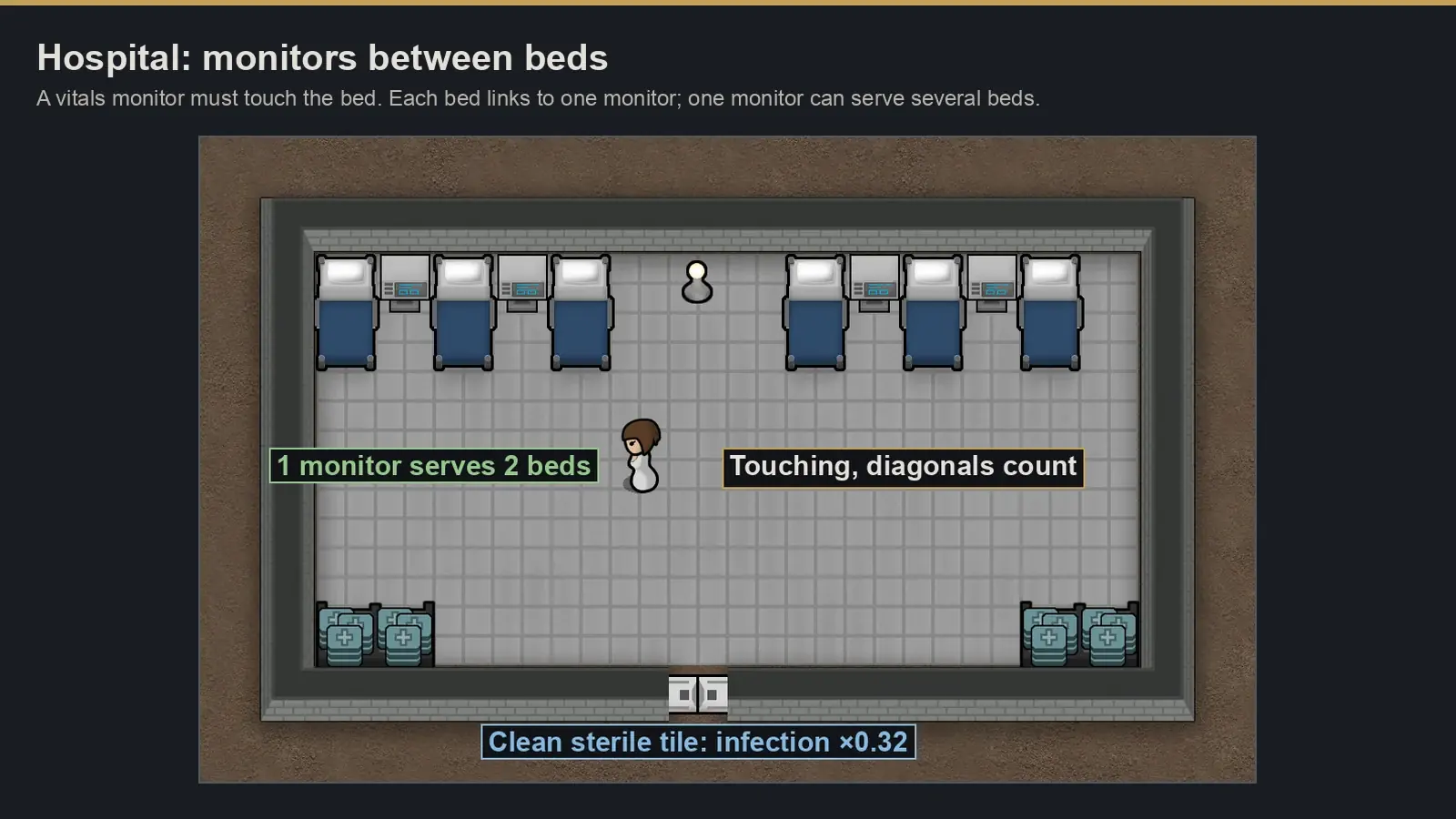
| Vitals monitor | Adds +0.07 tend quality, +0.02 immunity gain and +0.05 surgery factor to the bed (1.1 → 1.15) | Must touch the bed, diagonals count. One per bed, and one monitor can serve several beds |
| Room cleanliness | Infection chance ×1.0 at −5, ×0.5 at 0, ×0.2 at +1 | Sterile tile adds 0.6 per tile |
| Room cleanliness | Surgery success ×0.6 at −5, ×1.0 at 0, ×1.1 at +1 | Same room average |
A clean room with sterile tile everywhere averages about 0.6 cleanliness. That multiplies the base infection chance by 0.32 instead of the 0.5 you get on a plain clean floor, and sets the surgery cleanliness factor to 1.06. A filthy room is the real danger, so autodoors, a cleaner on priority 1 and no butchering nearby matter more than the tile itself. The hospital guide has the ward and surgery planner.
Put the hospital near the main door and the kill zone so rescues are short, and store medicine on a shelf inside. For prisoners, a medical bed in the prison cell works, and a door between the prison and the hospital keeps doctors' trips short.
Storage and Shelves
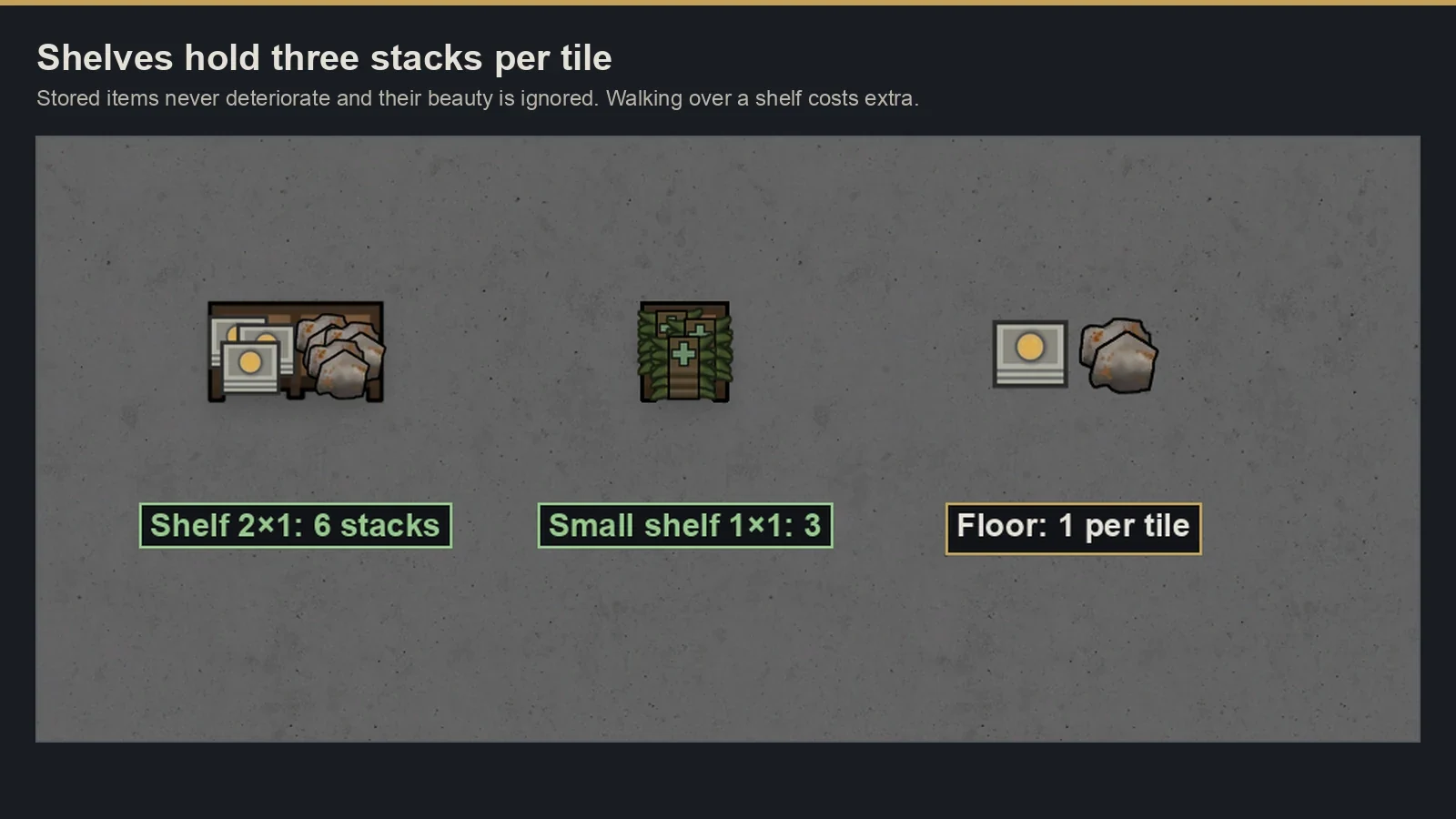
- A shelf (2×1) holds 6 stacks and a small shelf (1×1) holds 3. Both need Complex furniture research.
- Stored items never deteriorate, even outdoors, and their beauty (usually ugly) is ignored.
- Shelves can't take chunks, plants, buildings, large corpses or wastepacks.
- Put the main storeroom next to the workshop and the kitchen, then add small shelves where things get used: medicine in the hospital, meals by the dining table, components by the fabrication bench.
- Chunks, slag and corpses go in a dumping zone outside. Chemfuel and mortar shells go in a separate small room, because they explode or burn.
The shelving guide covers aisles and hauling distance in detail.
Temperature and Infestations
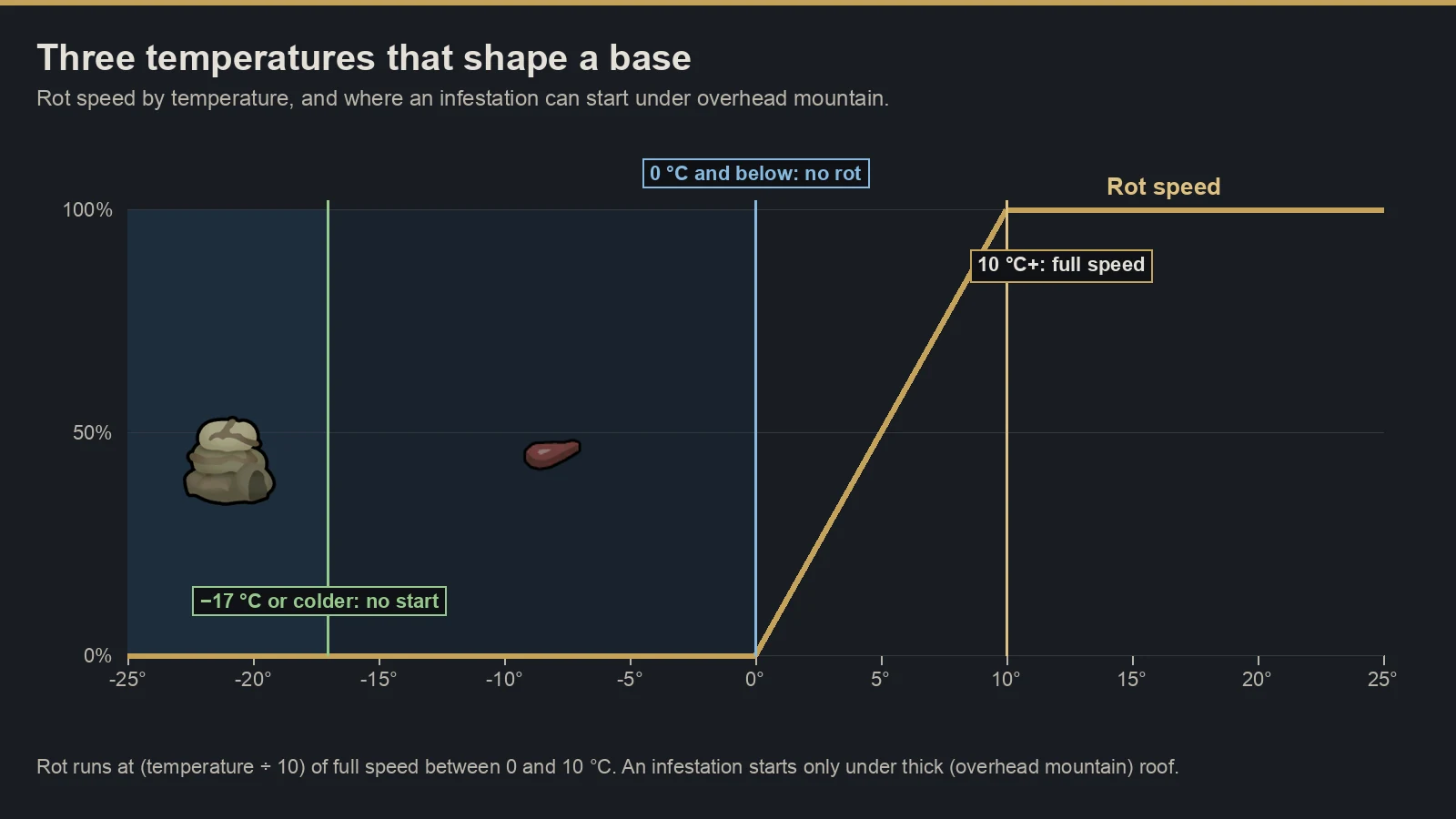
A natural infestation picks its starting tile only under thick roof (overhead mountain) and only where it is warmer than −17 °C. The odds fall as the tile cools from −7 to −17 °C. Once the first hive lands, the extra hives in the same event spread to nearby roofed tiles without the temperature check, so a cold room next to a warm one is not guaranteed safe. Keeping all open mountain-roofed space at −17 °C or colder, or having none, stops the starting spot. Work out where an infestation could land and keep that area away from bedrooms and the hospital.
For living space, keep rooms at roughly 16 to 26 °C so nobody needs extra clothes indoors. Heaters and coolers both go in or near the room. In extreme biomes, double walls and an airlock help more than extra machines.
Defense in Your Base Layout
Plan defense into the walls from the start.
- Leave one obvious way in. Raiders take the cheapest path, so a single opening with turrets and sandbags behind it becomes a killbox.
- Breachers and sappers ignore that path and cut through walls. Keep the core rooms behind at least one outer room, and keep a fallback position inside.
- Constructed roofs and thin rock roofs don't stop drop pods, and center-drop raids punch straight through them. Only thick overhead mountain blocks them, so don't count on a roof to protect the stockpile.
- Stone walls don't burn. Wood walls next to a battery bank or a fueled generator are a fire waiting to happen, and firefoam poppers (radius 9.9) cover a room.
Weapons, turret types and tactics are in the combat and defense guide.
Expansions: Rooms They Add
Royalty: throne rooms and noble bedrooms
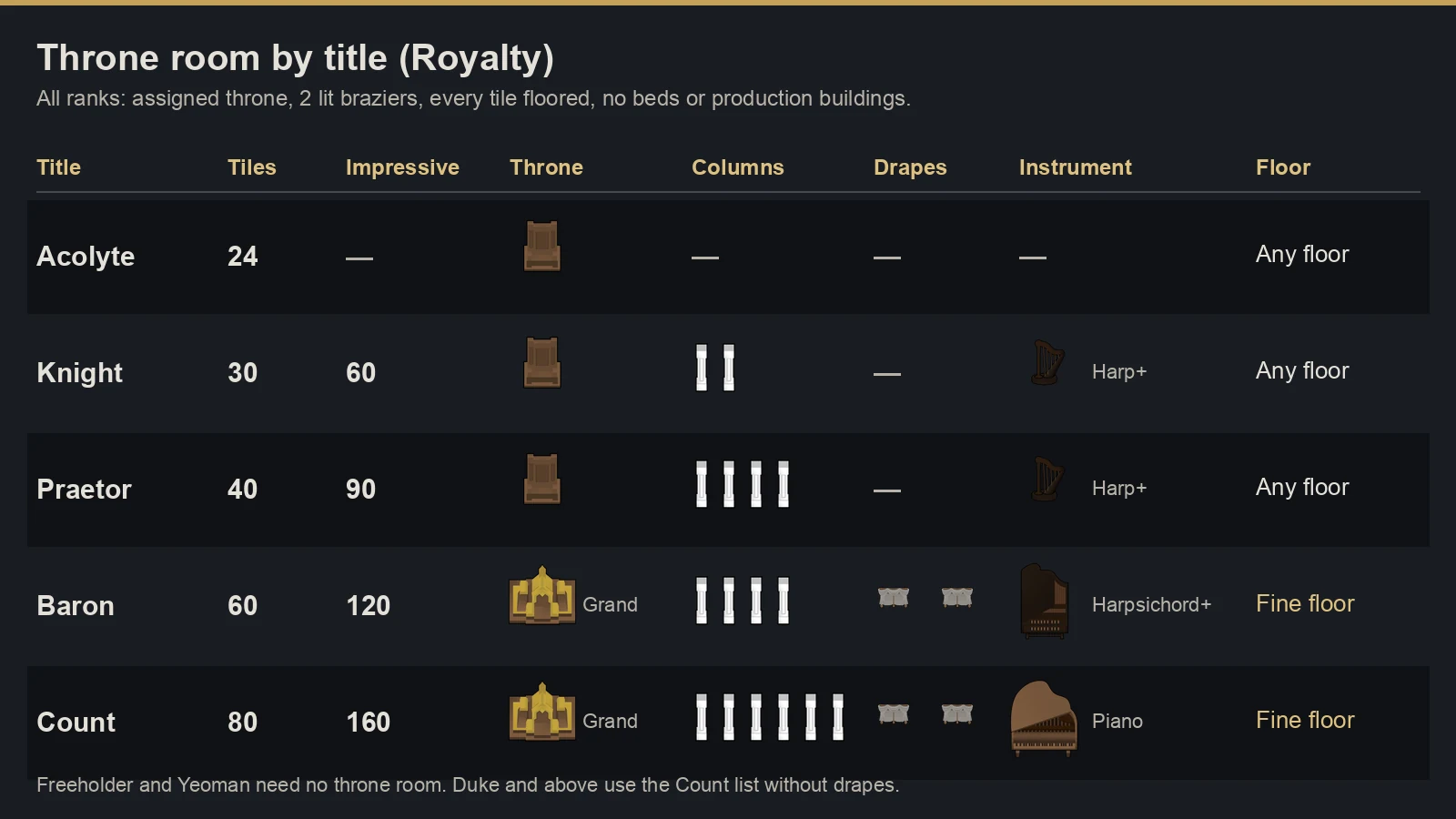
The first title that wants a throne room is Acolyte. Freeholder and Yeoman need none. Every throne room needs two lit braziers (darklight braziers count with Ideology), every tile floored, and no beds, production buildings, altars, or buildings tagged Biotech or Anomaly. Duke and above use the Count list without the drapes.
| Title | Bedroom tiles | Bedroom impressiveness | Bed | Also needs |
|---|---|---|---|---|
| Acolyte | 16 | — | Double or royal | Floored, no production |
| Knight | 24 | 40 | Double or royal | Floored, end table, dresser |
| Praetor | 24 | 50 | Double or royal | Floored, end table, dresser |
| Baron | 30 | 70 | Royal | Floored, end table, dresser, 1 drape |
| Count | 30 | 80 | Royal | End table, dresser, 1 drape, fine floor |
With Biotech a deathrest casket also counts as the bed, and the Ideology precept that prefers slab beds removes the bed requirement.
A dining hall can't double as a throne room once it has a stove or other production building in it. Build the throne room next to it and use it for meditation, since a throne is a dignified focus.
Ideology
Rituals need their focus (altar, ideogram, or the right spot) in a room that is big and impressive enough for good ritual quality. Style changes how buildings look, not what they do. Putting the slave barracks near the fields and work areas cuts their walking. That is a layout choice, not a rule.
Biotech: building sizes
| Building | Size | Note |
|---|---|---|
| Mech gestator | 3×2 | 350 W working, 50 W idle |
| Large mech gestator | 4×3 | 500 W working |
| Band node | 2×2 | 300 W |
| Wastepack atomizer | 3×2 | 400 W, holds 10 wastepacks |
| Gene extractor | 2×2 | Put it near the hospital |
| Gene assembler | 2×3 | Gene banks link within 12.9 tiles |
| Gene bank | 2×1 | Holds 4 genepacks |
For children, put a nursery with cribs near the parents' rooms and add toy boxes for play. A wastepack stack loses one pack every 8 days outdoors (4 in rain) and every 16 days indoors, and the timer pauses while frozen.
Base Layout by Start Scenario
| Start | Colonists | Layout priority |
|---|---|---|
| Crashlanded | 3 | The 13×13 shell above. Get power and a cooler early. |
| Lost Tribe | 5 | No power at first. Passive coolers only cool to about 17 °C, so they make rooms bearable but don't preserve food. Eat fresh harvests and hunts, make pemmican, and use winter cold until you have electric coolers. Cook on a campfire until there is a roofed kitchen. |
| Rich Explorer | 1 | One small room for bed, food and storage. Recruit before you expand. |
On ice sheet and sea ice, build almost everything indoors with an indoor farm. In deserts, coolers and shade matter more than heaters.
Base Planning Tools and Mods
Vanilla 1.6 covers more of this than older guides suggest.
- Plans: name a plan, give it a color, and copy and paste plan shapes from the Orders tab. That covers most of what planning mods used to do.
- Replace in place: place a wall of a different material over an existing wall, and colonists tear down the old one and build the new one. New floors tear up old floors automatically.
- Allowed areas keep colonists out of pens and dumping zones, which cuts tracked-in dirt.
| Mod | What it adds |
|---|---|
| Allow Tool | Haul urgently, select similar, mass forbid |
| LWM's Deep Storage | Pallets, racks and lockers with more stacks per tile |
| Dubs Bad Hygiene | Plumbing, bathrooms, water |
| Replace Stuff | Replace furniture and more in place, as one job |
| Blueprints | Save and place whole room layouts |
Check the Steam Workshop page for a 1.6 version tag before you subscribe. The mod guide covers load order.
Quick Answers
What is an 11x11 base in RimWorld?
A 13×13 outer shell with an 11×11 interior, split by walls into a freezer, kitchen, barracks and dining room. It fits a three-person Crashlanded start.
What is a good bedroom size?
5×5 inside is average-sized with a bed, end table and dresser (space 30.5). With the same furniture, 4×4 is rather tight and 3×3 cramped. Impressiveness drives the mood thought more than size does.
How cold should a freezer be?
0 °C and below stops rot. Aim for −5 to −10 °C for a safety margin.
Can I combine dining and rec rooms?
Yes. Both thoughts read the room's impressiveness, not its role.
Does a dirty kitchen cause food poisoning?
Only below −2 cleanliness, up to 5% at −5. Outdoors it is a flat 2%. If the room roll passes, the cook's skill rolls separately.
How many tool cabinets per bench?
Two, +6% each, within 8 tiles with line of sight, on benches that accept them.
Where do vitals monitors go?
Touching the hospital bed, diagonals included. One between two beds serves both.
How many stacks does a shelf hold?
Three per tile: 6 on a shelf, 3 on a small shelf.
What temperature stops infestations?
An infestation can't start on a tile at −17 °C or colder, or outside overhead-mountain roof. Extra hives can still spread to nearby roofed tiles.