How to Treat Plague in RimWorld Before It Hits 100%
How to Treat Plague in RimWorld Before It Hits 100%
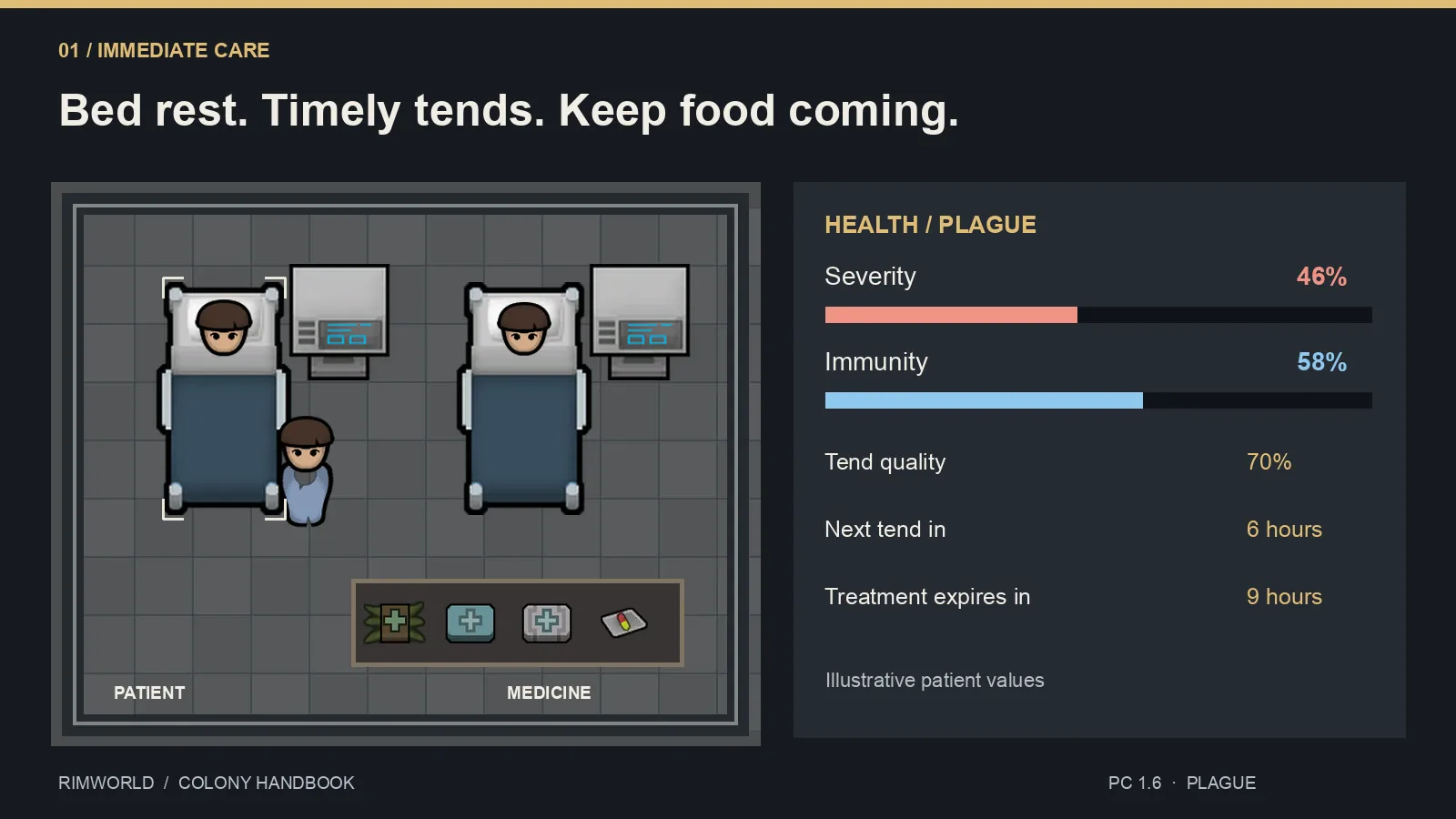
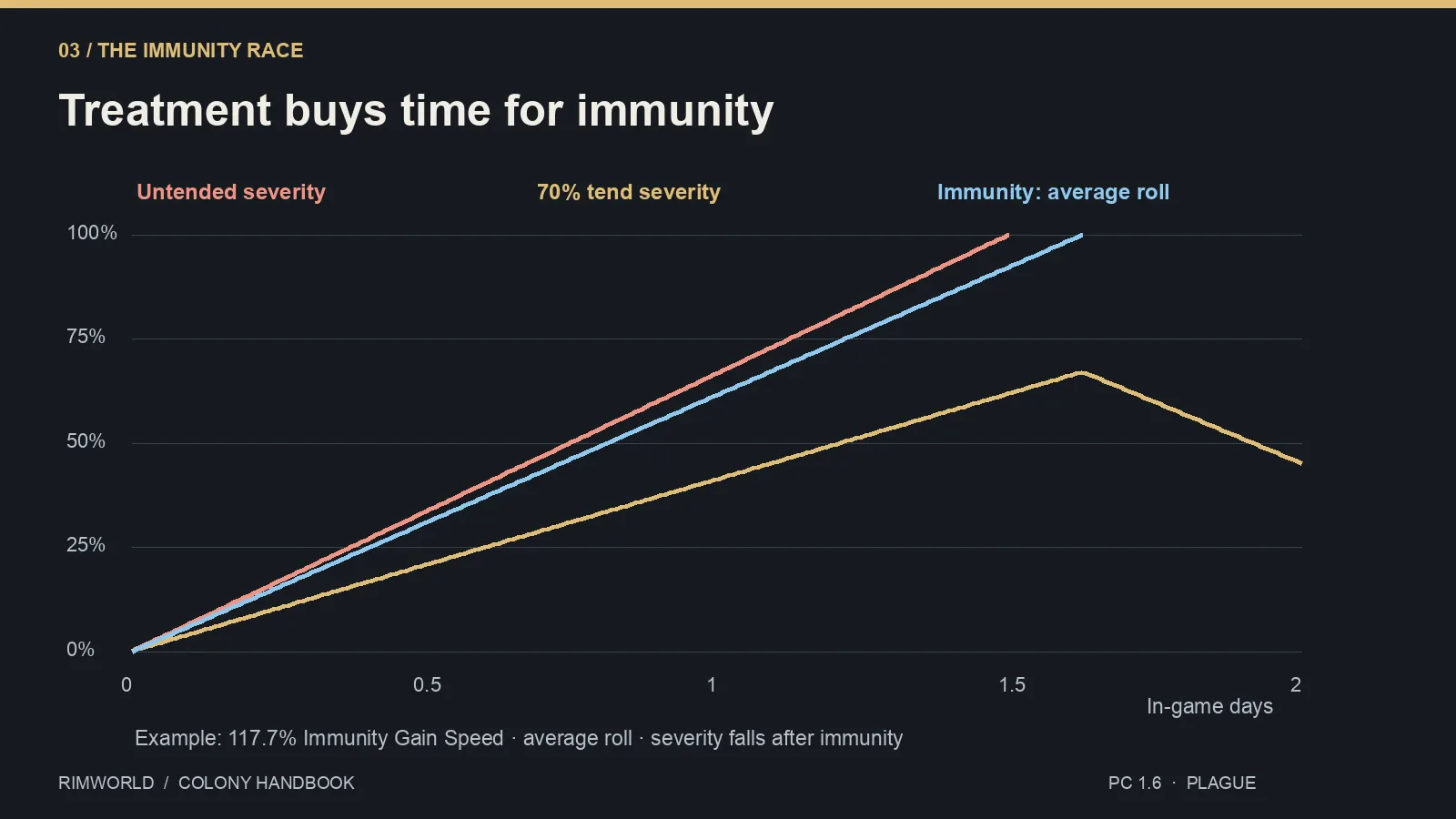
Put the patient on bed rest, get a doctor to tend them, and repeat when the Health tooltip allows it. Without treatment or immunity, plague reaches lethal severity in about 1.5 in-game days. You need 100% immunity before 100% severity.
PC 1.6.4871 · Vanilla Core; DLC options labeled · Updated September 29, 2026
Watch on Open.Video · English audio
What to do when the plague letter arrives
- Pause and inspect every affected pawn. Open Health and hover plague. Note severity, immunity, completed tend quality, and when the next tend becomes available. One patient's progress does not tell you how the others are doing.
- Prioritize Bed rest above ordinary work. Use an accessible medical bed, undraft the patient, and use Rest until healed when available. Rescue a downed pawn. A sleeping spot can be a stopgap; an ordinary bed is better. Do not delay the first tend while you build a hospital.
- Assign a capable doctor and check the care policy. Allow the medicine you want used, then make sure the doctor can reach both patient and supplies. Prioritize tending when it is available. A prompt tend without medicine is still useful.
- Keep food and rest coming. Feed anyone who cannot get up. Urgent hunger, starvation and exhaustion reduce immunity gain. Keep medicine close enough that a walk across the map does not burn the remaining treatment window.
- Recheck at the next-tend window. Look at actual tend quality after every treatment. Upgrade care when the margin is shrinking, and continue until immunity is complete. Watch anyone still downed during recovery.
No medicine or only one doctor?
Choose medical care that allows tending without medicine rather than no care. Tending uses a 30% potency substitute when no medicine is available, with a 70% quality cap; a good result is not guaranteed. If the patient is your only capable doctor, enable self-tend in their Health settings. Self-tending applies a 0.70 multiplier to base tend quality before the final random variation.
How long does plague take to kill?
Human plague normally starts at 0.1% severity and adds 66.6 percentage points per day while untreated and not immune. That gives a 1.5-day lethal timer. At 100% actual tend quality with uninterrupted coverage, severity still rises 30.32 points per day. Treatment buys time; even a very strong tend does not reverse plague before immunity.
| Actual tend quality | Severity gain per day | Lethal timer from 0.1% |
|---|---|---|
| Untended / 0% | 66.60 points | 1.50 days |
| 50% | 48.46 points | 2.06 days |
| 70% | 41.20 points | 2.42 days |
| 100% | 30.32 points | 3.29 days |
| 130% | 19.44 points | 5.14 days |
These are hypothetical lethal timers if immunity never arrives, not expected illness durations. Delaying the first tend or allowing coverage gaps shortens the available time.
Immunity is a separate clock
Base immunity gain is 52.24 points per day, multiplied by the patient's Immunity Gain Speed and a hidden case multiplier from 0.8 to 1.2. That multiplier is stable for that disease instance; it does not reroll every day. At a final displayed speed of 100%, an average case takes about 1.91 days to go from zero to full immunity. The slow-to-fast range is about 2.39 to 1.60 days.
A healthy, well-fed, rested human without extra modifiers, resting in an ordinary bed, has a typical final speed of 117.7%: 1.07 for the bed and 1.10 for resting. Average time from zero immunity is then about 1.63 days, with a hidden-roll range of about 2.03 to 1.36 days. Do not multiply bed and rest bonuses again if you have already copied the final pawn stat.
What happens at 100% immunity?
Plague starts receding instead of advancing. Its base severity falls by 33.3 percentage points per day; any existing tend continues to reduce severity until that treatment expires. The condition disappears when severity reaches zero. At 50% severity with no remaining tend, this would take about another 1.50 days.
Immunity does not instantly restore consciousness or remove pain. Keep caring for a downed patient, especially if other illnesses or injuries are present. Plague's lethal threshold is still 100% severity. Rounded displays do not give you a safe 101% grace period.
The first re-tend window is about 12 hours, not 15
A fresh human-plague tend starts with about 15 hours of coverage. Re-tending is allowed during its final three hours, so the first opportunity opens about 12 hours after treatment. The Health tooltip separates Next tend in from Treatment expires in.
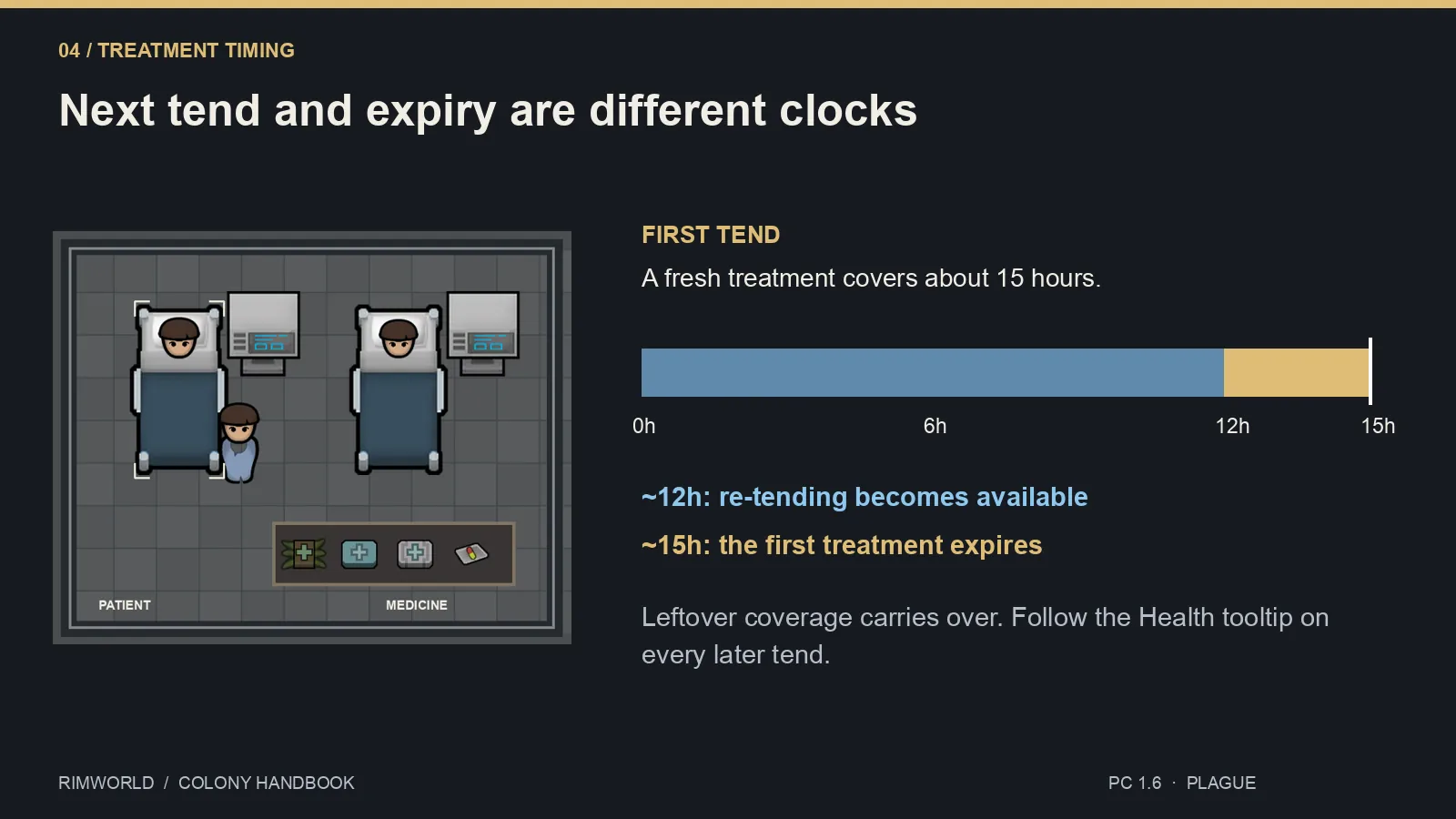
Remaining coverage is added to the new tend. If you re-tend with almost three hours left, the new timer can be nearly 18 hours, with the next window about 15 hours away. Quality is replaced by the new tend's quality. It is not a second independent treatment stacked on top.
A weak tend does not grant an immediate retry. If the option is unavailable, read the timer before looking for another doctor. Upgrade the medicine policy in advance so the next legal tend uses the intended supplies.
Will your patient reach immunity in time?
Use the current Health values and Immunity Gain Speed from the pawn's info panel while resting in the intended bed. Enter completed tend quality, not medicine potency. The treatment-gap field models a total amount of future time without an active tend, all before immunity.
Human plague only. This estimate holds speed and quality constant, shows three possible hidden multipliers, and does not predict future tend rolls, changing needs, injuries or other causes of death. It cannot reveal your actual case roll. Rounded game values make a tiny margin unreliable. An existing stronger tend remains stronger until replaced; choose a future quality your planned medicine can support.
Which medicine is enough for plague?
Herbal medicine can be enough when a patient's immunity is keeping ahead. It is not a universal safe minimum. Old age, damaged kidneys or liver, late treatment and a slow hidden roll can make the same care fail on another pawn.

Herbal medicine
60% potency
70% tend-quality cap
Useful when prompt care gives a comfortable margin.

Industrial medicine
100% potency
100% tend-quality cap
A higher ceiling when the race is close.

Glitterworld medicine
160% potency
130% tend-quality cap
The highest of these caps, without a guaranteed result.
Doctor Medical Tend Quality is multiplied by medicine potency, the current bed's tend offset is added, and self-tending applies its penalty. The base result is capped. The disease's completed tend then rolls ±25 percentage points, clamped between zero and the medicine's cap. Even a base result already at the cap can roll lower.
Why “15% treatment is enough” can mislead you
For a case starting near zero with a final Immunity Gain Speed of 117.7%, steady treatment of roughly 14% barely balances an average hidden roll; the slow 0.8 case needs roughly 48%. If the final pawn stat is only 100%, those rough break-even qualities become 40% and 68%. These are mathematical boundaries, not recommended targets. Late tends, variable quality and hunger can erase the margin.
If the patient is already sick, calculate from their current severity and immunity. A fixed minimum cannot tell you whether a colonist at 85% severity can still catch up.
Why a treated colonist can still lose
- Leaving bed: keeping a bed nearby is not enough. Resting and the bed's factor must actually apply. Drafting, work and travel can interrupt care.
- Hunger and fatigue: urgent hunger applies a 0.9 factor and starvation 0.7. Tired, very tired and exhausted states apply 0.96, 0.92 and 0.8. Arrange feeding instead of watching only the disease row.
- Age: for a standard human life expectancy of 80, the age factor starts falling beyond biological age 52. It reaches 0.95 at 64, 0.90 at 80, and 0.80 at 96. Species or gene changes can alter the context.
- Blood Filtration: damaged filtering organs reduce immunity gain. Its factor blends at half weight: 50% Blood Filtration produces a 0.75 immunity factor from that capacity alone, before the other modifiers. Read the final stat for the whole patient.
- A slow case or a missed tend: the hidden immunity multiplier can be as low as 0.8, while every untreated hour restores the full severity rate. A tidy hospital layout does not cancel either risk.
Bed type helps; fancy quality does not replace it
| Resting place | Bed immunity factor | Example final speed while resting* |
|---|---|---|
| Sleeping spot | 1.00× | 110.0% |
| Bedroll | 1.05× | 115.5% |
| Ordinary bed | 1.07× | 117.7% |
| Hospital bed | 1.11× | 122.1% |
| Hospital bed + linked vitals monitor | 1.13× | 124.3% |
*Healthy, rested, well-fed baseline human with no age penalty or other modifiers, including the separate 1.10 resting factor.
A hospital bed also adds 10 percentage points to base tend quality. A powered, directly adjacent vitals monitor adds 7 more and adds 0.02 to the bed's immunity factor. Only one monitor benefits each hospital bed; normal beds do not receive these monitor bonuses. Tend quality still cannot exceed the medicine cap. See hospital placement and setup.
Bed quality does not improve its immunity factor. Cleanliness does not directly accelerate plague immunity or add to plague tend quality; it matters for other systems such as wound infection risk and surgery. Keep the room clean, but do not treat a sterile floor as an emergency immunity boost.
Recognize the dangerous stages
| Severity | Stage | Pain added | Consciousness / manipulation |
|---|---|---|---|
| Below 60% | Minor | 20 points | −5 / −5 points |
| 60–<80% | Major | 35 points | −20 / −20 points |
| 80–<90% | Extreme | 60 points | −30 / −30 points |
| 90–<100% | Extreme, life-threatening | 85 points | −30 / −30; breathing −15 |
These are plague's own offsets. Other conditions still stack. Pain can down a colonist before plague reaches its lethal threshold; do not wait for 100% severity to act. Read more about consciousness and overlapping health penalties.
Why nobody is tending the patient
| What you see | What to check |
|---|---|
| Tend is unavailable | Read Next tend in. Active treatment can block a retry even when its quality is poor. |
| The doctor keeps working elsewhere | Enable and prioritize Doctor work; undraft them. Check that they are capable of caring and can reach the patient. |
| Medicine stays in storage | Check the patient's care policy, forbidden stacks, allowed areas, doors, and reachable stock. |
| The patient leaves bed | Raise Bed rest above other work. Check bed accessibility and ownership, draft status, hunger and mental breaks. |
| The only doctor is sick | Enable self-tend if they can still act. Arrange another doctor when possible; self-tend quality is penalized. |
| Animals are skipped | Check animal medical care, reachable animal sleeping spaces, and the animal's own treatment timer. |
If a doctor is tending another urgent injury, plague may still have to wait. Pause to inspect both patients instead of assuming a work-priority number guarantees instant attention.
When bed rest and better medicine are not enough
Start with the changes that can help in time: uninterrupted rest, feeding, a faster bed, and the best practical tend at the next legal opportunity. If the projected race is still lost, check what is already available. Building an advanced rescue system from scratch is unlikely to beat a nearly full severity bar.
| Option | What it does | Important limit |
|---|---|---|
| Cryptosleep casket · Core | Suspends the patient, pausing disease progression and immunity gain. | Buys time to arrange a rescue. It does not cure plague. Get the patient inside before death. |
| Healer mech serum · Core | Can remove plague by curing the selected worst health condition. | One use fixes one condition. Another condition may take priority; do not promise automatic plague selection. |
| Luciferium · Core | Raises Blood Filtration, which can increase immunity gain. | Does not purge plague. Creates a permanent need; consider only with a sustainable supply and enough time to benefit. |
| Medic cycle · Ideology | Suspends the occupant; on completion cures one random eligible disease, including plague. Base cycle: 6 days. | Several eligible diseases mean plague is not guaranteed. Requires a ready, usable pod and sustained operation; check the cycle dialog. |
| Preach health / immunity drive · Ideology | The moral guide's Preach health adds 0.25 to Immunity Gain Speed; medical specialist Immunity drive applies a 2× factor. | Requires the appropriate role, ability availability and target. Use the updated final pawn stat in the calculator. |
| Immunoenhancer · Royalty | Each installed enhancer adds 0.08 to Immunity Gain Speed before later modifiers. | Needs an appropriate kidney and surgery. It is not an instant rescue item. |
| Detoxifier kidney · Biotech | Replaces a kidney with a 110%-efficient part, potentially improving Blood Filtration. | The improvement depends on existing organs. Check the final stat instead of applying a universal flat bonus. |
The biosculpter medic cycle is the disease option; do not substitute a bioregeneration cycle. See biosculpter use and luciferium supply and consequences before committing.
Amputation does not remove plague. It is a whole-body disease. Surgery may help an underlying organ problem, but the time, anesthesia and operation risks make it a poor automatic response to an already critical patient.
Penoxycyline prevents the next plague
 A scheduled dose every five days maintains protection if supplies and access hold. Each dose lasts about 5.56 days. It blocks new human plague, malaria and sleeping sickness, including cases the storyteller would otherwise assign.
Penoxycyline does nothing for an infection already present, even if it is still hidden. It does not prevent flu, wound infection or animal plague. Craft one dose from two neutroamine at a Drug lab after researching Penoxycyline production. Ten protected colonists need ten doses, or twenty neutroamine, every five-day round.
Does plague spread through the hospital?
Not by contact in vanilla. A disease event can affect several eligible pawns at once; sharing a room does not transmit plague from one patient to another. Quarantine does not stop that event. Mods that add contagion can change this.
Biome and storyteller settings influence disease events. Biome disease frequencies describe disease events overall, not a guaranteed plague schedule. Recovery also does not grant permanent protection: immunity decays after the disease is gone. Keep prevention stocked where repeated outbreaks are a concern.
The Biotech perfect immunity gene also blocks acquisition of human plague. Installing it after infection is not a cure for the current case.
Plague, wound infection, flu and animal plague
| Condition | Untended severity | Base immunity gain | Severity with 100% tend | First re-tend / expiry |
|---|---|---|---|---|
| Human plague | 66.60 | 52.24 | 30.32 | ~12h / 15h |
| Wound infection | 84.00 | 64.41 | 31.00 | ~12h / 15h |
| Flu | 24.88 | 23.88 | 17.15 | ~12h / 15h |
| Animal plague | 66.60 | 60.92 | 24.06 | ~48h / 51h |
The different immunity rate and tend effect make the human calculator unsuitable for animals. Animal plague is still urgent: waiting two days for the first tend would be too late. The 48-hour interval concerns re-tending after that first treatment.
Wound infection belongs to a body part, so removing an infected limb can sometimes remove that condition. Plague cannot be amputated away. Sleeping sickness uses the same general immunity race over a much longer period. Gut worms and muscle parasites instead clear through accumulated tend quality; do not apply that rule to plague.
Quick answers
Can a colonist survive plague with herbal medicine?
Yes, if actual treatment and immunity gain leave enough margin. Herbal's 70% cap does not guarantee every tend will reach 70%. Check the patient, not just the medicine type.
Does medicine make immunity increase faster?
Ordinary tending slows severity. It does not directly increase immunity gain. Rest, the bed, capacities and other pawn modifiers affect that separate clock.
Why did a colonist die when a bar showed 100%?
Confirm which bar it was. Severity reaching 100% is lethal; full immunity reverses disease progression. Rounded displays and other health conditions can obscure a close finish.
Is a sickly pawn automatically slower to become immune?
Sickly increases disease susceptibility; the trait itself does not lower Immunity Gain Speed. Check the pawn's actual health modifiers.
Can console players use these exact numbers?
These values describe the stated PC build. Console versions and mods can differ; use the Health tooltip for your current patient.