RimWorld Sleeping Sickness: Treatment, Immunity & Recovery
RimWorld Sleeping Sickness: Treatment, Immunity & Recovery
Bed rest, food, and timely tends. Untreated sleeping sickness hits lethal severity in about 8.3 in-game days unless immunity reaches 100% first. Penoxycyline blocks the next case. It does not clear this one.
PC 1.6.4871 rev595 · Vanilla mechanics · DLC options labeled · Updated September 22, 2026
Watch on Open.Video · English audio
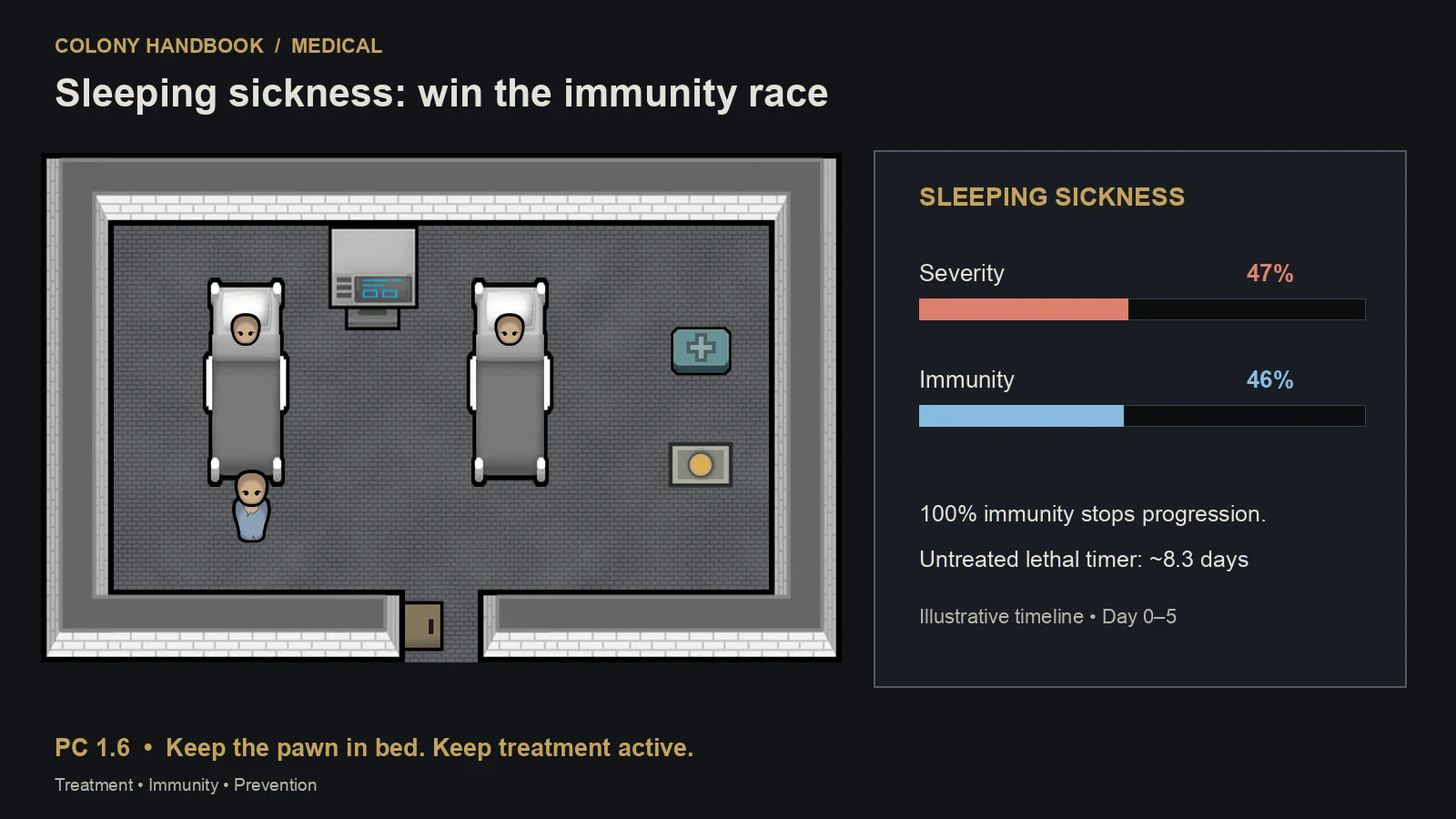
What to do when the disease letter arrives
- Open each affected pawn's Health tab. Hover sleeping sickness for severity, immunity, tend quality, and next treatment time. Patients do not all move at the same pace.
- Prioritize Bed rest. Put them in an accessible medical bed and raise Bed rest above ordinary work. A regular bed works until you have a hospital bed. Stop drafting them or sending them back to jobs.
- Tend with your best available doctor. Check medical-care settings, allowed areas, medicine stock, and the doctor's priorities. Step up medicine when the margin looks thin. A prompt tend with no medicine beats waiting on a shipment while severity climbs.
- Keep food and care coming. Feed patients who cannot get up. Urgent hunger and exhaustion slow immunity. One strong tend does not cover the whole illness.
- Return when the Health tooltip says treatment is available. Keep a tend active until full immunity. Recheck after a mental break, injury, missed meal, or bed change.
Why "every 32 hours" is only a shorthand
A fresh tend covers about 35 hours. Re-tending unlocks in the last three hours, so the first window sits near 32 hours after treatment. Later waits stretch because leftover coverage stacks. Follow "Next tend in" and "Treatment expires in" instead of a fixed alarm.
A weak last tend does not unlock an early re-tend. If the option is greyed out, check eligibility first, then access and work settings.
How long does sleeping sickness last?
Two clocks matter: time to full immunity, and time to clear leftover severity after that. Untreated, severity rises 12 percentage points per day. An active tend cuts up to 7 points per day at 100% quality. From the usual 0.1% start, the untreated lethal timer is about 8.325 days.
| Actual tend quality | Severity gain / day | Time to lethal severity |
|---|---|---|
| Untended / 0% | 12 points | 8.33 days |
| 50% | 8.5 points | 11.75 days |
| 70% | 7.1 points | 14.07 days |
| 100% | 5 points | 19.98 days |
| 130% | 2.9 points | 34.45 days |
Timers assume immunity never arrives. They are not how long a tended case usually lasts. Continuous treatment means no gaps and the stated quality on every tend.
Bed rest alone is a gamble
A healthy, well-fed, rested human age 52 or younger, normal Blood Filtration, no other modifiers, resting in an ordinary bed on an average hidden roll, gains about 11.77 percentage points of immunity per day. From zero that is about 8.50 days, a hair slower than the untreated lethal timer.
Each case also rolls a stable hidden immunity multiplier between 0.8 and 1.2. Same conditions, the range is about 7.08 to 10.62 days. Identical-looking patients can still diverge. Tending buys the margin bed rest alone may not give you.
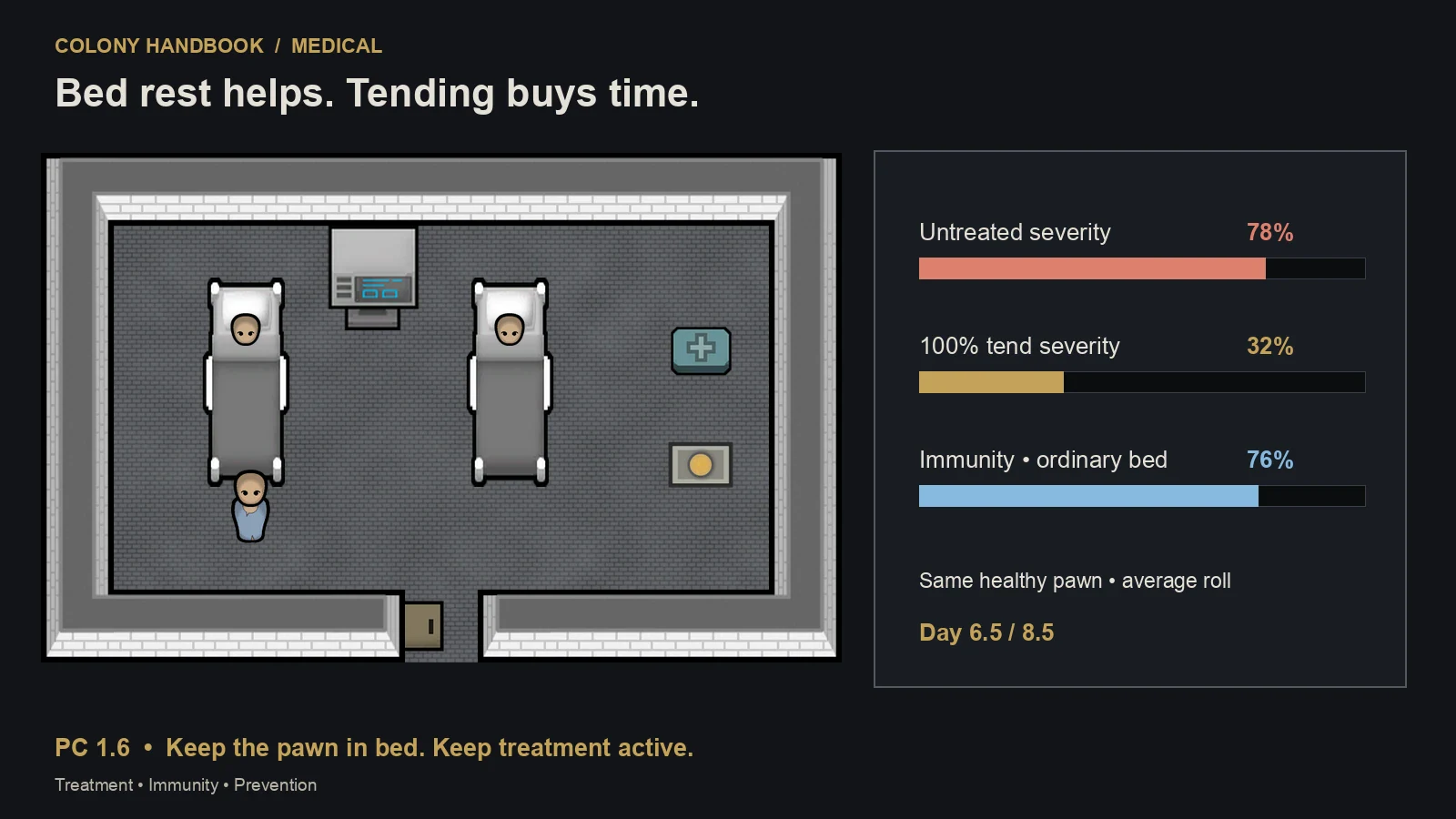
100% immunity does not instantly remove the illness
At full immunity, severity falls at a base 17.6 percentage points per day. Any tend still active keeps subtracting until it expires. Symptoms ease as severity drops through the stages; the condition leaves when severity hits zero.
At 50% severity with no leftover tend effect, clearing takes about 2.84 more days. Time to immunity is not total time sick. Keep feeding and protecting anyone still down.
Will your patient reach immunity in time?
Enter current values. Take Immunity Gain Speed from the pawn's info panel while they are in the bed you plan to use; that figure already folds in active modifiers. Use the quality on the disease's completed tend, not the medicine's potency rating.
The estimate freezes your inputs, assumes no treatment gaps, and shows the hidden roll range. It cannot forecast hunger, injuries, treatment rolls, or other deaths. Rounded in-game values make a thin margin unreliable. Zero quality means no effective treatment.
Pick care that widens the margin

Herbal medicine
60% potency; 70% tend-quality cap. Fine when the immunity margin already looks comfortable.

Industrial medicine
100% potency; 100% tend-quality cap. Step up here when ordinary care is cutting it close.

Glitterworld medicine
160% potency; 130% tend-quality cap. Save it for patients who need a harder severity brake.
Potency is not the final tend quality. Doctor skill, bed, self-tend penalty, and roll variance all matter. Glitterworld medicine does not guarantee 130%. With no medicine, potency is 30% and the quality cap is 70%.
Which bed helps most?
| Resting place | Bed factor | Approx. time to immunity |
|---|---|---|
| Sleeping spot | 1.00× | 9.09 days |
| Bedroll | 1.05× | 8.66 days |
| Ordinary bed | 1.07× | 8.50 days |
| Hospital bed | 1.11× | 8.19 days |
| Hospital bed + linked vitals monitor | 1.13× | 8.04 days |
These estimates also fold in the separate 1.1× resting multiplier. A hospital bed's average is not a free pass without treatment. A slow hidden roll still loses. Confirm the vitals monitor is linked and powered. Placement notes: hospital setup.
Why immunity may be too slow
- Leaving bed: ordinary work can strip both the bed bonus and the resting bonus. A pawn lying down is not always resting for immunity.
- Food and Rest: urgent hunger multiplies immunity gain by 0.9, starvation by 0.7. Tired, very tired, and exhausted states apply 0.96, 0.92, and 0.8 respectively.
- Biological age: the normal human age penalty begins beyond 52, gradually reaching 0.95× at 64, 0.90× at 80, 0.80× at 96, and 0.50× at 120. Chronological age is not the number to use.
- Blood Filtration: damaged or missing filtering organs slow immunity. Read the capacity and Immunity Gain Speed; one organ tooltip is not the whole picture.
- Missed tends: when coverage lapses, severity climbs at the untreated rate again. The race gets worse even if immunity is still rising.
Recognize the dangerous stages
Percentages below are from this disease alone. Other health conditions still stack. Vomiting intervals are averages, not a clock.
| Severity | Stage | Pain | Consciousness | Manipulation | Vomiting average |
|---|---|---|---|---|---|
| Below 43.75% | Minor | +2 points | −2 points | −2 points | None |
| 43.75-<62.5% | Minor | +3 | −4 | −4 | None |
| 62.5-<87.5% | Major | +5 | −15 | −6 | 3.5 days |
| 87.5-<93.75% | Extreme | +10 | −20 | −20 | 1.75 days |
| 93.75-<100% | Extreme | +15 | Capped at 10% | −20 | 1 day |
At the final stage the pawn barely functions. Stack another consciousness hit and you can lose them early. Raise care before you hit this band; do not wait for the last few percent.
Penoxycyline stops the next wave
Set a drug policy for one penoxycyline every five days on the colonists you want covered. Protection lasts about 5.56 days, so the five-day cadence leaves a small buffer. Keep stock on hand and make sure they can reach it.
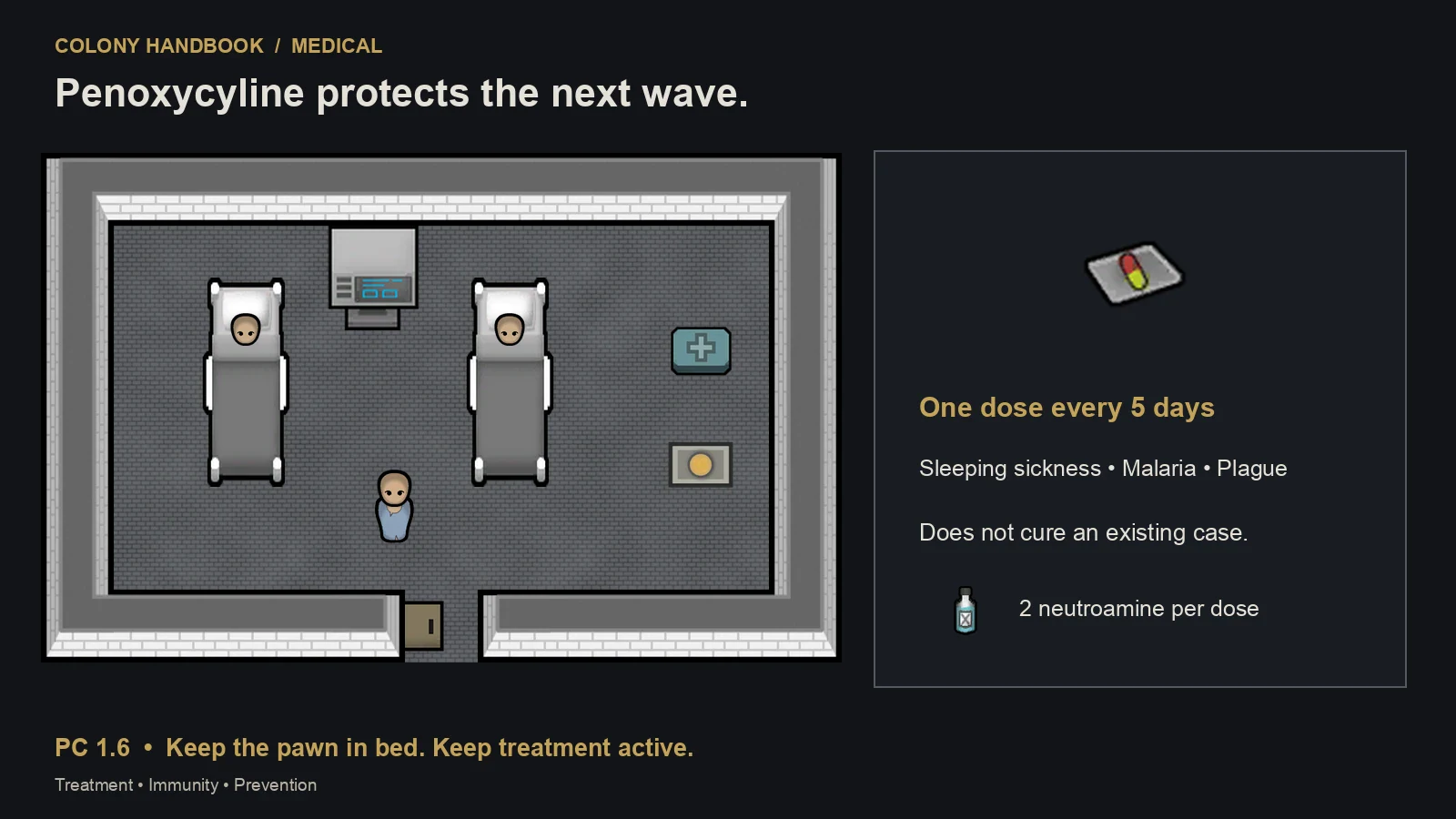
Craft it at a Drug lab after Penoxycyline production research. One dose needs two neutroamine. Ten colonists means ten doses every five days, twenty neutroamine per round.
It does not clear an existing case, including one you have not discovered yet. It also skips flu, wound infections, gut worms, and muscle parasites. Those last two clear on accumulated tend quality; sleeping sickness is an immunity race.
Where does sleeping sickness happen?
In Core, the natural storyteller event hits tropical rainforest and tropical swamp. Odyssey adds glowforest. A pawn can carry an active case into another biome. Mods, scenarios, and scripted effects can change where it shows up.
Sharing a hospital does not spread it by proximity. The human incident picks eligible colonists and prisoners; ordinary animal disease events do not give animals sleeping sickness.
Caravans do not roll disease more often. Their checks use four times the mean interval, so rolls are less frequent under the same settings. Travel still hurts care: a moving caravan is not a hospital bed.
Why did another wave happen?
Recovery does not immunize the whole colony. After a natural clear, that pawn's immunity falls two percentage points per day. At 60% or above it still blocks a new case of this disease: roughly twenty days of full protection after clearing, then a partial window. Everyone else can still catch it.
How it compares with flu, malaria, and plague
Sleeping sickness is slow, so the long case leaves more room for missed tends and interruptions. Plague forces a much faster response.
| Disease | Untended severity | Base immunity | Severity at 100% tend | Base re-tend interval |
|---|---|---|---|---|
| Sleeping sickness | 12 | 10 | 5 | 32 h |
| Flu | 24.88 | 23.88 | 17.15 | 12 h |
| Malaria | 37.02 | 31.45 | 13.82 | 12 h |
| Plague | 66.6 | 52.24 | 30.32 | 12 h |
Use the Health timer for real eligibility. These rates describe the diseases, not one pawn's final immunity speed.
When ordinary care is not enough
Raise the doctor, medicine, and bed as soon as the margin looks bad. Age or organ damage that tanks immunity gain can beat otherwise solid care. Skip emergency surgery for a tiny theoretical bump when the patient is already unstable.
- Cryptosleep casket (Core): parks the pawn in suspended animation while you arrange a fix. It buys time. It does not cure the illness by itself.
- Healer mech serum (Core): can remove a disease, but you do not pick the target freely. A higher-priority problem may eat the effect.
- Luciferium (Core): raises immunity gain and locks in a permanent dose dependency. It is not a routine stand-in for tending. Read the luciferium article before you commit.
- Biosculpter medic cycle (Ideology): can cure one eligible disease on completion, including sleeping sickness. If several eligible diseases are present, do not assume it picks this one. Need a usable, powered pod; see biosculpter care.
- Perfect immunity gene (Biotech): blocks new sleeping sickness. Implanting it does not instantly clear a case already running.
Quick answers
Can sleeping sickness kill a pawn who stays in bed?
Yes. Average healthy ordinary-bed immunity is about 8.50 days, slightly past the 8.33-day untreated lethal timer. A slow hidden roll widens the gap. Keep tending.
Does higher tend quality build immunity faster?
Not directly. It slows severity growth. Immunity growth comes from Immunity Gain Speed and the disease's hidden multiplier.
Why is the pawn still sick at 100% immunity?
Full immunity flips progression into recovery. Remaining severity still has to fall to zero.
Can a 100% tend cure it immediately?
No. Before full immunity, severity still rises five percentage points per day at 100% tend quality. Old-version tips about reversing the disease with an early tend do not apply here.
Should console players use these timers?
These figures are for the stated PC version. Console editions and mods can differ; check your version and the patient's Health tab.
Related reading & references
Build a hospital · Find neutroamine · Treat gut worms
RimWorld Wiki: Sleeping sickness, Immunity Gain Speed, Penoxycyline. This PC build uses a base immunity rate of 10 percentage points per day; older writeups may still say 11.