How to Survive Cold Snap in RimWorld | 1.6 Survival Toolkit
Cold Snap Survival Toolkit | Local 1.6.4633 rev1266 data checked
How To Survive A Cold Snap In RimWorld
When temperature suddenly crashes, you do not need a long lecture. You need a fast triage order, hard local numbers, and a way to tell whether your beds, power, clothes, and greenhouse will hold for the next few in-game days. This page is built around exact game data and tuned for urgent use.

Restrict Zones
Flip everybody to an Inside Only area that covers bedrooms, dining, freezer, workshop, greenhouse, and indoor pens. Stop outdoor hauling until the colony is warm again.
Heat Beds First
Push bedrooms to 21C before anything else. Small rooms stabilize quickly, and a single warm sleep cycle prevents mood collapse and buys time for everything after it.
Force Warm Gear
Put the best shell and head layer on outdoor pawns now. Parkas and tuques scale hard with textile quality, while recon and power armor are already cold-safe by raw insulation.
Seal Food And Power
Close freezer leaks, keep workshops out of the cold penalty band, and count stable winter watts before you commit to sun lamps or hydroponics.
Heater Math Assistant
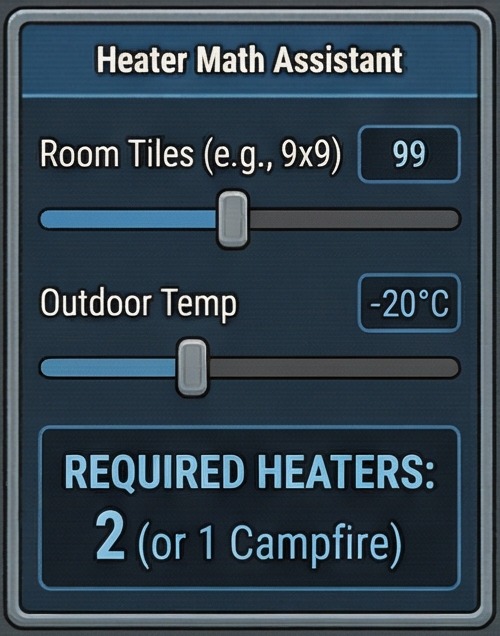
A 9x9 room at -20C targeting 21C usually wants 2 heaters if the shell is normal and traffic is moderate.
Local Defs backing this card: Heater draws 175W and pushes 21 heat energy per second. Campfire also pushes 21, caps at 28C, costs 20 wood to build, and stores 20 fuel.
Greenhouse Build Order
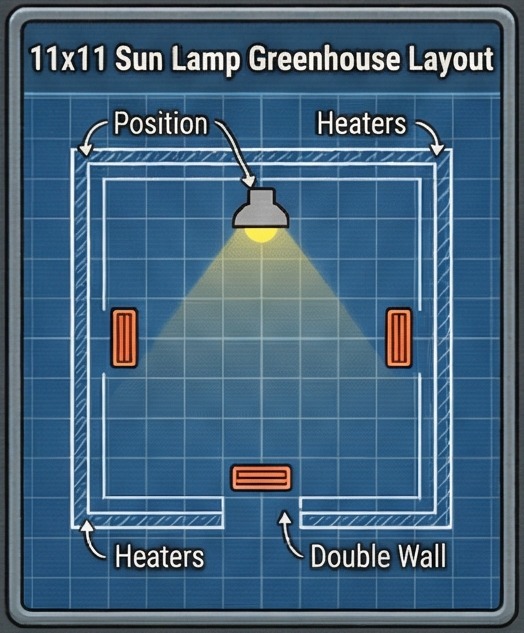
Fastest stable winter room: 11x11 soil greenhouse, one sun lamp, two heaters, double wall the outer shell, and put the airlock on the short side so growers do not keep venting all your heat.
11x11 cold-snap greenhouse

###########
# H.....H #
# ....... #
# ...S... #
# ....... #
# H.....H #
#### D D ##

H = heater
S = sun lamp
D = two-door airlock
| Room | Core draw | Cold snap note |
|---|---|---|
| Soil greenhouse | 2900W lamp + 350W for 2 heaters = 3250W | Best year-one recovery room if you already have stable power. |
| Hydro room, 24 basins | 2900W lamp + 1680W basins + 350W heaters = 4930W | Excellent yield, but only after the winter grid is actually secure. |
Local Defs: SunLamp consumes 2900W and glows at overlight radius 7. HydroponicsBasin consumes 70W and has fertility 2.8.
Apparel Warmth Calculator
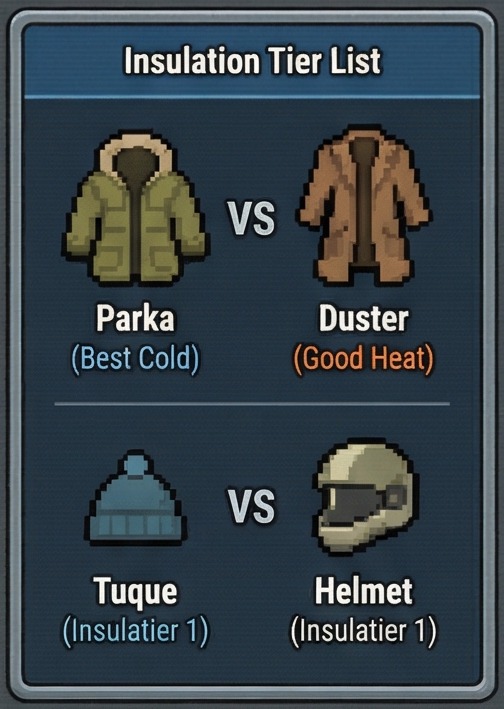
Approximate minimum comfortable temperature: -54C for a baseline human before extra body modifiers.
| Shell | Local cold stat | Use it when |
|---|---|---|
| Parka | Stuff power x 2.00 | Best raw cold shell in normal clothing tech. |
| Jacket | Stuff power x 0.80 | Fine for milder cold or early labor sets. |
| Duster | Stuff power x 0.60 | More heat-friendly. Not the right cold snap shell. |
| Recon / power armor | 64 / 68 fixed cold insulation | Already winter-safe by raw insulation, especially with helmets. |
Local apparel Defs and stats: Parka uses StuffEffectMultiplierInsulation_Cold 2.00, Duster uses 0.60, Jacket uses 0.80, and Tuque uses 0.50. Quality scaling for cold insulation follows the local apparel stat multipliers up to 1.8x at legendary.
Winter Power Budget
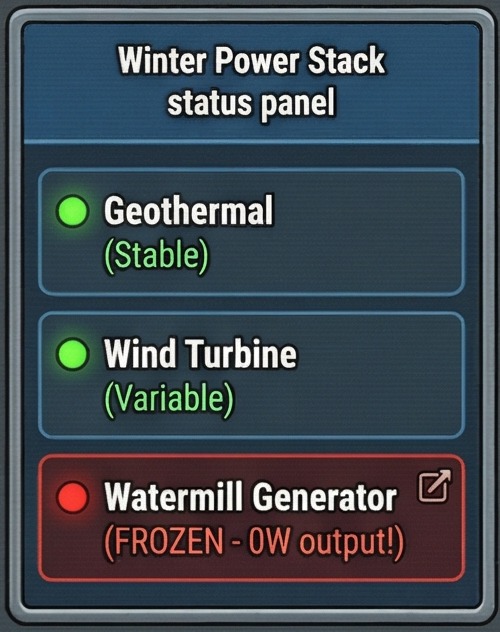
You can hold the cold snap without relying on swing power. Wind and solar become upside, not life support.
Local generator Defs: Geothermal 3600W, Watermill 1100W, Wind 2300W peak, Solar 1700W peak, Chemfuel generator 1000W, and Wood generator 1000W. Watermills are strong only if the river stays usable.
Airlock Heat Save
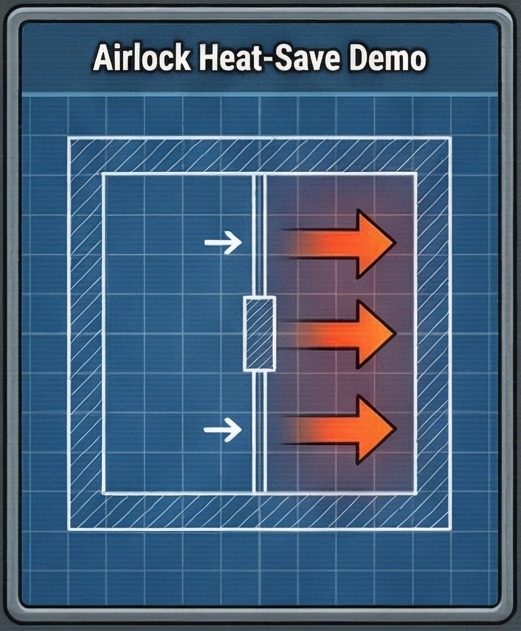
A two-door airlock is the cheapest permanent fix once the emergency is over. Put it on the dorm, greenhouse, and freezer before you start overbuilding heaters.
Best placement
Use the highest-traffic outside doors first. Dining room exits and freezer doors leak the most heat per day.
Do not vent the freezer
Vents are for warm rooms sharing heat. A freezer wants airtight walls and a dedicated cold side.
Heated spine
Run bedrooms and workshops off a warm interior hall so heat sources are concentrated instead of scattered.
Traffic still matters
Even with an airlock, hauling bursts can dump heat. Keep allowed areas tight until the snap ends.
Related reads: airlock guide and freezer troubleshooting.
Workshop Temperature Monitor
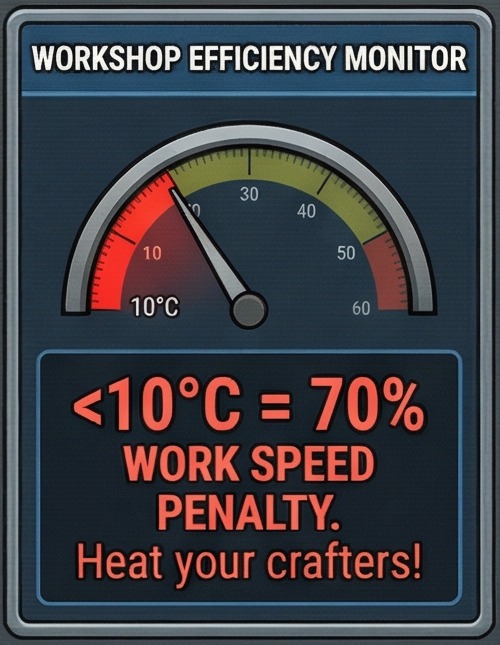
The local building stats wire work tables through StatPart_WorkTableTemperature. The practical player threshold is simple: do not let crafters work in a freezing room when you can spend one heater and buy the time back.
Local 1.6 Facts That Matter In Cold
| Thing | Local value | Why you care in a snap |
|---|---|---|
| ColdSnap | 1.5 to 3.5 day duration, 30 day min refire | You are stabilizing for a short disaster window, not a whole season. |
| Human | Base comfy range 16C to 26C | All clothing math starts from this baseline. |
| Campfire | 20 wood build, 10 fuel use, 20 fuel cap, +21 heat, 28C cap | Early-game rescue heat for tiny sealed rooms. |
| Heater | 50 steel, 1 component, 175W, +21 heat | The basic winter room control unit. |
| SunLamp | 2900W, overlight radius 7, +3 heat | One lamp can eat a small colony grid by itself. |
| HydroponicsBasin | 70W each, fertility 2.8 | Hydroponics is powerful, but winter-expensive. |
| Watermill | 1100W nominal output | Great on paper, dangerous if river reliability disappears in winter. |
| Geothermal | 3600W stable output | The gold standard for winter life support. |
| Parka / jacket / duster / tuque | 2.00 / 0.80 / 0.60 / 0.50 cold multipliers | Why parkas crush dusters in real cold. |
| Apparel quality | Cold insulation quality factor up to 1.8x at legendary | A masterwork parka is not a cosmetic upgrade. |
| Material | Local cold stat | Parka + tuque score |
|---|---|---|
| Cloth | 18 | 45 points |
| Devilstrand | 20 | 50 points |
| Hyperweave | 26 | 65 points |
| Muffalo wool | 28 | 70 points |
| Alpaca wool / heavy fur | 30 | 75 points |
| Megasloth wool / thrumbofur | 34 | 85 points |
Material values above come from the installed local textile Defs such as Cloth, Devilstrand, Hyperweave, WoolMuffalo, WoolAlpaca, WoolMegasloth, Leather_Heavy, and Leather_Thrumbo.
How many heaters should a 9x9 room use during a cold snap?
Start with the heater tool above, but the practical answer is usually 2 heaters for a 9x9 room at about -20C if you want 21C bedrooms or a warm common room. If the room is only a workshop targeting 12C to 16C, airtight, and low traffic, you can often get away with less.
Can a campfire actually save an early colony?
Yes, if the room is small and sealed. Local data shows campfires push the same raw heat value as a heater, but they cap at 28C and burn fuel. That makes them a rescue tool for starter bedrooms and dorm corners, not a good permanent grid plan.
What is the fastest clothing fix if pawns are already shivering?
Shell slot first, head slot second. A parka multiplies material cold insulation by 2.00, while a tuque adds another 0.50. That is why even a normal muffalo wool parka plus tuque outclasses the usual jacket or duster stopgaps.
Why does the colony feel power rich until I add a greenhouse?
Because winter agriculture is a power spike, not a background cost. One local sun lamp consumes 2900W, and hydroponics basins add 70W each. A full hydro ring under one lamp is a serious winter commitment before you even count heaters.