RimWorld Manipulation: What the Percent Changes
COLONIST HEALTH / WORK & BIONICS
RimWorld Manipulation:
what the percent changes
Better hands finish jobs sooner. Item quality still rolls off skill, Inspiration, and Ideology role bonuses. Manipulation stays out of that roll.
Manipulation is how well a pawn uses arms, hands and fingers. Work speed, some yields and a few combat stats lean on it. Healthy human baseline: 100%. Lose one arm and you sit at 50%. Two bionic arms land at 125% before consciousness and anything else piles on.
Unmodded PC 1.6.4871 · Core unless a DLC is named · Updated September 24, 2026
Watch on Open.Video · English audio
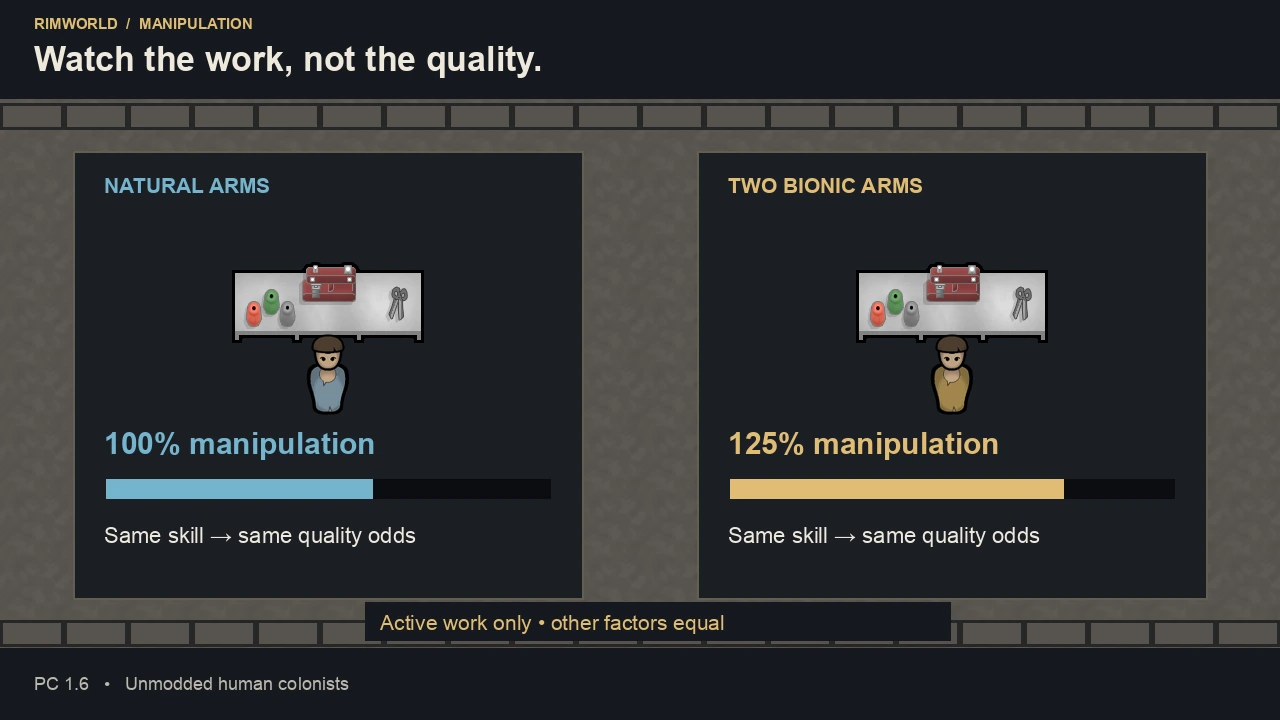
Work speed and item quality are different
Gave your crafter a second bionic arm and still see Normal or Good gear? That is expected. Manipulation does not raise Crafting skill. It is not an input on the normal item-quality roll either. Skill, randomness, Inspired Creativity when it fires, and an Ideology production-quality role bonus drive that roll.
General Labor Speed covers jobs like tailoring, smithing, sculpting and stonecutting. The manipulation factor scales straight: 100% → 125% means 25% more work in the same active work time, other factors equal. A continuous 100-second job drops to 80 seconds. Travel, hauling, eating and interruptions keep their own clocks.
Medical “quality” is a different word. Manipulation does feed Medical Tend Quality and Medical Surgery Success Chance. Those are doctor stats. Awful-to-Legendary labels on furniture and guns are a separate system. For gear tiers, see item quality.
Missing arms, prosthetics and bionics
Table below: human, 100% consciousness, remaining natural parts healthy, no other capacity modifiers. A wooden hand only works on an otherwise functional arm. It cannot replace a whole missing arm.
| One side | Effective side | Before rounding | Final capacity |
|---|---|---|---|
| Missing arm | 0% | 50% | 50% |
| Prosthetic arm | 50% | 75% | 75% |
| Wooden hand | 60% | 80% | 80% |
| Natural arm | 100% | 100% | 100% |
| Bionic arm | 125% | 112.5% | 112% |
| Archotech arm | 150% | 125% | 125% |
| Flesh tentacle · Anomaly | 120% | 110% | 110% |
Why 112%, not 112.5%? Arm average hits 112.5%, then this PC build rounds the final capacity to whole percentage points. Exact halfway values go to the nearest even integer: 112.5 → 112, and 137.5 → 138. Use 112.5% when you are checking the raw arm math; work stats consume the rounded figure.
137.5% before rounding
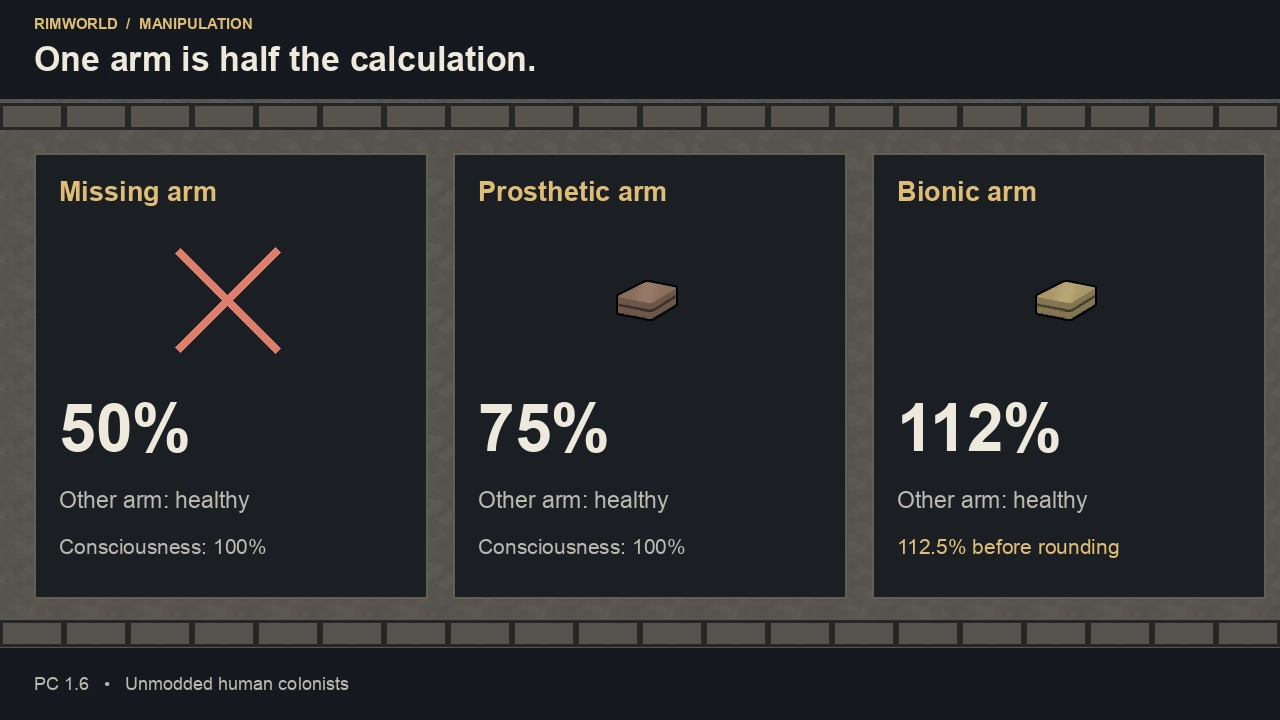
A bionic arm is a 125% efficiency replacement, not a flat “+10% manipulation” implant. Filling a stump moves you much farther than swapping a healthy arm. One natural arm still on the pawn: missing → bionic on the other side takes final capacity from 50% to 112%.
You can craft bionic arms in Core. Research Bionic replacements, then a fabrication bench with a Crafting 8 worker. Cost per arm: 15 plasteel and 4 advanced components. Installation is its own medical operation. Wiki detail: bionic arm acquisition.
Calculate your arm combination
Set each side’s effective replacement and the consciousness number from the Health tab.
Standard human limbs, healthy leftover parts. Skips finger-by-finger injuries, other diseases, genes, temporary effects, special consciousness caps and mods. Consciousness under 30% forces zero for an ordinary human. Being asleep is different from having too little consciousness to stay awake.
Each arm is calculated first
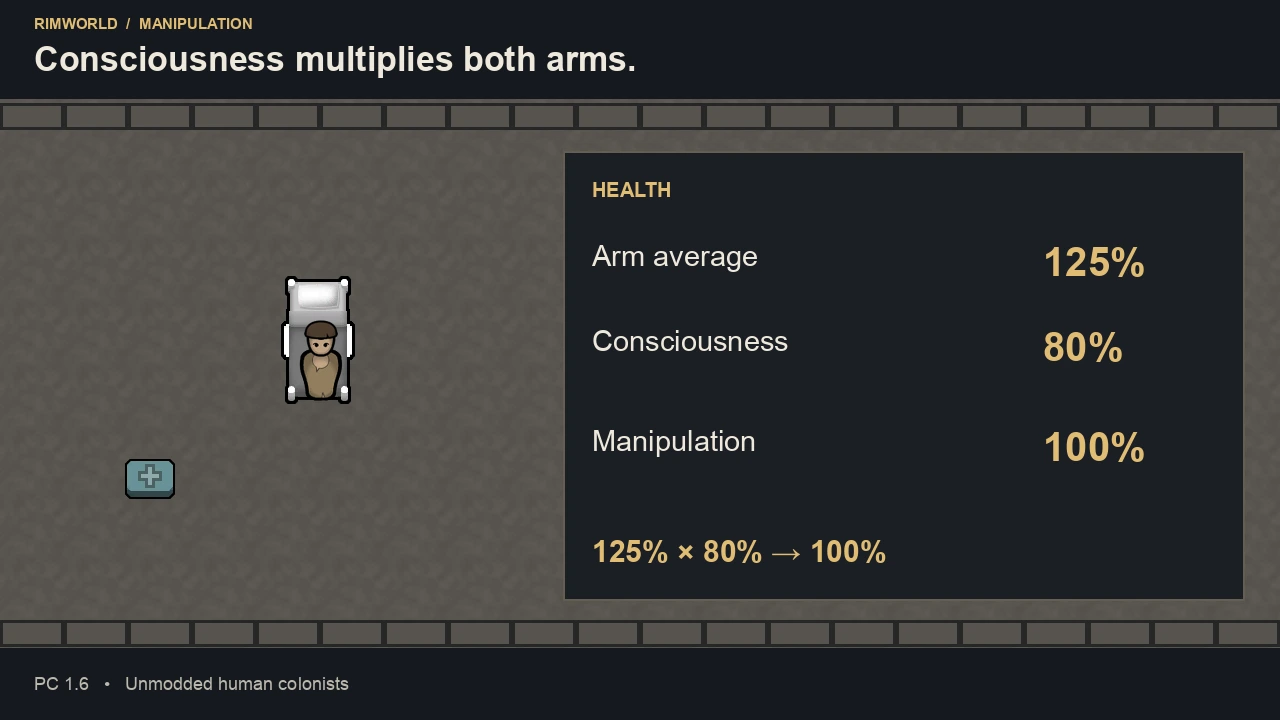
Ordinary human path: get an effective left side and an effective right side. Average them. Multiply by consciousness. Then capacity offsets and multipliers land, then caps, then rounding.
Arm average × Consciousness → add offsets → apply multipliers → apply caps → round
Two bionic arms average 125%. Drop consciousness to 80% and you get 100% manipulation before other modifiers. Sometimes fixing consciousness beats buying a pricier arm. More on that in how consciousness works.
Why damage on the same arm matters
Segments on one side multiply together. Hand, shoulder or arm-bone damage stays on that side until the two sides average. Do not average each matching bone pair across the body and then multiply those averages.
Quick efficiency check: two left-side segments at 50% each, everything else intact. Left contributes 0.5 × 0.5 = 0.25; right contributes 1. Combined: 62.5% before rounding, 62% at 100% consciousness. Cross-body averages multiplied instead would give 56.25%, which is the wrong path. These are efficiency inputs. Remaining hit points at 50% do not always mean 50% efficiency.
Fingers and replacement limbs
Fingers are 80% of an otherwise intact side. Lose all five on one natural hand and that side keeps 20%, so overall manipulation is 60% when the other side is healthy. One missing finger on an otherwise healthy human: 92% total. Those neat “8 points per finger” shortcuts break once other limb damage, replacements or consciousness modifiers show up.
A full bionic or archotech replacement does not take an extra hit for the natural fingers it replaced. Inside the replacement math, descendant parts count as fully efficient.
Offsets cannot invent hands from a zero base. Trauma savant with both arms gone is still zero. If the pawn cannot stay awake, that overrides the arm math too.
Which jobs benefit above 100%?
A capacity’s contribution can cap before the finished stat does. That gap decides who gets the next arm.
| Stat or job | Benefit above 100%? | What to expect |
|---|---|---|
| General labor, mining speed, construction speed | Yes | Manipulation scales the work-speed factor. Other modifiers still apply. |
| Shooting Accuracy | No direct gain | This capacity contribution stops at 100%. Restoring lost function helps; extra manipulation alone adds nothing beyond that threshold. |
| Melee Hit Chance | Up to 150% | Feeds an accuracy curve. You will not see a matching percentage bump in hit chance or damage. |
| Cooking Speed | Up to 150% | Feeds a curve with Cooking and Sight. The result is not simply equal to manipulation. |
| Research Speed | Up to 110% | Only a partial contribution; Intellectual and the research setup still matter. |
| Medical Tend Quality | Up to 140% | Manipulation input cap. Final treatment percent is a separate result. |
| Medical Surgery Success Chance | Yes | Raises the doctor stat; patient facilities, medicine and the operation still decide the outcome. |
| Construct Success Chance | Sometimes | Extra manipulation can cover deficits, but finished success cannot go above 100%. |
| Mining Yield | No direct gain | Manipulation's contribution stops at 100%, even though the stat itself maxes at 125%. |
| Butchery Efficiency | Yes, until capped | Manipulation has a 0.9 factor weight; the finished stat caps at 150%. |
| Carrying Capacity | Yes | Base 75 × manipulation × body size. Stack limits still shape a haul; caravan mass capacity is separate. |
Curve inputs are not multipliers
Shooting uses a manipulation offset scale of 8, melee hit chance uses 12, cooking speed uses 16. Those nudge a value before a stat-specific curve. They do not mean eight times the accuracy, twelve times the hits, or sixteen times the cook speed.
Injured shooter: fixing the arm can claw accuracy back. Healthy shooter: ordinary Shooting Accuracy already sat at the 100% contribution cap, so bionics bought only for that line are a weak spend. Sight can keep feeding that stat up to 200%, so glance at Sight, Shooting skill, weapon and target conditions too. Higher manipulation still helps that pawn on other jobs.
Full-time crafter or miner? The uncapped manipulation factor usually makes enhanced arms worth the bill. Researcher shopping for a second arm solely for research should read the 110% input cap first. Doctor shopping should open the whole surgery setup. 150% manipulation does not mean a 150% success chance.
Why is manipulation low or “incapable”?
- Open the Health tab. Read the Manipulation explanation and the listed injuries. A missing finger, a damaged hand and a missing arm are three different fixes.
- Check Consciousness. Pain often cuts consciousness, and that cuts manipulation. Some conditions hit consciousness directly. Healthy arms will not cancel a low multiplier.
- Scan for direct capacity modifiers. Frail and muscle parasites each subtract 30 percentage points from manipulation; bad back subtracts 10. Some of those also raise pain or hit other capacities, so the real total can be worse than that one line.
- Illness, withdrawal and temporary stages still apply after a new arm. Read the active stage, not just the condition name. Sleeping sickness is one example that changes over time.
- Genes and specialist parts (DLC) can add offsets, multiply the capacity, or buff one job while overall manipulation looks almost normal.
- If the number is already positive, blame the job settings next: work restrictions, disabled work types, priorities, reachability, skill gates and bill options.
Zero is the capability cutoff. At 50% a normal pawn still has the capacity. At zero, manipulation-dependent tasks disappear, and a normal equipped colonist on the map drops their primary weapon. Restoring a limb or clearing the disabling condition can bring the capacity back; it will not auto-clear unrelated work restrictions.
Crawling needs more than a percent. The pawn must be humanlike, awake, at least 8 biological years old, at 15% manipulation or higher, and free of crawl-blocking conditions. Clearing 15% alone does not guarantee a downed pawn can crawl.
Modifiers that are not arm damage
| Effect | Manipulation change | Scope |
|---|---|---|
| Trauma savant | +50 percentage points after consciousness; disables talking and hearing | Core |
| Elongated fingers | ×1.10 | Biotech |
| Trotter hands | ×0.85 | Biotech |
| Smooth tail | +5 percentage points before multipliers | Biotech |
| Flesh tentacle | 120% replacement efficiency; 110% total with one healthy natural arm | Anomaly |
| War trumpet | ×0.85 manipulation while affected | Odyssey |
| Thrumbo roar | ×0.80 manipulation and ×0.90 consciousness while affected | Odyssey |
Each row is one modifier entry. The Health tab total can stack more. Thrumbo roar’s two multipliers on an otherwise healthy human: 100% × 0.90 × 0.80 = 72%.
Trauma savant does not lock you at 150% manipulation. Two healthy natural arms at 80% consciousness plus the +50-point offset land at 130%. Longer writeup: trauma savant.
Drill arms, field hands and implanted weapons
Royalty: drill arms and field hands use normal replacement efficiency, not the 125% of a bionic arm. Specialist work gets separate stat offsets; each also has a −8-point Moving offset. You are trading specialist speed against a bionic arm’s broader gains. Relative to a healthy natural limb, that is not a direct manipulation penalty.
Core: a power claw sits at 100% replacement efficiency. Royalty: an elbow blade has no direct manipulation penalty in its definition. Compare the finished job stat you care about. Do not assume every combat implant cuts manipulation, or that every specialist part raises the general capacity. Part pages: field hand, flesh tentacle.
Who should get the next bionic arm?
Restore lost function first. A skilled worker missing an arm gains far more from one replacement than a fully healthy pawn gains from the same surgery. Also check whether low consciousness or an illness will keep sitting on the result.
After that, favor sustained work. A crafter glued to a bench turns extra manipulation into finished items. Miners and builders pick up real speed too. Someone who walks half the day may feel less of the percentage on the clock.
Match the upgrade to the bottleneck. Better Crafting skill is what improves item-quality odds. An injured shooter wants restored manipulation; a healthy shooter already hit the ordinary accuracy contribution cap. Doctors need a working hospital as much as working hands. A specialist farmer may want a field hand’s job bonus instead.
After the install, open that pawn’s actual stat explanation. Manipulation is one input. It does not replace every work speed, yield or success chance on its own.
Quick answers
Do bionic arms raise crafting skill or masterwork chance?
No. They improve manipulation and therefore relevant work speed. At the same skill and quality modifiers, the per-item quality roll is unchanged.
Does manipulation above 100% do anything?
Yes. It improves general labor and several other stats. Some contributions cap: ordinary Shooting Accuracy at 100%, Research Speed at 110%, and Melee Hit Chance at 150%.
What happens after losing one arm?
With the other side healthy, 100% consciousness and no other modifiers, a human has 50% manipulation.
Why can healthy arms still show low manipulation?
Consciousness, direct disease offsets, withdrawal, genes and temporary effects can all change the result. Check the capacity explanation on the Health tab.
Does pain lower manipulation directly?
Pain commonly lowers consciousness, which then lowers manipulation. A painful condition may also have a separate manipulation modifier; check both effects.