How to Survive Scarlands in RimWorld Odyssey
Secure one small shelter, plant on usable dirt, and count the food that will last until harvest. Keep your distance from scaria wildlife and unopened ruins. The city can wait.
PC 1.6.4871 rev590 · Odyssey required · Biotech options labeled
Watch on Open.Video · English audio
Your first 48 hours
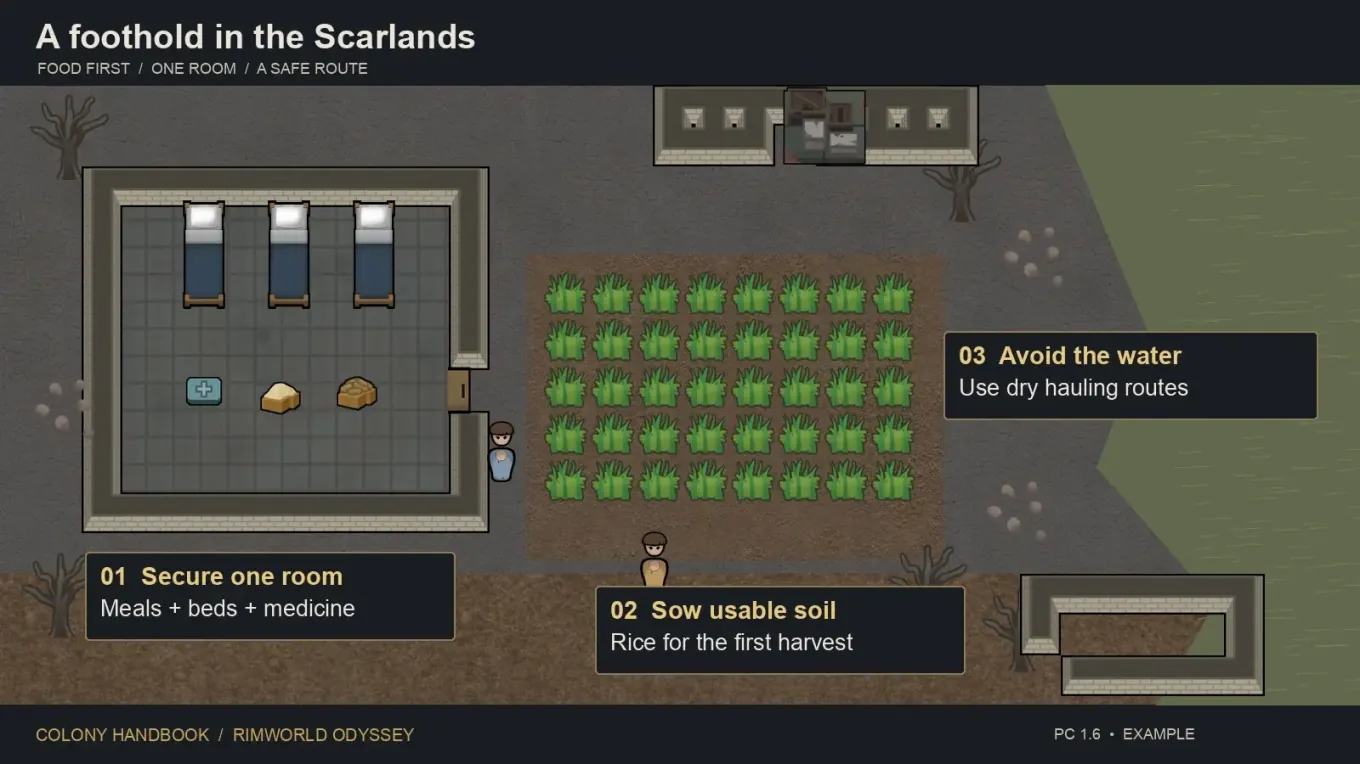
- Pause and inspect the landing area. Locate food, usable soil, visible enemies and a small building you can reach safely. Check fertility and pollution on the actual cells. A good world tile still may not give you a usable field next to shelter.
- Secure a room you can defend. Claim usable perimeter doors, patch breaches, and confirm the roof covers sleeping spots and stored food. Keep a short escape route. An unexplored back room means the ruin is not cleared yet.
- Restrict ordinary work to the safe area. Keep hauling, plant cutting, animals and children out of unexplored blocks. Forbidding an item only stops interaction with that item; it does not make the surrounding route safe.
- Sow immediately if the season allows. Rice on clean soil brings the first harvest sooner. On gravel, weigh earlier rice against better sustained potato output. You still need food during the wait.
- Count food in days, then make an exit plan. Use brought supplies, safe harvests, trade, or carefully selected healthy game. Leave before hunger forces a fight with a trapped room or an infected animal.
Do not assign the whole ruined city as a home area. That invites long cleaning and firefighting trips, stretches your perimeter, and burns labor that should go to food. Claim the structures you intend to use; repair and expand after the first harvest.
Naked Brutality and tribal starts
A lone pawn has no backup for a downing, food poisoning, or a missed treatment. Reachable food and shelter beat loot. A small rice patch is a start, not a self-sufficient food supply. Tribal colonies have more mouths and cannot assume quick hydroponics or EMP access. If the first harvest cannot bridge the food gap, relocate while your pawns can still travel.
Food is the first real deadline
Scarlands has fewer wild plants and animals than a temperate forest. Berry bushes and trees can exist, but they are too sparse to build a food plan around. The biome has no fish population, so a visible river is not a fishing fallback. Caravan forageability is only 0.25×; inspect the caravan's food estimate before departure.
- Protect the food you brought. Store it under a roof, away from animals and hazards. Use perishable food before survival meals or pemmican; roofed storage alone does not refrigerate it.
- Harvest safe, mature edible plants. Check the yield and path first. Walking past a hostile trap for a few berries is a bad exchange.
- Trade while you still have a reserve. Visitors are not scheduled food deliveries. For a caravan, budget the entire journey and a margin.
- Hunt selectively. Inspect Health for scaria, prefer manageable healthy animals, and use range with a retreat behind a door. Do not count a scaria corpse as guaranteed meat: it may rot immediately.
Cannibalism is an emergency choice with ideology, mood and relationship costs. It is not a default first-week instruction. Livestock also consume resources; starting a ranch does not fix tonight's hunger.
Rice or potatoes? Ask when you need to eat
| Crop / ground | Minimum fertility | First harvest | Base yield | Best use |
|---|---|---|---|---|
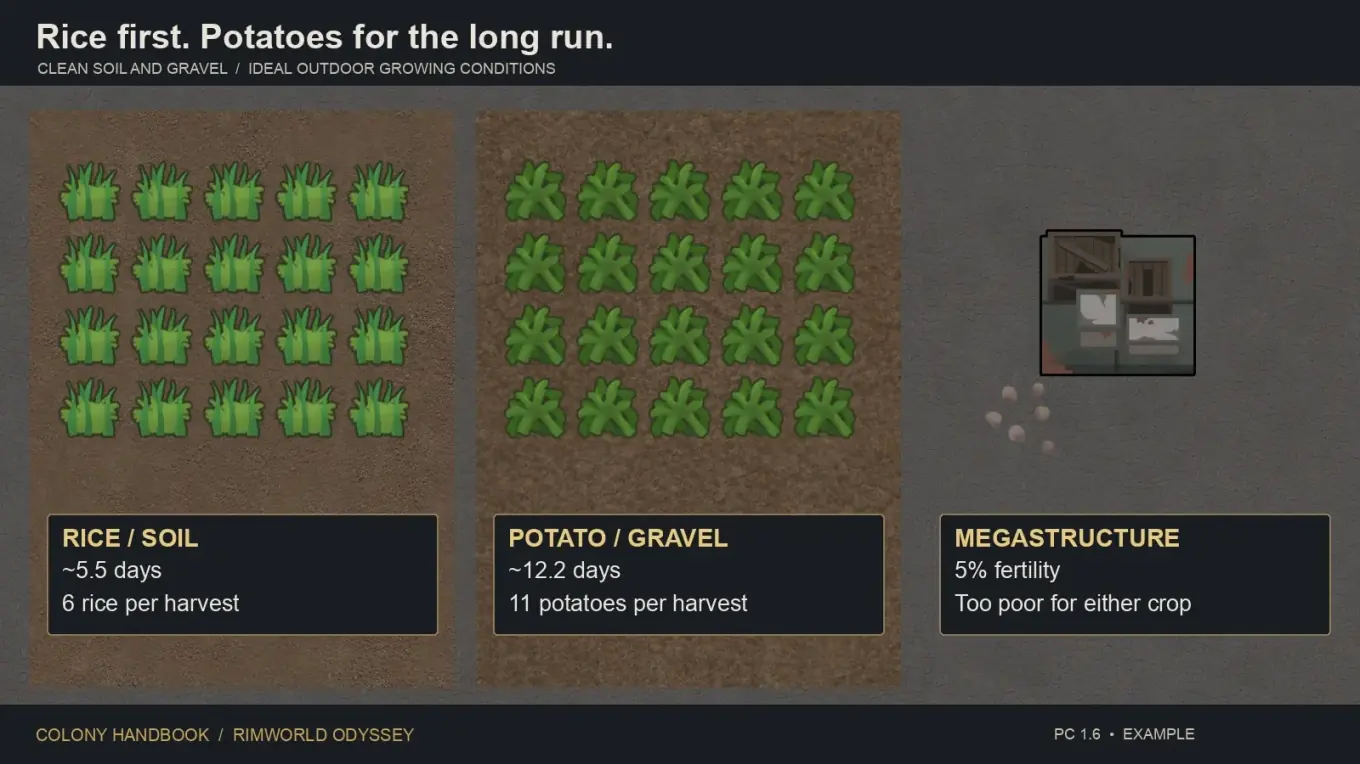
| Rice / 100% soil | 70% | ~5.5 days | 6 | First food on clean soil |
| Rice / 70% gravel | 70% | ~7.9 days | 6 | Earlier food on gravel |
| Potatoes / 100% soil | 70% | ~10.7 days | 11 | Fewer planting cycles |
| Potatoes / 70% gravel | 70% | ~12.2 days | 11 | Better long-run gravel output |
| Toxipotatoes / polluted ground | 50% | ~9.0 days | 7 | Biotech: polluted fields only |
These estimates assume full growth light during the active part of the day, suitable temperature, no sowing delay and no interruptions. Actual harvests can take longer. Yield assumes 100% harvest yield and crop-yield settings.
Potatoes tolerate poor soil; they do not ignore it. Their fertility sensitivity is 40%, compared with rice's 100%. At 70% fertility, potato growth runs at 88% of its soil rate. Rice runs at 70%. Rice still ripens first; potatoes supply more food per tile per day over repeated harvests on gravel.
Toxipotatoes have zero fertility sensitivity, but still require at least 50% fertility and polluted ground. Pollution does not turn paving into farmland. Cook toxipotatoes or use nutrient paste instead of relying on raw consumption.
Can you remove the floor and plant underneath?
Inspect the terrain first. A removable constructed floor may expose usable ground. Ancient megastructure has only 5% fertility and is terrain in its own right; removing the city does not guarantee a perfect farm. Find existing soil before committing your food reserve. The normal Scarlands fertility mapping uses ancient megastructure and ordinary soil, so do not choose the biome expecting natural rich-soil patches.
Hydroponics comes after the bridge to your first harvest
Powered basins and a sun lamp can grow food where outdoor ground fails. They need research, materials, reliable electricity and temperature control. Rice makes good use of basin fertility. Keep reserve meals for outages, and read the hydroponics setup before spending your last components.
Will your food last until harvest?
Compare your reserve with the crop clock. This planner uses your colony's total daily food demand, so adjust it for children, genes, animals and unusual pawns.
Changing people resets demand to 1.6 nutrition per person per day; you can then override it. Simple meals use 0.5 ingredient nutrition to produce 0.9 meal nutrition. Tile estimates include a 25% planning margin and assume normal crop yield; they exclude cooking waste, replanting delays, blight, spoilage and interruptions. They are a starting budget, not a survival guarantee.
Opening a door can be enough to trigger a trap
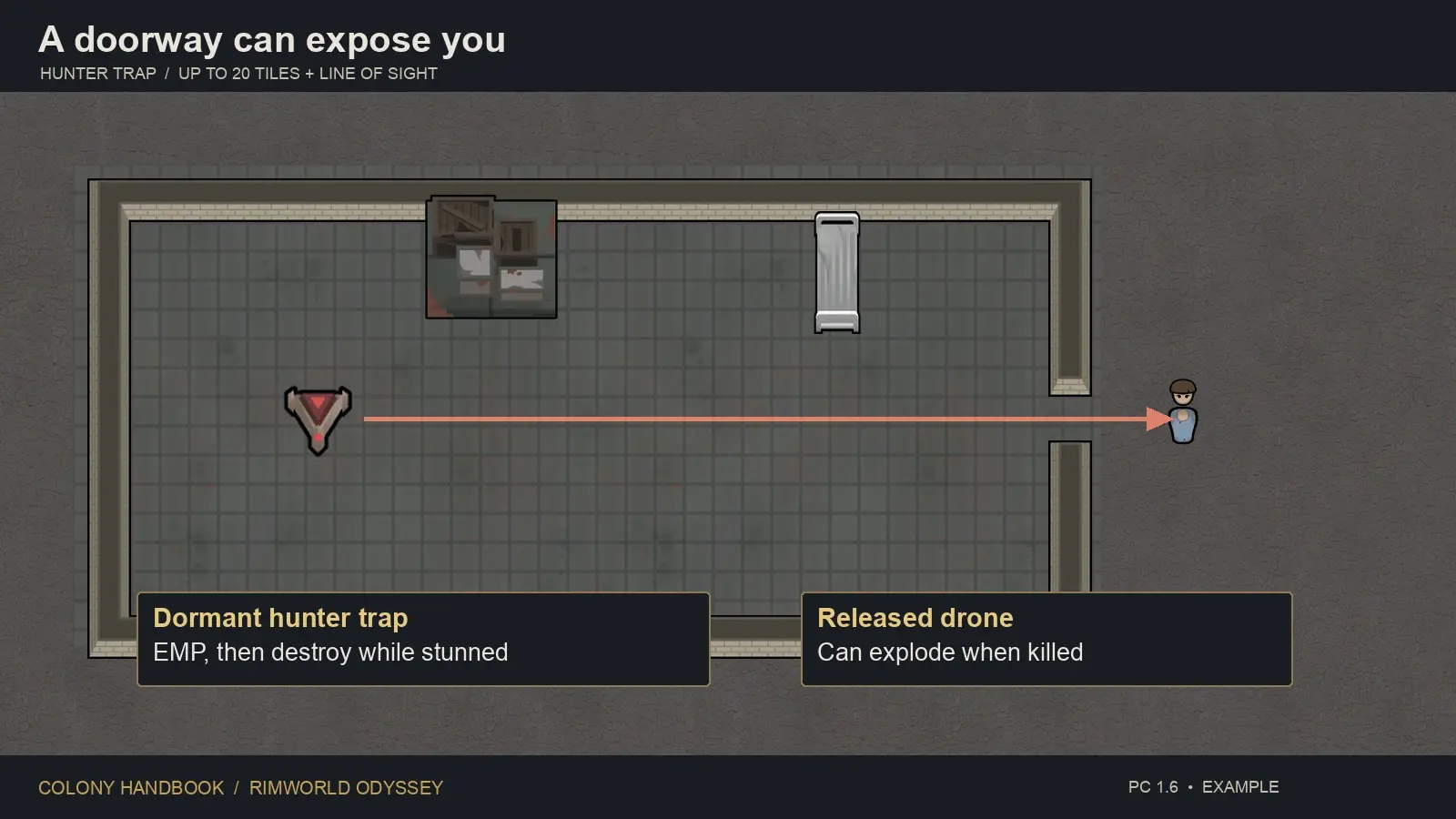
A hunter trap can detect a hostile pawn within 20 tiles and line of sight. You do not have to step on it. Opening a door may create that sight line immediately. Peeking first is a poor default for an unarmored survivor.
- Leave sealed, suspicious rooms alone until food, armor and an escape route are established.
- Approach a known trap from cover with an EMP plan and ranged support. Keep bystanders away from the route.
- An inactive hunter trap can be EMP-stunned and destroyed while the stun lasts. Destroying an unstunned trap can release the drone.
- A released hunter drone is a separate explosive threat. It can explode when killed, even when stunned. Do not finish it beside your colonists.
Forbid risky salvage and use allowed areas to keep workers out. The trap itself is not claimable. Dormant mechanoids and other drone types need their own combat plan; clearing one trap does not clear the building.
Make salvage pay for the colony
Prioritize loose supplies in cleared rooms, then inspect each structure's actual deconstruction yield. Ruined furniture and scenery do not all repay their apparent size in components. Use recoverable steel and slag when you have the labor and smelting setup; see component sources. Do not dismantle your cover or remove roof supports casually. A collapsed roof can turn a resource job into a rescue.
Scaria: avoid the wound, then watch the infection
Each eligible wild-animal spawn has a 50% scaria chance in Scarlands. That does not mean exactly half of today's wildlife is infected. Check individual animals. Infected animals cannot be tamed and are more likely to turn manhunter when attacked; scaria can keep that manhunter state going instead of letting it expire normally.
A scaria infection can be tended while the pawn builds immunity, like an ordinary wound infection. Full scaria is a different problem: humans become berserk, and the cure is a special operation. Disarm an at-risk pawn before control is lost, if you can do so safely.
The cure requires a downed patient, Medical 8, and three industrial medicines or better. Herbal medicine does not satisfy this operation. Success is not automatic. The five-day lethal timer runs with the scaria-driven permanent manhunter or berserk state; it is not a five-day countdown from every wild animal's spawn or from the original bite. Act urgently rather than waiting for the pawn to calm down. An Ideology biosculpter medic cycle is another eligible cure when you can use one.
Ranged hunting helps avoid infectious wounds, but it is not invulnerability. A fast animal can close the gap. Keep a reachable door and backup shooter, and avoid hunting explosives such as boomalopes near crops or the base. Fresh healthy meat is a more reliable food plan than gambling on an infected corpse.
Roof, route, or clean? Match the fix to the hazard
| Hazard | What to do | What does not solve it |
|---|---|---|
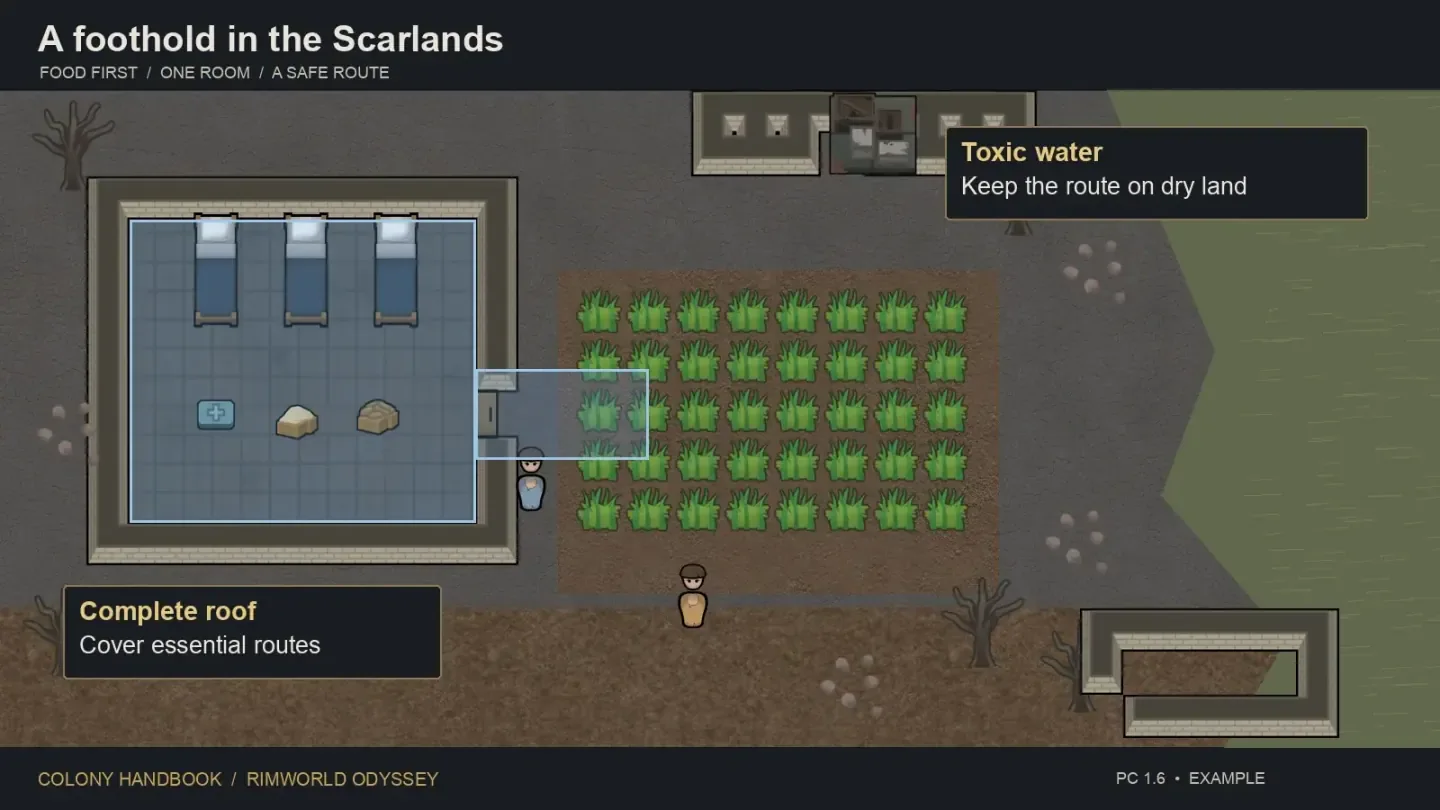
| Odyssey tox rain | Move vulnerable pawns under roofs; use covered work routes | A room label without a complete roof |
| Toxic water | Keep paths and allowed areas on dry land | A roof over contaminated water |
| Biotech polluted ground | Clean occupied cells or use suitable protection / toxin-adapted pawns | Putting a roof over polluted cells |
| Core toxic fallout | Restrict exposure and budget for a longer event | Assuming it follows ordinary weather changes |
Tox rain is possible, not permanent. Its base weather weight is 1, compared with 12 for clear weather and 6 for overcast. These are selection weights, not percentages of the year: temperature, rainfall and weather rules change the available outcomes. Gray pall's entry requires Anomaly.
Toxic water hurts through exposure while traversing it; vanilla colonists do not need a drinking-water supply. Do not send haulers across it merely because the destination is indoors. Check toxic buildup in Health and stop exposure before symptoms become severe.
Biotech changes the ground, not just the weather
With Biotech, even the zero-world-pollution generation branch applies Scarlands' 0.05 biome pollution offset. A world setting of zero therefore does not promise a pristine Scarlands start. Other generation settings and landmarks can produce different amounts. Check the world tile and the pollution overlay after arrival. What matters for farming is whether each growing cell is polluted.
Keep ordinary rice and potatoes on clean ground. Use toxipotatoes on eligible polluted ground, or clean a field and keep it clean. Wasters and other toxin-adapted pawns can make polluted living easier, but they do not remove food requirements or hunter-drone explosions. A mechanitor can put mechs on dangerous jobs; the human operator still needs food and protection.
Environmental toxic damage is reduced by the pawn's Toxic Resistance and Toxic Environment Resistance. Check both stats after equipping protective gear; incomplete protection still allows buildup. Use the pollution cleanup tool for waste management and toxic fallout advice for that separate event.
Settle, loot, or leave?
Settle
You have a defensible shelter, a usable field, enough food to reach harvest, and a safe work route. Rebuild one block at a time.
Loot and leave
Your gravship brings food and an exit. Take reachable supplies from cleared areas and leave unopened rooms for a better-equipped visit.
Relocate now
No workable field, no dependable food bridge, or threats block the only shelter. Leave while the colony is mobile.
A gravship visit has no universal Scarlands countdown. Set your own return threshold from carried food, injuries and fuel. Reserve supplies for the next leg, confirm the ship can depart, and stop expanding the loot run when that margin shrinks. See gravship preparation.
After the first harvest
Build a food buffer before adding mouths. Establish reliable cooking, temperature-controlled storage, a small medical area and a defensible perimeter. Replace risky routes with safe ones. Use scarce wood for jobs that need it; inspect trees and salvage rather than assuming either an endless forest or absolutely no wood.
Scarlands disease mean time between events is 50 days at the biome level, not a guaranteed fifty-day grace period or a timer for each pawn. Malaria and plague are among the possible diseases. Keep medicine available instead of spending every component and trade good on expansion.
When the plan is not working
| Problem | Check first | Next action |
|---|---|---|
| Nothing will sow | Fertility, pollution, roof, temperature, allowed area and Grow work | Move the zone to eligible ground; toxipotatoes need pollution |
| Food runs out before harvest | Real days to maturity, not the raw growDays figure | Trade, safe harvests, or departure; enlarging the field does not make it mature sooner |
| Pawns get toxic indoors | Roof gaps, water crossings and polluted cells | Fix the route or ground source, then monitor recovery |
| A closed ruin releases a drone | The sight line opened by the door | Withdraw and keep workers away; prepare EMP and ranged support |
| An injured pawn becomes berserk | Scaria infection progression in Health | Secure the area and arrange the full-scaria cure |
| Hostiles walk through the base | Unclaimed / held-open doors, wall gaps and actual path | Claim the perimeter you use and close openings; claiming a door does not make it indestructible |
Quick answers
Do I need Odyssey?
Yes. This article covers vanilla PC Odyssey Scarlands in the version shown above. Mods may change biome and threat behavior.
Can I fish in Scarlands?
The biome's fish population cap is zero. Plan another source even when the map has a large body of water.
Are all animals infected or already manhunters?
No. The scaria spawn chance is 50%, and infection does not mean every animal starts in a manhunter state. Inspect Health before hunting.
Are potatoes always the best first crop?
No. Rice matures sooner on both soil and gravel. Potatoes perform better for sustained output on gravel, provided you can survive the longer wait.
Can I turn this biome off?
Choose a different landing tile for the simplest unmodded solution. World-generation mods can change biome distribution, but their settings and compatibility are outside this vanilla article.
Do these instructions cover console or co-op?
The numbers here are for the stated PC build. Check your edition's DLC and version; modded multiplayer can add different behavior.
References & next steps
RimWorld Odyssey · RimWorld Wiki: Scarlands, rice, potatoes, toxipotatoes, scaria, hunter traps.
Stretch ingredients with nutrient paste · Plan pollution cleanup · Prepare a gravship