RimWorld Nuclear Stomach: Food Savings, Cancer and When It’s Worth It
Royalty · Artificial organs
Nuclear stomach:
less food, a real tradeoff
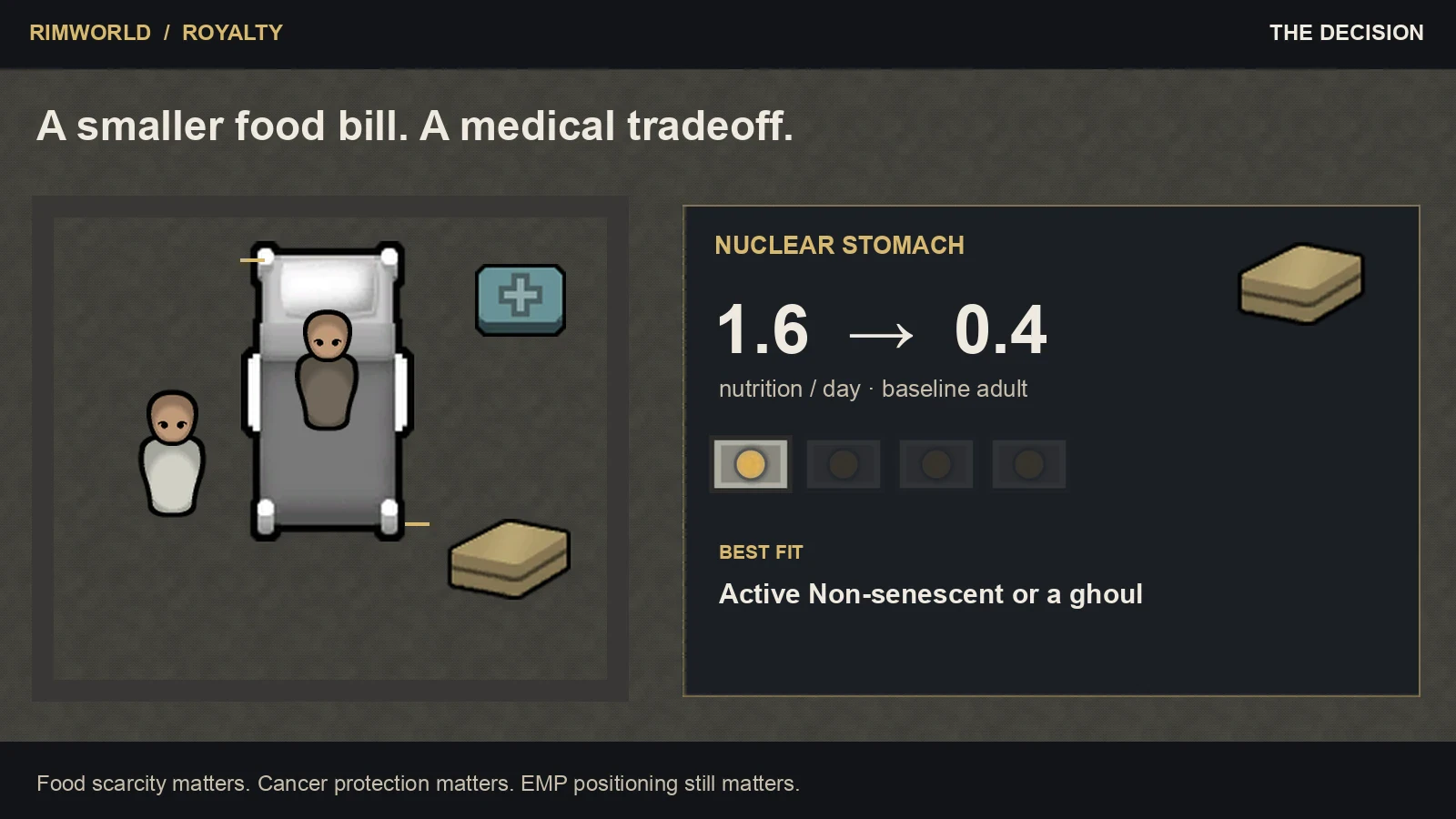
A RimWorld nuclear stomach lowers a baseline adult’s hunger to 25%: 0.4 nutrition per day. It blocks food poisoning and gut worms, but it can plant torso carcinoma and it makes EMP trigger vomiting. Best fits: a pawn with active Non-senescent, or a ghoul. On an ordinary, well-fed colonist, a bionic stomach is usually the simpler swap.
Unmodded PC 1.6.4871 · Royalty required. Biotech adds genes; Anomaly adds ghouls; Ideology adds neural superchargers. Baseline figures assume a healthy, fed adult human with no other modifiers.
Watch on Open.Video · English audio
Is a nuclear stomach worth it?
A strong fit
- Active Non-senescent: prevents carcinoma from this implant. The gene needs Biotech.
- Ghouls: their illness protection blocks this carcinoma. Lower hunger makes their restricted diet easier to supply.
- Expensive diets or scarce food: a high-hunger pawn, long caravan, ice sheet or limited growing area can make the savings worthwhile.
Think twice
- Food is plentiful: four advanced components and ongoing medical care may buy little practical benefit.
- Friendly EMP is routine: a melee blocker vomiting during a mechanoid fight can disrupt your defense.
- Cell instability: these genes raise the implant’s carcinoma rate unless prevention blocks it.
For a normal adult, the steady hunger saving is 1.2 nutrition per day. Ten comparable adults save 12 per day before meal waste and other modifiers. That can reduce cooking and hauling, but it does not mean every colony needs ten implants. Start with the pawn whose food demand matters most.
Start the research chain before food collapses. Crafting needs advanced production, and installation is surgery. If you already have the implant, medicine, and a capable doctor, use it; otherwise, fix the food supply first.
What the implant changes
- Hunger: stomach factor 0.25, before additive health offsets and the other multipliers.
- Digestion: 125% stomach part efficiency. On an otherwise healthy gut, Digestion moves from 100% to 112.5%.
- Sleep: that Digestion bump adds 3.75 percentage points to the rest-rate multiplier. It does not speed eating or stack another hunger discount.
- Illness: food-poisoning chance from eating drops to zero; gut worms are blocked, and an existing case clears when the artificial stomach takes over.
- Drawbacks: EMP makes the wearer vomit, and a random disease effect can create torso carcinoma.
A stomach does not improve the cook’s food-safety skill. Giving one to the chef protects that chef when eating; it does not make meals safe for everybody else. The other three artificial stomachs compared below also prevent gut worms.
The ×25% label does not multiply everything
For the combinations below, take the stomach’s factor, add neural supercharge (+0.20) and smokeleaf high (+0.30), then multiply by metabolic efficiency and Gourmand. A plain nuclear stomach looks like a −75 percentage-point cut from the starting 100%. That “offset” shorthand works for these examples, but health factors and health offsets are still separate steps in the engine.
The game first multiplies health-condition hunger factors together, then adds health-condition hunger offsets and clamps the result at zero. Trait, life-stage, bed and gene effects also matter. The simplified formula here is for a healthy, fed adult, with the selected stomach as the only non-default health factor.
| Pawn setup | Calculation | Baseline hunger | Nutrition/day |
|---|---|---|---|
| Nuclear only | 0.25 | 25% | 0.400 |
| Nuclear, −5 metabolism | 0.25 × 2.25 | 56.25% | 0.900 |
| Nuclear, +5 metabolism | 0.25 × 0.50 | 12.5% | 0.200 |
| Nuclear, Gourmand | 0.25 × 1.50 | 37.5% | 0.600 |
| Nuclear, −5, supercharge | (0.25 + 0.20) × 2.25 | 101.25% | 1.620 |
| Nuclear, −5, smokeleaf | (0.25 + 0.30) × 2.25 | 123.75% | 1.980 |
| Nuclear, −5, both offsets | (0.25 + 0.20 + 0.30) × 2.25 | 168.75% | 2.700 |
With −5 metabolism and neural supercharge, you land at 1.62 nutrition/day, a hair above an unmodified adult’s 1.6. Compared with that same supercharged −5 pawn without the implant, you still cut 4.32 down to 1.62. What fails is assuming the final number is always one quarter of the unimplanted pawn’s hunger.
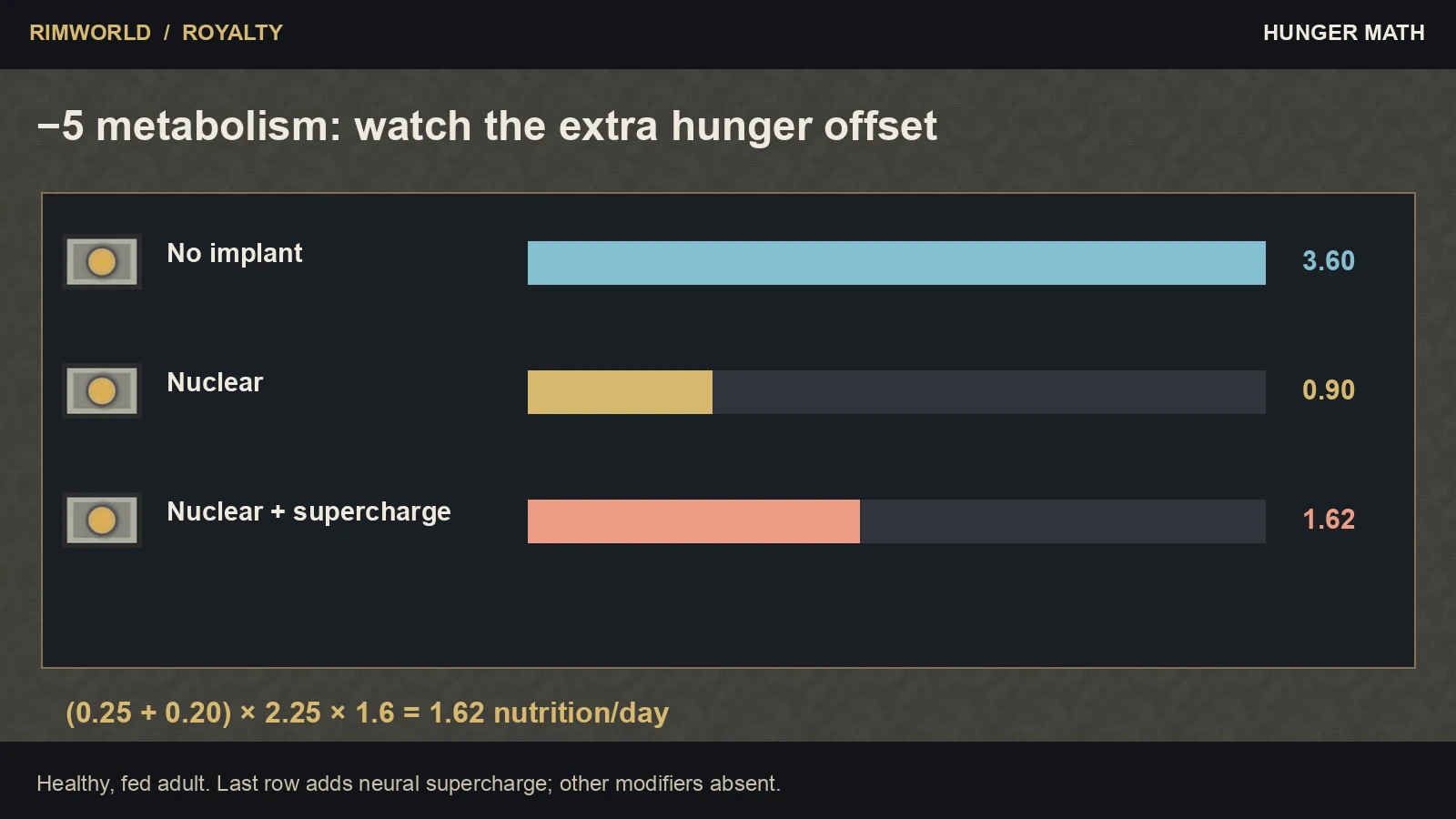
For the gene system itself, see metabolic efficiency and hunger. A positive score reduces the gene multiplier by 10% per point down to ×0.50 at +5; a negative score raises it by 25% per point up to ×2.25 at −5.
Food planning
Calculate this pawn’s hunger
Choose a stomach and the common modifiers. The comparison keeps your other selections the same.
1.6 × (0.25 + 0.00) × 1.00 × 1.00 = 0.400
0.44 simple-meal nutrition equivalents/day.
Meal equivalents divide nutrition by 0.9; they are not a predicted eating schedule. Pawns can waste meal nutrition by eating before the food bar empties. This tool excludes children, hunger-category slowdown, lactation, malnutrition, sleep accelerators, other conditions and ghoul-specific hunger.
Carcinoma: frequency, pain and treatment
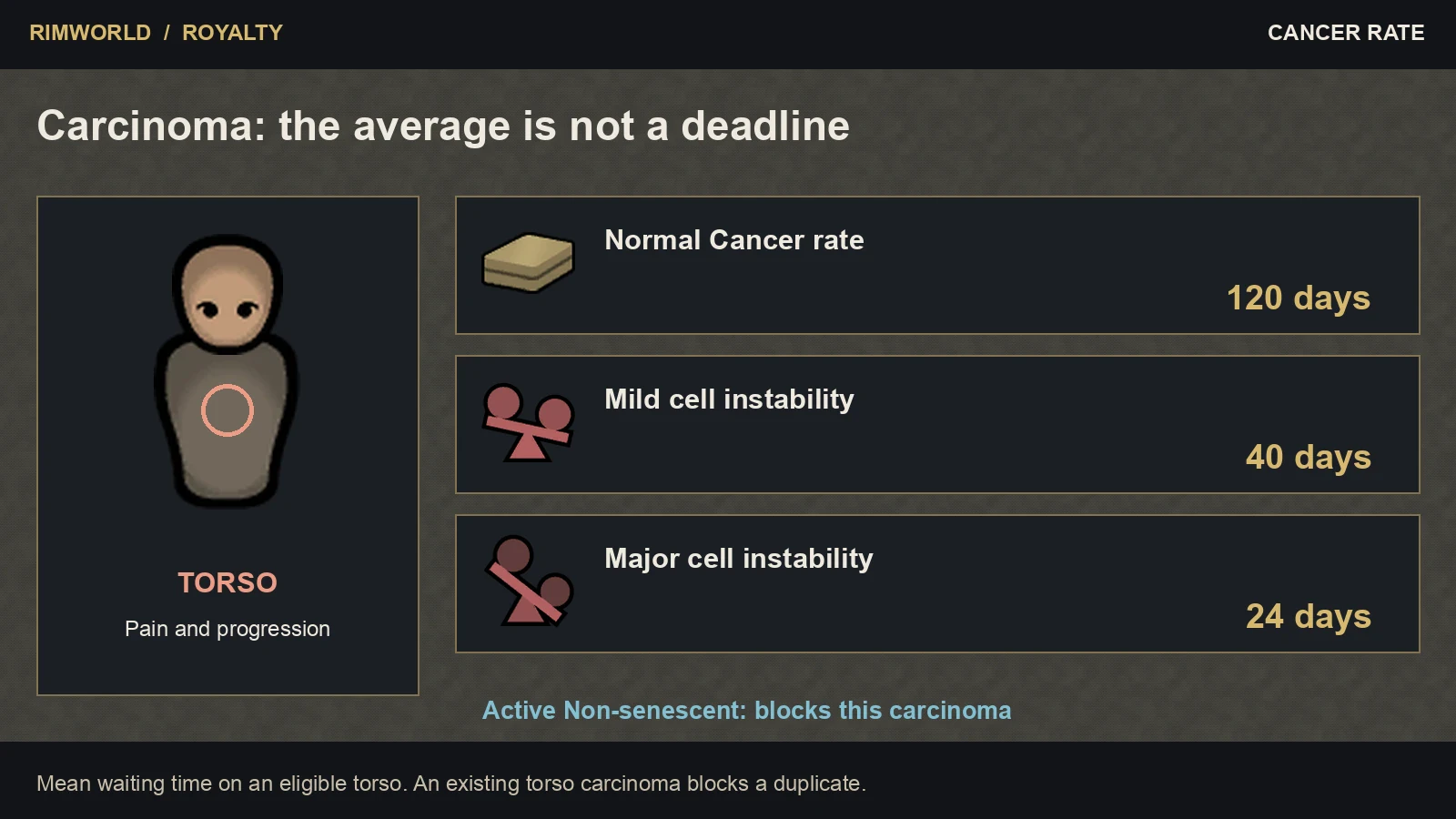
The implant targets the torso. At 100% Cancer rate, the base mean wait is 120 in-game days (two RimWorld years). You can roll earlier or later; treat 120 as a mean, not a safe window.
A torso already carrying carcinoma cannot receive a second carcinoma from this implant while that condition remains. Once it is removed, the implant can cause another. That does not protect other body parts from unrelated cancer sources.
Initial severity is 0.30. A torso efficiency penalty does not directly cut a listed capacity, but carcinoma can cause pain, and late stages can kill. Location alone does not make it cosmetic.
| Option | What it does | What remains |
|---|---|---|
| Active Non-senescent · Biotech | Blocks this carcinoma giver. | Does not itself remove an existing carcinoma. EMP vomiting remains. |
| Ghoul · Anomaly | Ghoul illness protection blocks this chronic disease. | Restricted food and EMP vulnerability still matter. |
| Tend | Each treatment lasts 96 hours / 4 days. Growth and remission make recovery variable. | Keep checking severity and treatment. There is no fixed cure date. |
| Excise carcinoma | Removes it if surgery succeeds; requires Medical 10 and 4 industrial medicine or better. | Failure may kill or injure the patient. The implant can cause a later carcinoma. |
| Scarless · Biotech | Can heal an existing carcinoma over time. | A cure mechanism, not prevention; other eligible conditions may also need healing. |
| Luciferium | Can heal carcinoma over time. | Lifelong supply commitment. Most sensible if the pawn is already taking it. |
| Biosculpter bioregeneration · Ideology | Does not cure carcinoma. | Choose a different treatment. |
How risky is excision?
Ordinary surgery success caps at 98%. Excision has a special 25% fatal result on failure, so at that cap the special fatal branch alone is 2% × 25% = 0.5% per operation. This is not a guaranteed total death risk: a lower success chance raises it, and other failed-surgery injuries can also be dangerous. Use your best doctor and proper surgical conditions.
On a valuable pawn, tend while you line up a better cure. That is not a guaranteed walkaway: growth and remission are random, and tend quality matters. The “111-day cure” number floating around is an approximation, not a schedule you can bank on. Continuous tending can mean about 15 visits per 60-day year; medicine spend tracks care policy and how long the case sticks around.
Prevention and cure are different
Ageless ≠ Non-senescent. Stopping biological aging does not block this implant’s carcinoma giver. Removing the nuclear stomach stops future cases from this source, but an existing tumor stays until you treat it. If the pawn is already on luciferium, that healing helps; starting a lifelong dependency only to prop up a stomach swap is a much bigger call.
Healer mech serum or Anomaly healing abilities can cover a case when you have them, but you do not need them to run the implant. Budget them as scarce tools, not a free auto-cure for every future tumor. A biosculpter pod is not a carcinoma plan.
Nuclear vs reprocessor, sterilizing and bionic
These four replacements all provide 125% stomach efficiency and gut-worm immunity. The differences that matter are hunger, food poisoning, EMP and the nuclear stomach’s cancer effect.
| Stomach | Nutrition/day | Food-poisoning factor | EMP vomiting | Craft cost |
|---|---|---|---|---|
| Bionic · Core | 1.6 | ×0.5 | No | 10 plasteel + 3 advanced components |
| Sterilizing · Royalty | 1.6 | ×0 | Yes | 15 plasteel + 4 advanced components |
| Reprocessor · Royalty | 1.2 | ×1, unchanged | Yes | 15 plasteel + 4 advanced components |
| Nuclear · Royalty | 0.4 | ×0 | Yes | 15 plasteel + 4 advanced components |
Bionic is the conventional swap with no EMP vomiting. Sterilizing when the wearer’s food-poisoning risk is the problem. Reprocessor for a milder hunger cut without nuclear carcinoma. Nuclear when the hunger win outweighs the medical and EMP tradeoffs on that pawn.
Healthy colonists do not need any of these. If food, digestion, and illness are already fine, put the components elsewhere. Fleshmass organs use a different route and bring their own drawbacks; they are not craftable drop-ins in this table.
How to get and install a nuclear stomach
- Unlock Artificial metabolism. Apply the one techprint, clear Fabrication and Prosthetics, then finish the project at a hi-tech research bench with a multi-analyzer. The techprint opens the gate; it does not finish the research.
- Craft it. Fabrication bench, Crafting 8. Cost: 15 plasteel + 4 advanced components. WorkToMake 26,000 ticks at 100% speed; real time follows the worker. No uranium, no refuel bill.
- Prep surgery. Keep the implant in reach and allow 2 herbal medicine or better. Doctor at Medical 5+ under decent surgical conditions.
- Add the bill. Health → Operations → Install nuclear stomach. Base work 2,500 ticks. A failed install can destroy the item.
- Verify. Confirm the stomach on the Health tab, then watch food use with the pawn’s current genes and conditions. Keep your own EMP off them.
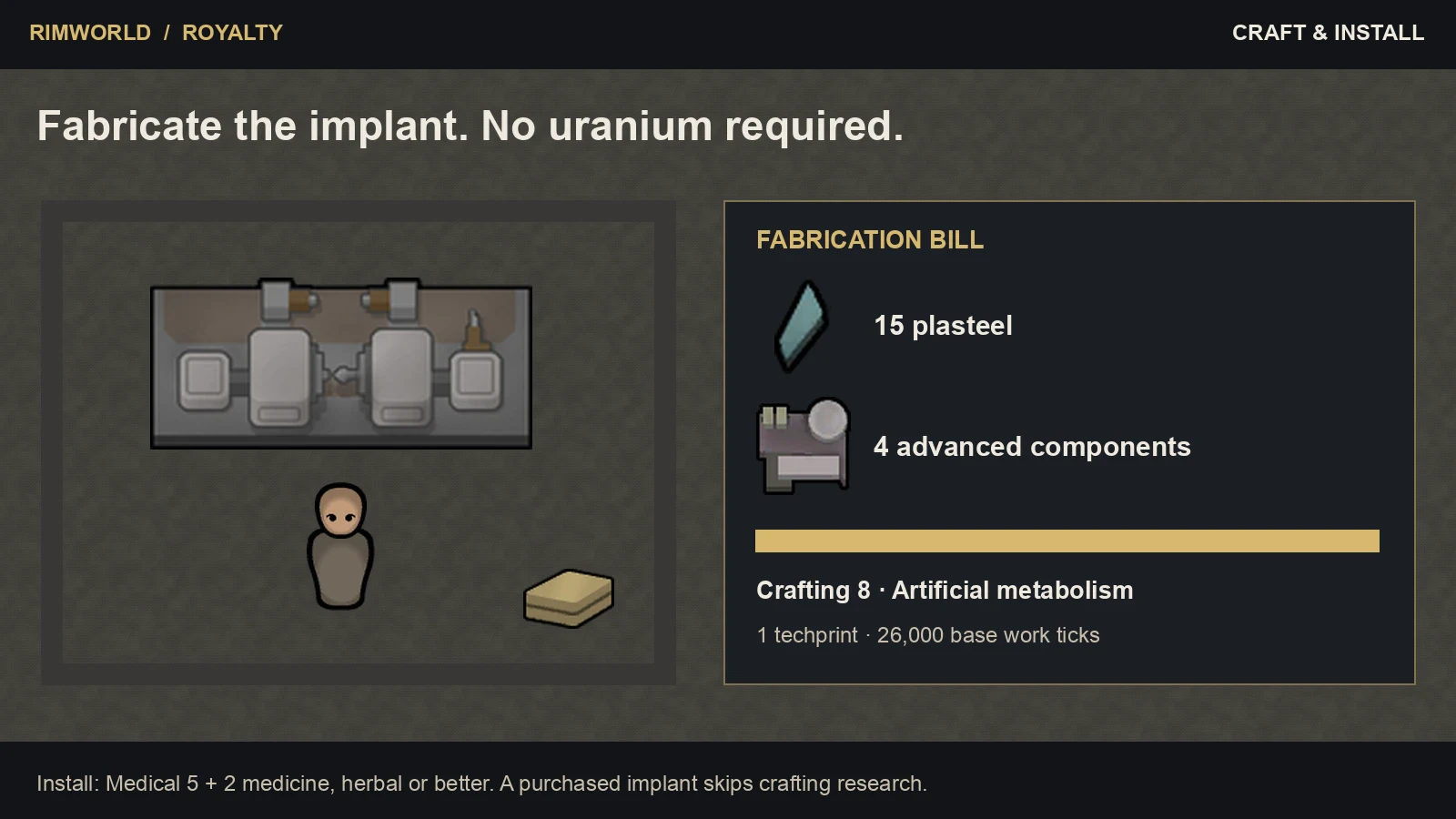
Buying skips the crafting research. Check imperial traders and technologically advanced settlements that stock bionic parts. Inventory is random, and faction trading access still applies; no particular visit guarantees this implant. You still need medicine and a doctor to install a purchased one.
Removal is another operation. Remove part has 2,000 ticks of base work, uses 1 medicine of herbal quality or better, and has no minimum Medical skill. Successful removal returns the nuclear stomach item. The pawn will then need a replacement stomach, and any existing torso carcinoma still needs treatment.
Common surprises
Why is my implanted pawn still eating a lot?
Check metabolic efficiency, neural supercharge, smokeleaf, Gourmand, other health conditions and bed effects. Also distinguish nutrition consumed from full meals taken. The 0.4/day example is for an unmodified adult, not every implanted pawn.
Does it stop food poisoning and gut worms?
Yes. Nuclear prevents food poisoning from eating and grants gut-worm immunity. Reprocessor only grants the gut-worm protection; it does not reduce food-poisoning chance. Installing an artificial stomach clears gut worms.
Does Non-senescent stop nuclear stomach cancer?
Yes, when the Biotech gene is active. Ageless is a different gene. Non-senescent blocks new carcinoma from the implant rather than acting as a cure for a tumor already present.
Why did my colonist vomit during an EMP blast?
Nuclear, reprocessor and sterilizing stomachs react to EMP with vomiting. Your own EMP weapons can trigger it. An existing brain implant may already make EMP dangerous, but its brain-shock effect is not the same as stomach-triggered vomiting.
Does a nuclear stomach need uranium?
No. Crafting takes 15 plasteel and 4 advanced components. It has no uranium fuel bill.
Will this work the same in a modded or console game?
These values apply to unmodded PC 1.6.4871. Mods can change implants, surgery and hunger. Check the version and installed content before applying the numbers to another edition.