RimWorld Kin: Death Mood, Romance and Solitary Recreation
Colonist relationships · PC 1.6.4871
RimWorld Kin: Death Mood, Romance and Solitary Recreation
There is no vanilla mechanic called “Solitary Kin.” Kin is a blood-family relationship; solitary relaxation is a recreation type. A “my kin died” memory gives −4 mood for 30 days. Deaths with different displayed names usually count separately, so ten active kin-death memories can total −40 mood.
Unmodded PC 1.6.4871. Family relationships and grief are Core; human reproduction requires Biotech; Inhumanized requires Anomaly. Other editions and mods can differ.
Watch on Open.Video · English audio
What does Kin mean in RimWorld?
Kin is the broad blood-family relation behind the more specific family labels. A pawn can be related through parents, children and shared ancestors even when that connection stretches past the familiar cousin label. The family tree has no simple “three generations and then unrelated” cutoff.
In the Social tab, the more important relationship takes precedence. A parent, sibling or cousin is more specific than Kin. The game also recognizes great-grandparents, great-grandchildren, grandaunts and granduncles, grandnieces and grandnephews, cousins once removed, and second cousins. Those are easy to miss on a simplified family list.
For example, a second cousin can show as a second cousin in Social and still cause “my kin [name] died” in Needs. That matters for reproduction: a second cousin and generic Kin do not share the same relationship-triggered Inbred risk.
Marriage alone does not create a blood connection between two unrelated pawns. Spouses and lovers have their own relationship memories. The game picks the most important applicable relationship when deciding which family-death thought to give; it does not stack a separate cousin, kin and spouse grief penalty for every overlapping label.
“My kin died”: the number and the timer
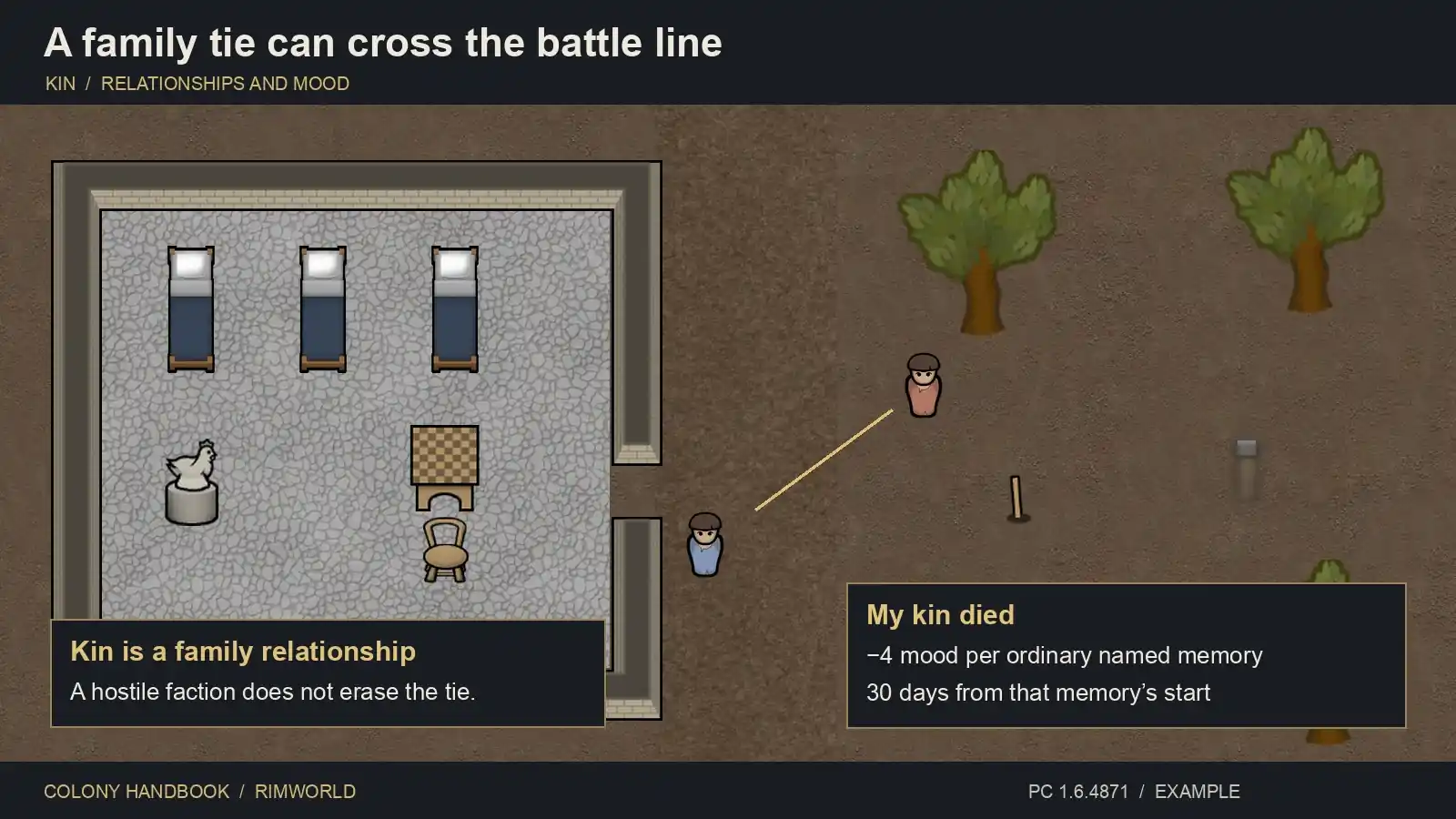
One ordinary memory is −4 mood and lasts 30 in-game days. Its counter runs from that memory’s creation. If another relative dies later, that newer memory has its own remaining time. Burying or cremating the body does not erase family grief.
“My kin lost” is a different memory used when the game records a relative as lost. It has the same base −4 and 30-day duration. A pawn merely leaving on a normal caravan is not a reason to assume this loss memory applies. Read the actual Needs entry before treating a missing pawn as dead.
| Relationship to the deceased | Base mood |
|---|---|
| Child or spouse | −20 |
| Fiancé or fiancée | −18 |
| Lover | −16 |
| Brother or sister | −14 |
| Grandchild | −12 |
| Parent | −8 |
| Niece, nephew or half-sibling | −5 |
| Aunt, uncle, grandparent or cousin | −4 |
| Named distant relative or generic Kin | −4 |
The ten-memory limit applies to each thought definition. Some relations have separate male and female death memories, such as son and daughter. Do not treat ten as a global cap on all grief a pawn can carry.
Why the 0.75 multiplier does not protect you from ten named deaths
The multiplier applies within a thought group. Family memories include the relative’s name. “My kin Ava died” and “My kin Bram died” have different displayed labels, so they normally form different groups. Each group contains one −4 memory. Their combined contribution is −8.
That makes the ordinary distinct-name totals −8 for two, −20 for five and −40 for ten. The family memory also allows only one memory in the same group, while the overall limit for MyKinDied is ten. Identical displayed names are an edge case: labels can collide, so count the actual active named entries rather than assuming every death leaves a separate entry.
The geometric calculation −4 × (1 + 0.75 + …) would give roughly −15.10 for ten equal memories in one group. That is not the normal calculation for ten differently named kin deaths. The table’s “0.75” column alone is not enough to predict the total.
Count your active kin memories
Select the number of distinct named “my kin died” entries currently active in Needs. This calculates their base contribution only.
1 distinct named memory × −4 = −4 mood.
Assumes ordinary thought strength, different displayed names and unexpired memories. Other memories, precepts, genes and mood modifiers are excluded. Lost memories form a separate definition; do not fold them into this count. Psychopath and Bloodlust do not change this result.
Psychopath still feels family grief
Psychopath and Bloodlust do not nullify “my kin died” or “my kin lost.” Their protection from some other death-related thoughts does not extend to these family memories. The Anomaly condition Inhumanized does nullify them. It comes with wider consequences; it is not a routine grief treatment.
Nullifying a memory is not the same as wiping every social consequence. “Killed my kin” is an opinion memory toward a killer, and other relationships or events can still show on the Social tab. Inhumanized also does not force a pawn’s total mood to zero: the calculator removes only the selected grief contribution.
One death can affect several lines
The relationship memory can sit alongside another applicable reaction. “Colonist died” has base −3 for six days, and Psychopath or Bloodlust nullify it. A pawn who witnesses the death can receive a witnessed-death reaction instead of that ordinary non-witness colonist entry. The exact mix depends on where the pawn was and how the death happened.
Friend grief is also separate. It needs an opinion of at least +20 and scales with that opinion; it is not an automatic extra −10 for every dead relative. A raider can therefore cause family grief without being a colonist or a friend. Check the individual Needs lines instead of adding every penalty from a reference table.
What to do while grief runs down
Stabilize food, rest, recreation and comfortable surroundings. If the pawn is near a mental-break threshold, cut avoidable stress before another long shift or dangerous trip. Good meals and a pleasant room support the mood budget; they do not shorten the memory’s timer.
Remove bodies from living areas to prevent extra corpse-related stress. That is a different problem from bereavement. For the surrounding mood budget, see corpse handling and room impressiveness.
Can Kin pawns become lovers?
Yes. Generic Kin contributes a ×0.5 romance chance factor. That is a penalty inside the attraction calculation. It is not a 50% final success chance, and it is not a hard ban. Age, attraction, opinion, existing relationships and other applicable factors still matter.
The game uses generic Kin only when it finds no more specific blood relationship. A first cousin has a different relation factor, ×0.25, and full siblings use ×0.03. If several specific relationships overlap, applicable factors multiply. The generic ×0.5 value is therefore not a complete romance calculation for every relative.
A colony that only grows through childbirth gradually builds a dense web of relatives. Recruitment brings in potential partners from outside that web, although a newly generated pawn can already have relatives. Inspect Social before choosing a pair. For the pregnancy mechanics themselves, see having babies in RimWorld.
Will their child have the Inbred gene?
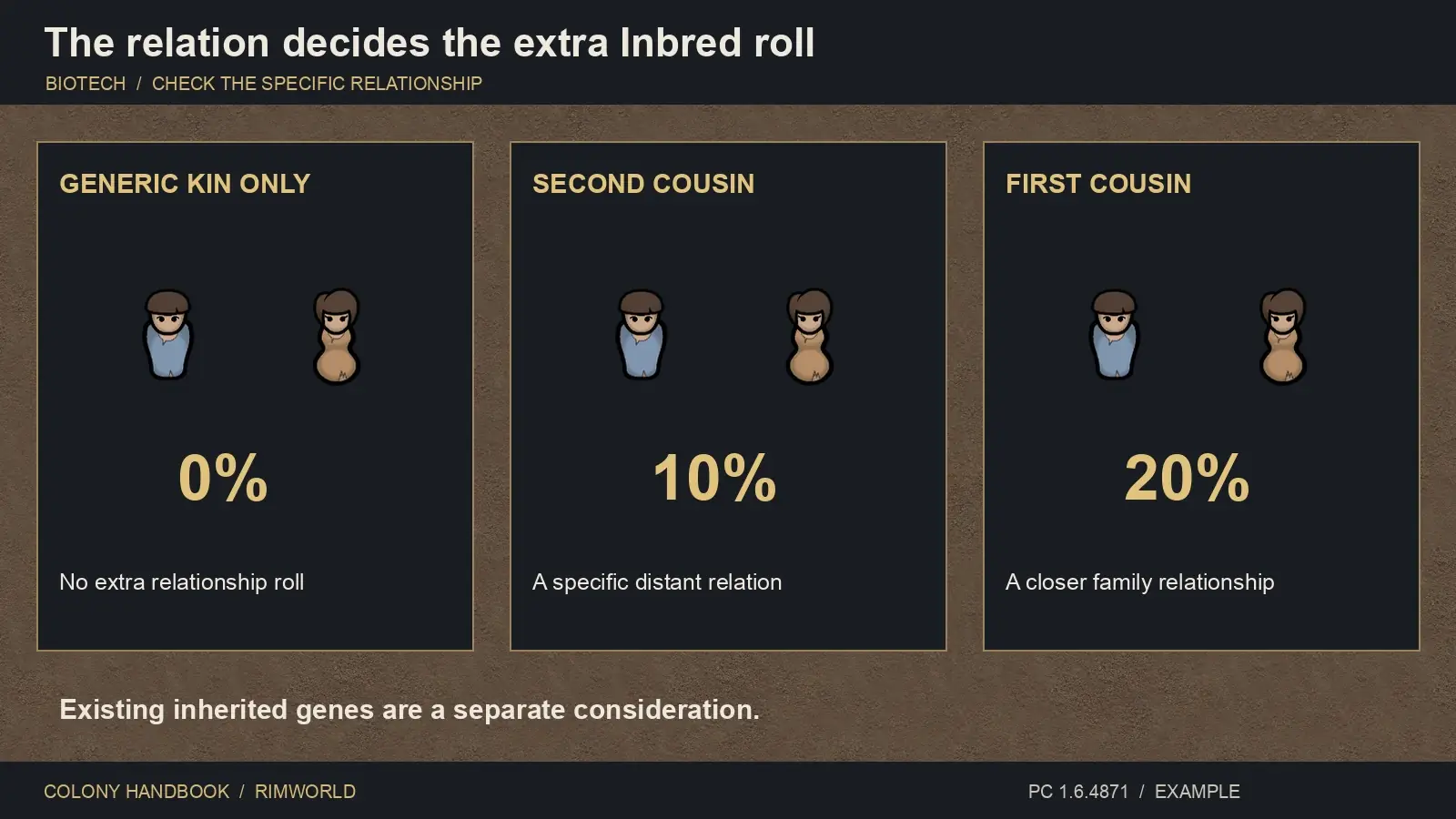
Generic Kin alone adds 0% relationship-triggered Inbred chance. That does not make every “kin” pairing equivalent. The game checks the parents’ applicable relationships and uses the highest listed Inbred chance, rather than adding all the percentages together.
| Parental relationship | Chance |
|---|---|
| Parent/child or full siblings | 80% |
| Half-siblings, grandparent/grandchild, aunt/uncle with niece/nephew | 40% |
| First cousins | 20% |
| Great-grandparent/great-grandchild; grandaunt/granduncle with grandniece/grandnephew; cousins once removed; second cousins | 10% |
| Generic Kin only | 0% |
These are game probabilities, not real-world genetic-risk estimates. They describe the extra relationship check. A parent’s existing inheritable Inbred gene can still matter through ordinary gene inheritance, so “0% from this relationship” is not a universal guarantee that the child cannot have Inbred.
Once pregnancy or an embryo exists, inspect the baby’s genes. Birth quality is a separate system: better medical care helps childbirth outcomes but does not change a relationship-triggered gene roll into a different percentage. If long-term family planning is the concern, inspect both the relation labels and the parents’ germline genes.
Why was that raider my kin?
Vanilla pawn generation can create family links to existing pawns. A relative showing up with a hostile faction does not by itself prove a mod created them. The relation and the faction are separate: being enemies does not automatically switch off the survivor’s family memory.
When time permits, pause and inspect incoming pawns and their relationships before combat. If preserving a relative matters, plan capture or avoidance around the actual threat; a family link does not make a raider safe to approach. Once the death occurs, burying the body or changing its stockpile cannot undo the relationship that caused the memory.
“Killed my kin” is an opinion penalty
When the death has an attributable pawn killer and the relationship conditions apply, another relative can remember that killer with −15 opinion for 60 days. This is a social memory, not another −15 on the mourner’s mood bar. The killer is not assigned a social opinion memory about themselves.
There is a cap of ten such memories toward the same killer and a larger overall definition limit of 300. Social memories use their own grouping and diminishing-effect calculation. Do not multiply −15 by 300 to estimate one pawn’s opinion of one killer. Read grief in Needs and blame in Social.
If you meant solitary recreation
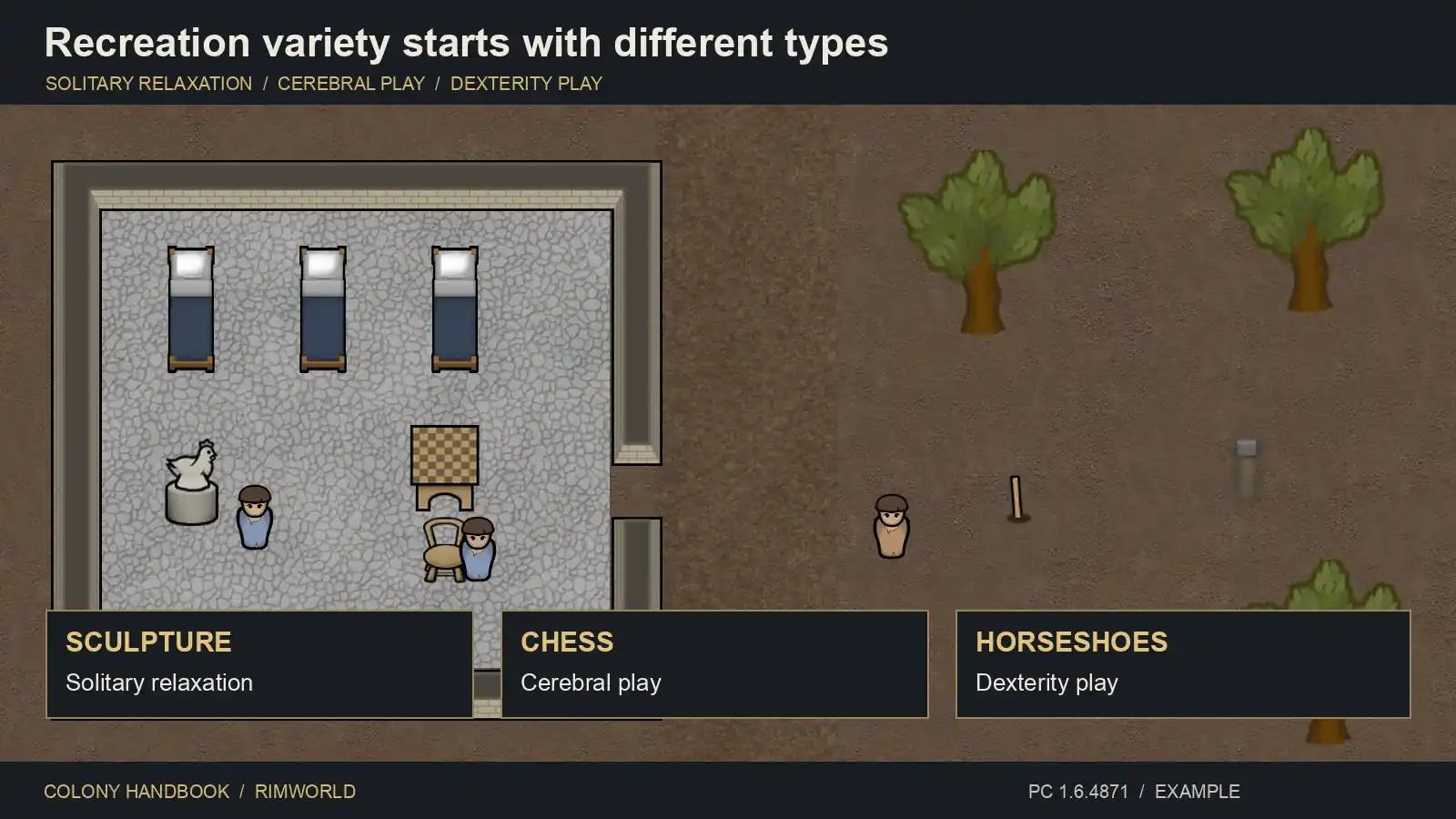
Look for “solitary relaxation” in the English recreation tolerance display. Its internal identifier is Meditative, but that is not a new display name you must search for. It has nothing to do with the Kin relationship.
Walking, skygazing, viewing art, visiting graves, praying and recreational meditation can share this recreation type. Adding several activities from that list does not create several independent types of recreation. A sculpture and a walk can both raise tolerance in the same category.
Pawn will not take a walk
- Allow actual recreation or free time, and check urgent hunger or tiredness.
- Provide accessible, unroofed, standable cells in an allowed outdoor region.
- Check outdoor conditions and known danger; a valid destination and walk route are both needed.
- A preference for chess is not proof that walking is broken.
Pawn ignores the sculpture
- Use owned, reachable, permitted art that can actually be enjoyed.
- Put it in an accessible common room; another pawn’s bedroom can be unsuitable.
- Check Sight and existing tolerance for solitary relaxation.
- Higher beauty can improve art recreation gain, but quality does not add another recreation type.
Recreation selection is weighted, and tolerance reduces a category’s attraction. A low base weight is not a fixed daily chance. Prayer and ordinary recreational meditation also have stable pawn-specific eligibility checks; repeatedly clearing the schedule does not make every pawn eligible for every activity. Royalty’s psyfocus meditation adds its own requirements and should not be treated as identical to the ordinary recreation job.
Expectations increase the suggested variety: extremely low needs 2 types; very low and low need 3; moderate 4; high 5; sky-high 6. Noble and royal expectations also use 6. Add a genuinely different kind, such as cerebral play or dexterity play, rather than buying several copies of the same game.
Ordinary prisoners and slaves do not have the Recreation need in vanilla. A prisoner refusing a horseshoes pin is therefore a different diagnosis from a colonist lacking variety. Children use their own learning/play needs; apply this recreation advice to pawns who actually have the Recreation bar.
Quick answers
Is Solitary Kin a trait or xenotype?
No. Kin is a family relationship. Solitary relaxation is a recreation type. They are separate systems.
Can ten kin deaths really cause −40 mood?
Yes, for ten active MyKinDied memories with distinct displayed names and ordinary mood strength. Each named memory forms its own group and contributes −4. The 0.75 multiplier does not combine all differently named relatives into one group.
Does Psychopath remove kin grief?
No. Psychopath and Bloodlust do not nullify this family memory. Inhumanized, from Anomaly, does.
Can Kin pawns have a child without the Inbred gene?
Yes. Generic Kin adds no relationship-triggered Inbred chance, but specific closer relationships can. Existing parental germline genes must also be considered.
Is solitary relaxation now called Meditative?
The English PC 1.6.4871 display label is still solitary relaxation. Meditative is its internal identifier.
References
RimWorld Wiki: death memories · lost memories · reproduction · recreation
Values apply to PC 1.6.4871. Named family memories are separate groups; the multiplier column is not a total-mood calculator. RimWorld artwork © Ludeon Studios.