RimWorld Batteries: Capacity, Charging & Zzztt Protection
How to make and protect batteries in RimWorld
Build storage for the outage you actually face, generation that can refill it, and a reserve a single short cannot drain. Batteries cover the gap when solar, wind, or fuel drops — they do not replace planning.
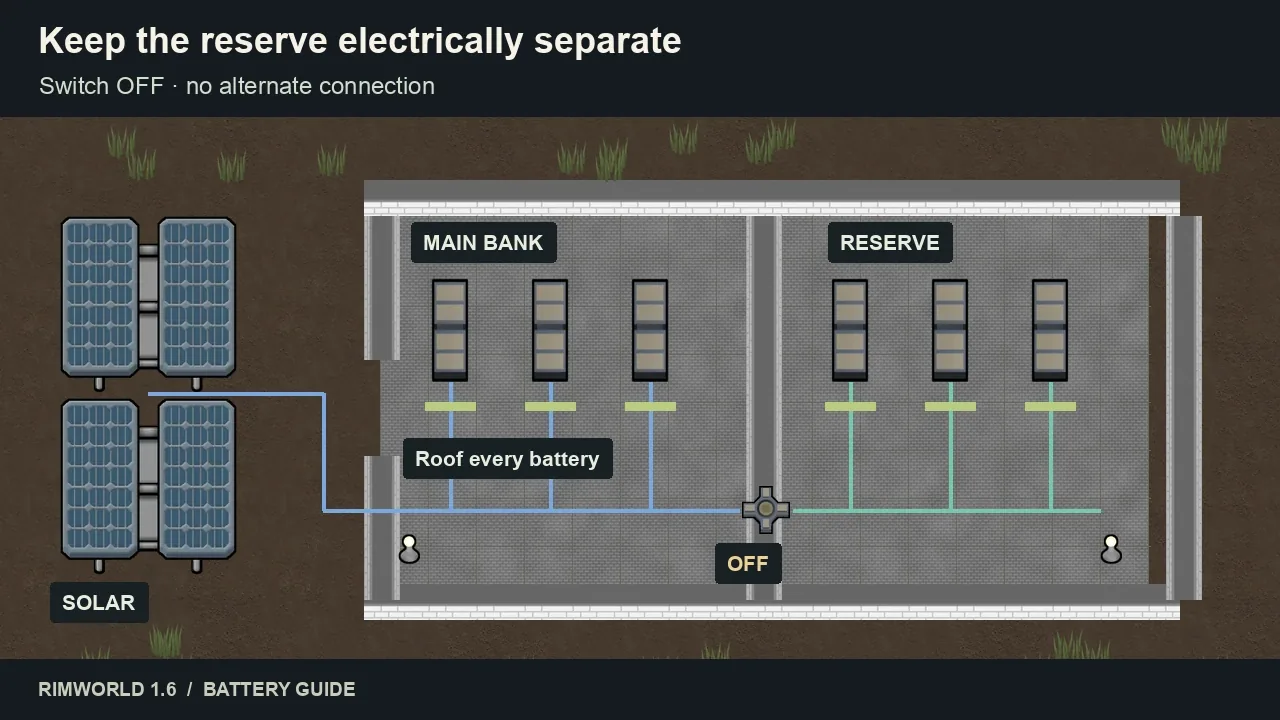
What a RimWorld battery actually stores
One battery holds 600 watt-days — energy for 600 W across one in-game day before you count self-discharge. That is capacity, not a 600 W output cap. Surplus generation charges the bank; a deficit on the same grid pulls from it. There is no separate discharge-efficiency tax.
Research Batteries (base cost 400, Electricity first), then build for 70 steel and 2 components. The footprint is 1 × 2. A battery must touch a conduit, generator, or another battery; it cannot use the wireless appliance link. Batteries also pass power, so a neighbor can quietly bypass a switch.
How many batteries you need
Work from net deficit: consumption minus generation that still runs during the outage. Multiply by duration, then add self-discharge. Start from a full bank and leave room for longer blackouts.
Bank size
About 202.1 Wd required, including self-discharge and a 20% extra load allowance.
Assumes a steady deficit, healthy batteries, and no flare or short. Extra load allowance does not stretch the outage clock.
At 400 W for 10 hours, appliances take 166.7 Wd. One battery loses another 2.1 Wd in that window, so you need about 168.8 Wd. One full battery covers it.
| Net deficit | Duration | Minimum full bank* |
|---|---|---|
| 400 W | 10 hours | 1 battery |
| 1,500 W | 10 hours | 2 batteries |
| 3,000 W | 12 hours | 3 batteries |
*Includes self-discharge; no extra safety margin. An empty bank is not backup.
Solar and hydroponics: count loads that stay on. Sun lamps shut off at night; basins, heaters, and other gear can keep drawing. Dawn and dusk still underproduce, so “dark hours” alone can undersize the bank. Wind lulls and eclipses need their own pad.
Sizing formula
For deficit P watts, duration H hours, and extra load allowance M percent:N = ceil([P × (1 + M/100) × H/24] / [600 − 5 × H/24]).
Assumes full batteries and a positive denominator. Each extra battery also adds self-discharge.
Charging costs more than you store
Only half the surplus that enters batteries becomes stored energy. Self-discharge still runs while units hold charge. For one battery with free capacity, 200 W of steady surplus for a day lands about 95 Wd: 100 Wd after the 50% charge loss, minus 5 Wd self-discharge.
For N nonempty batteries below capacity and steady surplus S watts, net gain is about 0.5 × S − 5 × N Wd per day. One empty battery needs roughly 1,210 W of continuous surplus for a day to reach 600 Wd. Tick timing can nudge the last digit.
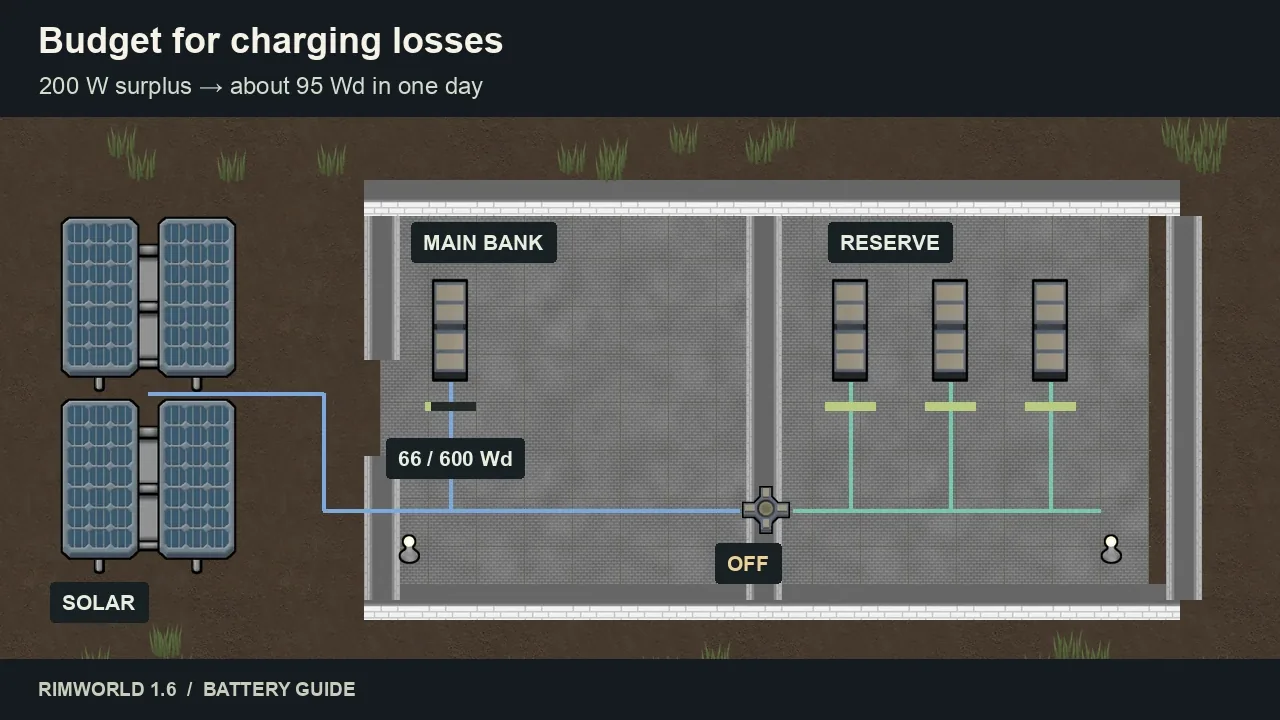
Charge energy splits across batteries that can accept it. More empty slots do not create generation. If the bank never recovers between outages, cut demand or add reliable power.
Three hazards, three different fixes
| Hazard | What happens | Best response |
|---|---|---|
| Random conduit Zzztt | Picks eligible normal power conduits. If any connected battery holds more than 20 Wd, the connected bank drains into an explosion. | Use hidden conduits. Isolate emergency storage. |
| Rain exposure | An unroofed battery above 100 Wd can spark a local flame blast. Different code path from the bank-drain conduit event. | Roof every battery, reserve included. |
| Fire damage | Above 500 Wd stored, flame damage can light a short fuse. | Stone walls, clear flammables, put fires out fast. |
Hidden conduits stop the random conduit event, not every electrical failure. One leftover eligible normal conduit can still endanger its grid. Low stored energy does not make a normal-conduit short harmless — it can still start a fire.
Park reserve batteries behind a power switch and leave it off after a charge. Block alternate conduit paths and adjacent power-passing buildings. Isolation does not pause self-discharge; top the reserve up on a schedule. Stone helps contain fire; it is not explosion-proof.
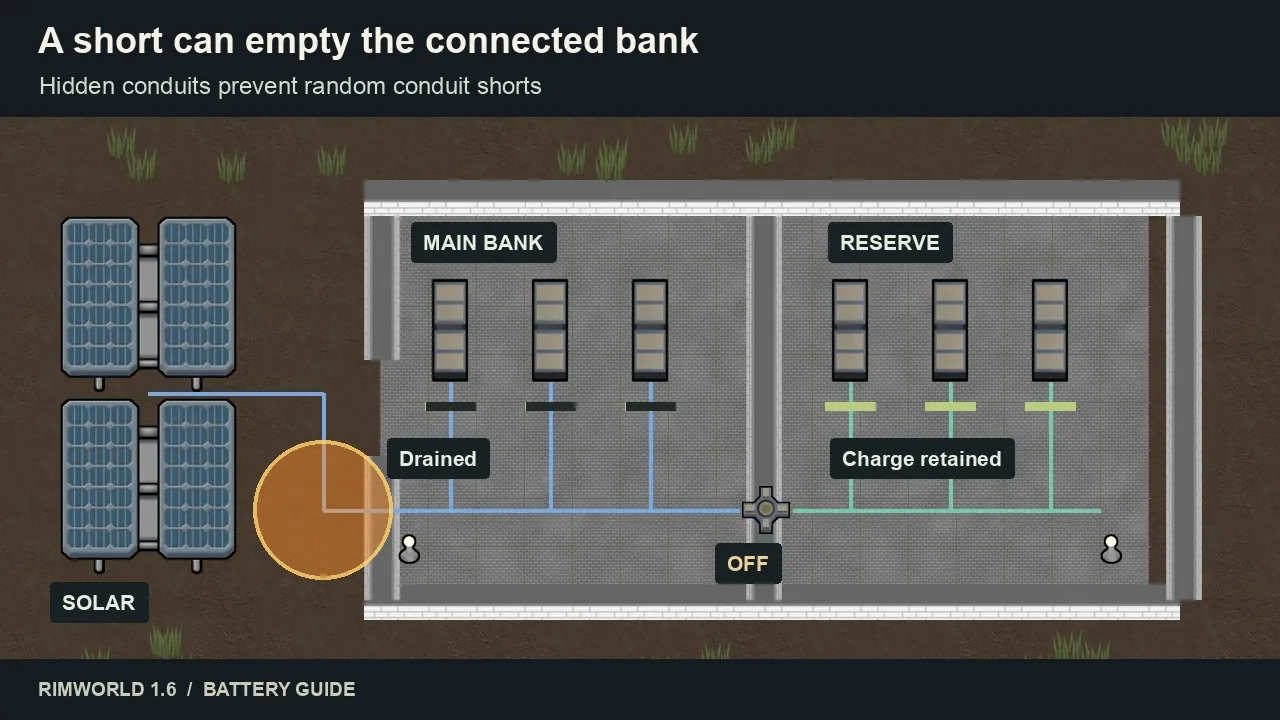
How stored energy scales the blast
For a bank-draining conduit short, flame radius in tiles is clamp(0.05 × √E, 1.5, 14.9), where E is total stored Wd on that network. Past a 3.5-tile flame radius, a bomb blast at 30% of that radius also fires. That threshold is above 4,900 Wd: nine full standard batteries cross it; eight do not. Radii are not guaranteed damage through walls.
A rain short uses a 1.9-tile flame blast instead. It does not run the whole-bank drain, though fire and damage can still cascade.
Why the batteries will not charge
- Check the physical join. Seat the battery on the network and confirm the switch is on.
- Check surplus. A generator that only matches load leaves nothing to store. Night, eclipse, or dead wind can wipe the surplus.
- Check the battery. Full units refuse more energy. Breakdown blocks charging and clears stored charge.
- Check EMP and flares. EMP stun blocks charging. A solar flare cuts normal electrical service.
- Check bank size. A thin surplus across many batteries crawls, and every charged unit still self-discharges.
Watch the battery guide
Short walkthrough of capacity, charging loss, backup sizing, and short-circuit protection.
Watch on Open.Video · English audio · ~1 min 42 sec
Common battery questions
Can I switch a battery off?
Batteries have no ordinary on/off toggle. Isolate the network with a power switch, or uninstall. Isolation does not stop self-discharge.
Do uninstalled batteries lose charge?
Yes. A normally ticking minified battery still loses 5 Wd per in-game day while it holds charge. Uninstall for transport, not long-term storage.
Is 600 Wd the same as 600 watts?
No. Watts are power; watt-days are stored energy. A full battery feeding a constant 600 W deficit lasts about 23.8 in-game hours once you include its 5 W self-discharge.
Do I need batteries for every generator?
No. Steady generation can feed loads directly. Add batteries for interruptions or spikes, and confirm surplus can refill them afterward.